Government bonds
Part 1 Candle Stick Patterns Types of Options:
Calls and Puts
Options are a type of derivative security. An option is a derivative because its price is intrinsically linked to the price of something else. If you buy an options contract, it grants you the right but not the obligation to buy or sell an underlying asset at a set price on or before a certain date.
A call option gives the holder the right to buy a stock, and a put option gives the holder the right to sell a stock. Think of a call option as a down payment on a future purchase.
Index Rebalancing Impact 1. What Is Index Rebalancing?
An index is a benchmark that tracks the performance of a selected group of securities, such as the Nifty 50, Sensex, S&P 500, or MSCI indices. Each index follows predefined rules regarding:
Number of constituents
Eligibility criteria (market capitalization, liquidity, free float)
Weighting methodology (market-cap weighted, equal-weighted, factor-based)
Index rebalancing occurs at regular intervals—quarterly, semi-annually, or annually—when the index provider reviews and updates its constituents and weights. Stocks may be added, removed, or reweighted based on changes in market capitalization, liquidity, corporate actions, or methodology updates.
2. Why Index Rebalancing Is Necessary
Markets are dynamic. Company valuations, liquidity profiles, and business fundamentals change over time. Without rebalancing, an index could become outdated or misrepresentative. Rebalancing ensures:
The index remains aligned with its objective
Accurate representation of the market or sector
Consistency and credibility for benchmark users
For example, if a fast-growing company’s market cap increases significantly, its index weight must rise. Conversely, declining or illiquid companies may be removed.
3. Role of Passive Investing in Rebalancing Impact
The rise of passive investing has dramatically increased the importance of index rebalancing. Exchange-Traded Funds (ETFs), index mutual funds, and pension funds replicate indices mechanically. When an index changes, these funds must buy or sell stocks to match the new composition—regardless of price or fundamentals.
This forced buying and selling creates predictable demand and supply shocks, leading to:
Sudden price movements
Volume spikes
Temporary mispricing
As passive assets grow, rebalancing effects have become stronger and more visible.
4. Impact on Stock Prices
a) Stocks Added to an Index
When a stock is added:
Passive funds must buy the stock
Demand increases sharply
Prices often rise before and on the rebalancing date
This phenomenon is known as the “index inclusion effect.” In many cases, the price rally begins after the announcement and peaks near the effective date.
b) Stocks Removed from an Index
When a stock is removed:
Passive funds are forced sellers
Supply increases suddenly
Prices often decline
This is referred to as the “index exclusion effect.” The negative impact may persist for some time due to reduced visibility and lower institutional ownership.
5. Liquidity and Volume Effects
Index rebalancing days are among the highest-volume trading sessions in markets. Key impacts include:
Sharp increase in traded volumes
Higher market depth in index-heavy stocks
Temporary liquidity stress in smaller stocks
Large-cap stocks usually absorb flows smoothly, while mid-cap and small-cap stocks may experience exaggerated price moves due to thinner liquidity.
6. Volatility During Rebalancing
Rebalancing can increase short-term volatility, especially:
Near the closing session on the effective date
In stocks with large weight changes
In indices with high passive ownership
Intraday price swings, large block trades, and closing-auction imbalances are common. However, this volatility is usually event-driven and short-lived, not necessarily a reflection of fundamental risk.
7. Impact on Index Weights and Sector Allocation
Rebalancing does not only change individual stocks—it also affects sectoral exposure. For example:
Higher weight to IT or banking if those sectors outperform
Reduced weight to underperforming sectors
This has a cascading effect:
Sector ETFs must rebalance
Portfolio asset allocation changes
Relative sector performance may shift temporarily
8. Effects on Active Investors and Traders
a) Arbitrage Opportunities
Active traders often try to profit from predictable rebalancing flows:
Buying stocks expected to be added
Short-selling stocks likely to be removed
However, these strategies are competitive and require precise timing, cost control, and liquidity management.
b) Tracking Error Considerations
Active funds benchmarked to indices must manage tracking error. Sudden index changes can:
Increase deviation from benchmark
Force portfolio realignment
Impact short-term performance metrics
9. Long-Term Fundamental Impact
A key debate is whether index rebalancing has lasting fundamental effects. Research suggests:
Short-term price impact is strong
Long-term impact is mixed
Inclusion can improve:
Analyst coverage
Institutional ownership
Corporate visibility
However, it does not automatically improve business fundamentals. Over time, stock prices tend to realign with earnings, growth, and balance-sheet strength.
10. Market Efficiency and Criticism
Index rebalancing has raised concerns about market efficiency:
Prices move due to flows, not fundamentals
Passive investing may amplify bubbles
Overcrowding in index heavyweights
Critics argue that excessive index concentration can distort capital allocation. Supporters counter that rebalancing improves transparency, discipline, and cost efficiency for investors.
11. Indian Market Perspective
In India, index rebalancing of Nifty 50, Nifty Bank, Nifty Next 50, Sensex, and MSCI India has significant impact due to:
Rising ETF and FPI participation
Increasing passive AUM
Lower liquidity in mid-cap stocks
MSCI rebalancing, in particular, attracts large foreign flows and often causes sharp price and volume changes in affected stocks.
12. How Investors Should Approach Rebalancing Events
Long-term investors should avoid emotional reactions and focus on fundamentals
Short-term traders should be cautious of volatility and execution risks
Portfolio managers should plan transitions early to reduce market impact
Understanding announcement dates, effective dates, and expected flows is crucial.
13. Conclusion
Index rebalancing is far more than a technical adjustment—it is a powerful market-moving event. Driven by the growth of passive investing, rebalancing influences prices, liquidity, volatility, and investor behavior across global and Indian markets. While the immediate impact is often mechanical and temporary, the broader implications for market structure, efficiency, and capital allocation are profound.
For anyone active in financial markets, understanding index rebalancing is no longer optional—it is essential for informed decision-making, risk management, and opportunity identification.
Candle Patterns Candle Patterns and Volume Profile
Volume profile defines where most trading activity occurs.
Key zones:
VAL (Value Area Low) → Strong buy zone
VAH (Value Area High) → Strong sell zone
POC (Point of Control) → Strong rejection or acceptance
High Volume Node (HVN) → Reversal zones
Low Volume Node (LVN) → Breakout zones
Combine candle patterns:
Example setups:
Bullish Engulfing at VAL
Shooting Star at VAH
Pin Bar at LVN breakout
Inside Bar at HVN compression
This combination gives professional-level accuracy.
Part 1 Ride The Big Moves Strategy Selection Using Market Conditions
Choosing the correct strategy depends on:
a. Trend Direction
Uptrend: Long calls, bull spreads.
Downtrend: Long puts, bear spreads.
Sideways: Iron condor, calendar spreads.
b. Volatility Expectation
High expected volatility: Straddle, strangle.
Low expected volatility: Credit spreads, condors.
c. Time to Expiry
Short expiry favors sellers due to fast time decay.
Long expiry favors buyers due to slower decay.
d. Liquidity
High open interest and narrow bid–ask spreads reduce slippage.
DE10YDE10Y – Bullish Breakout
The German 10-year yield just broke above the key 2.74–2.75% resistance that has capped the market for weeks. This move confirms a shift from consolidation back into an uptrend. As long as yields hold above the breakout level, momentum favors further upside toward 2.80% and beyond. Higher yields reflect firming inflation expectations and a market leaning toward a “higher-for-longer” ECB path.
Quantitative Trading in India1. What is Quantitative Trading?
Quantitative trading involves developing mathematical models that analyze large sets of historical and real-time market data to identify profitable trading opportunities. These models are then translated into algorithms that execute trades automatically when specific conditions are met.
Unlike traditional trading, where decisions are based on human analysis or intuition, quant trading depends on data-driven models—built from statistical patterns, price behavior, and probability-based predictions.
For instance, a quantitative model might identify that whenever a particular stock’s price crosses its 50-day moving average, there’s a 60% chance it will rise by 1% in the next two days. The algorithm will then automatically place a buy order when this condition occurs and exit when profit or risk targets are hit.
2. The Rise of Quantitative Trading in India
The Indian financial market has undergone a digital revolution in the past decade. The introduction of advanced trading platforms, co-location services by exchanges, and faster internet connectivity has made algorithmic and quantitative trading more accessible.
NSE and BSE Initiatives: Both the National Stock Exchange (NSE) and Bombay Stock Exchange (BSE) allow algorithmic trading through their APIs. The NSE launched “NOW” and later “Colo” services that let institutional traders place their servers near the exchange for low-latency execution.
Growth in HFT and Algo Desks: Many domestic and foreign institutional investors now operate high-frequency trading (HFT) and quant desks in India.
Retail Access: With brokers like Zerodha, Upstox, and Interactive Brokers offering APIs, even retail traders can deploy basic quant strategies today.
India’s equity and derivatives markets—known for their liquidity and volatility—offer ideal conditions for quantitative models to thrive.
3. Key Components of Quantitative Trading
Quantitative trading relies on multiple technical and analytical components:
a. Data Collection and Processing
The foundation of quant trading is data—price, volume, volatility, order book, and macroeconomic indicators. Traders use both historical data (to backtest strategies) and real-time data (for live execution).
Data is cleaned, normalized, and structured before being fed into analytical models.
b. Mathematical Modeling
Traders use statistical and machine learning techniques to find relationships in the data. Common techniques include:
Regression analysis to predict future price moves.
Time-series modeling like ARIMA or GARCH for volatility forecasting.
Machine learning models such as random forests or neural networks to identify non-linear market patterns.
c. Backtesting
Before deploying a model, it’s tested on historical data to evaluate performance metrics—profitability, drawdown, win rate, and Sharpe ratio. This step helps refine parameters and assess risk.
d. Execution Systems
The strategy is implemented using automated scripts written in Python, C++, or R. Execution systems ensure the trade is carried out efficiently and at the desired price, with minimal slippage and latency.
e. Risk Management
Quantitative traders use strict risk management protocols, including stop-losses, position sizing, and portfolio diversification. Models also include safeguards to handle sudden market disruptions.
4. Types of Quantitative Trading Strategies
Quant trading covers a wide range of strategies. Some of the most popular in India include:
a. Statistical Arbitrage
This strategy involves exploiting temporary price inefficiencies between correlated securities. For example, if two bank stocks usually move together but diverge briefly, a trader might short one and buy the other, expecting prices to converge.
b. Mean Reversion
Based on the idea that prices eventually revert to their mean, traders buy when prices fall below the average and sell when they rise above it.
c. Momentum Trading
Momentum models look for stocks showing strong price movements in one direction and attempt to ride the trend. These are popular in the Indian equity derivatives market.
d. Market Making
Market makers provide liquidity by simultaneously placing buy and sell orders, earning from the bid-ask spread. Quant systems are used to constantly adjust quotes based on volatility and order flow.
e. Machine Learning-Based Models
AI and deep learning models analyze large datasets—including news, social media sentiment, and macro data—to predict short-term price trends.
5. Technology and Infrastructure
Quantitative trading demands high computing power and low-latency infrastructure.
Key tools and technologies include:
Programming Languages: Python, R, C++, and MATLAB for model development.
Databases: SQL, MongoDB, and time-series databases to handle massive data.
Cloud Computing: Platforms like AWS and Google Cloud for scalability.
APIs and FIX Protocols: For real-time data and automated order execution.
Co-location Servers: Provided by NSE and BSE for high-speed trading.
6. Regulatory Framework in India
The Securities and Exchange Board of India (SEBI) regulates quantitative and algorithmic trading. Some of the major regulations include:
Approval Requirement: Institutional participants must get exchange approval before using an algorithm.
Risk Checks: Pre-trade risk controls are mandatory—such as order price bands and quantity limits.
Audit Trail: All automated strategies must maintain complete logs of trades.
Fair Access: SEBI ensures equal market access for all participants, preventing latency advantages.
Retail traders using broker APIs are also subject to compliance checks, including throttling limits and order validations.
7. Advantages of Quantitative Trading
Quant trading offers multiple advantages over traditional manual methods:
Emotion-Free Decision Making: Models rely on logic and data, not human emotion.
Speed and Efficiency: Algorithms execute trades in microseconds.
Backtesting Capability: Strategies can be tested before deployment.
Scalability: The same model can be applied across multiple instruments.
Diversification: Automated systems can manage hundreds of securities simultaneously.
8. Challenges in India’s Quant Landscape
Despite its growth, quant trading in India faces unique challenges:
Data Quality: Historical tick data is expensive and often inconsistent.
Regulatory Complexity: Frequent SEBI changes create compliance hurdles.
Infrastructure Costs: Co-location and low-latency systems are costly for small firms.
Talent Gap: Skilled professionals with expertise in both finance and coding are limited.
Market Depth: While Nifty and Bank Nifty are highly liquid, smaller stocks lack sufficient volume for quant models.
9. The Future of Quantitative Trading in India
The future of quantitative trading in India looks extremely promising. As AI, machine learning, and big data analytics continue to evolve, trading models are becoming smarter and faster. The democratization of APIs and data feeds is enabling more retail traders to experiment with quant strategies.
Additionally, with the growth of quant funds, hedge funds, and proprietary trading firms in India, institutional adoption is accelerating. Educational programs and fintech incubators are also nurturing the next generation of quantitative analysts.
In the coming years, India is likely to see:
Greater integration of AI-driven predictive analytics.
Expansion of retail quant platforms.
Development of multi-asset quant models including commodities and currencies.
Stronger regulatory frameworks ensuring market fairness.
10. Conclusion
Quantitative trading is transforming India’s financial landscape. It represents the intersection of finance, mathematics, and technology—allowing traders to make data-driven decisions with precision and speed. While challenges like regulation and data access remain, the momentum toward automation is irreversible.
As markets mature and technology becomes more accessible, quantitative trading will continue to dominate institutional desks and increasingly empower sophisticated retail participants. In essence, the future of trading in India is quantitative, algorithmic, and intelligent.
Commodity Trading: Gold, Silver, Crude Oil, Natural Gas on MCX1. Overview of MCX and Commodity Trading
The Multi Commodity Exchange (MCX) was established in 2003 and operates under the regulatory framework of the Securities and Exchange Board of India (SEBI). It provides a transparent and standardized platform for trading in commodity derivatives, allowing market participants to hedge against price volatility or take speculative positions based on their market outlook.
Commodity trading on MCX includes bullion (gold, silver), energy (crude oil, natural gas), and base metals (copper, zinc, aluminum) among others. Prices are largely influenced by international benchmarks — for example, COMEX for gold and silver, and NYMEX for crude oil and natural gas — since commodities are globally traded and denominated in U.S. dollars.
2. Gold Trading on MCX
a. Importance of Gold
Gold is considered both a precious metal and a safe-haven asset. It acts as a hedge against inflation, currency depreciation, and economic uncertainty. In India, gold also holds immense cultural and investment value, making it one of the most traded commodities.
b. MCX Gold Contracts
MCX offers multiple gold contracts to cater to different categories of traders:
Gold (1 kg)
Gold Mini (100 grams)
Gold Guinea (8 grams)
Gold Petal (1 gram)
Gold Petal (New Delhi)
Each contract differs in lot size and margin requirements, allowing both retail and institutional traders to participate. The price quote is in Rupees per 10 grams, and the underlying is standard gold of 995 purity.
c. Factors Influencing Gold Prices
Global economic data (especially U.S. inflation, employment, and GDP)
US Dollar movement – Gold has an inverse relationship with the USD.
Interest rate changes by the U.S. Federal Reserve.
Geopolitical tensions or crises that boost safe-haven demand.
Jewelry demand and central bank reserves.
d. Trading Strategy
Gold trading often combines technical analysis (using trendlines, moving averages, and RSI) with macro fundamentals (like Fed announcements). Traders also track the COMEX gold price and the rupee-dollar exchange rate for near-term movement cues on MCX.
3. Silver Trading on MCX
a. Role of Silver
Silver, often referred to as the “poor man’s gold,” has both precious and industrial uses. It’s widely used in electronics, solar panels, and medical instruments. This dual nature makes silver more volatile than gold.
b. MCX Silver Contracts
MCX offers several contracts:
Silver (30 kg)
Silver Mini (5 kg)
Silver Micro (1 kg)
Silver 1000 (30 kg, 999 purity)
The price quote is in Rupees per kilogram. Silver contracts are physically settled, ensuring price integrity and alignment with physical market demand.
c. Price Influencers
Industrial demand in electronics and solar sectors.
Gold price movement (since silver tends to follow gold trends).
US Dollar and bond yields.
Global supply-demand balances from major producers like Mexico and Peru.
d. Trading Insights
Silver’s high volatility appeals to short-term traders. It responds strongly to global macro news and industrial growth data. Many traders use gold-silver ratio analysis — when the ratio widens, it may suggest silver is undervalued relative to gold, and vice versa.
4. Crude Oil Trading on MCX
a. Significance of Crude Oil
Crude oil is the lifeblood of the global economy — influencing transport, manufacturing, and inflation. As one of the most liquid commodities, it offers dynamic trading opportunities. MCX crude oil prices track NYMEX WTI Crude, adjusted for the INR/USD rate.
b. MCX Crude Oil Contracts
MCX offers:
Crude Oil (100 barrels)
Crude Oil Mini (10 barrels)
Prices are quoted in Rupees per barrel. Contract expiries are aligned with global oil futures.
c. Key Factors Affecting Prices
Global demand-supply balance led by OPEC decisions.
U.S. crude inventory data from the Energy Information Administration (EIA).
Geopolitical tensions in the Middle East.
Dollar strength and global growth outlook.
Production levels in the U.S. shale industry.
d. Trading Strategies
Crude oil traders closely track weekly U.S. inventory reports, OPEC meetings, and economic indicators like global PMI data. Technical tools like Bollinger Bands and MACD help spot momentum reversals. Traders also hedge exposure against energy price swings using MCX crude futures.
5. Natural Gas Trading on MCX
a. Overview
Natural gas is a crucial energy source used for power generation, heating, and industrial processes. With the rise in clean energy demand, gas trading volumes have been rising sharply on MCX.
b. Contract Specifications
MCX offers Natural Gas (1250 mmBtu) contracts, quoted in Rupees per mmBtu (million British thermal units). Prices track NYMEX Natural Gas futures, with adjustments for INR movements.
c. Price Influences
Weather conditions – cold winters or hot summers drive higher consumption.
Inventory levels in U.S. gas storage.
Production trends from shale fields.
Transition toward clean energy and LNG demand.
Global geopolitical events affecting gas supply routes.
d. Trading Approach
Natural gas prices are highly seasonal and volatile. Traders use weather forecasts, EIA inventory data, and technical tools like support-resistance zones to time entries. Given its volatility, proper risk management and position sizing are essential.
6. Trading Mechanism and Settlement
All commodities on MCX are traded electronically, ensuring transparency. Contracts are margined, meaning traders need only deposit a fraction of the total value (typically 5–10%) as margin.
Settlement can be of two types:
Cash settlement, based on final settlement price.
Physical delivery, for bullion and select metals.
Traders should be aware of expiry dates, daily price limits, and margin requirements to manage positions effectively.
7. Risk Management and Hedging
Commodity derivatives are vital tools for hedgers (like jewelers or oil companies) to protect against adverse price movements. For instance:
A jeweler may short gold futures to hedge inventory.
An airline may buy crude oil futures to fix fuel costs.
Speculators and arbitrageurs add liquidity, but they must apply strict stop losses, technical discipline, and volatility tracking to avoid large losses.
8. Conclusion
Commodity trading on the MCX — particularly in Gold, Silver, Crude Oil, and Natural Gas — offers immense opportunities for profit and portfolio diversification. These commodities are deeply connected to global macroeconomic events, geopolitical developments, and currency movements.
Success in this market requires a blend of technical analysis, fundamental understanding, and emotional discipline. For retail traders, starting with mini or micro contracts and focusing on risk control is key. As India’s participation in the global commodity market expands, MCX remains a vital gateway for investors to tap into the pulse of international trade and energy trends.
AI and Data Analytics in Stock Market Decisions1. The Evolution of Stock Market Decision-Making
Traditionally, stock market decisions were made using two major approaches:
Fundamental analysis, which focuses on company performance, earnings, and macroeconomic factors.
Technical analysis, which studies past price and volume patterns to predict future trends.
While both methods remain relevant, they are now enhanced by AI and data analytics. AI can process enormous data sets that humans cannot handle manually, identify hidden correlations, and make decisions based on probabilities rather than assumptions.
The integration of these technologies started with algorithmic trading in the 1990s and has evolved into machine learning-driven trading systems and predictive analytics models in the 21st century.
2. Understanding AI and Data Analytics
Artificial Intelligence (AI) refers to systems that can mimic human intelligence, learn from experience, and make decisions autonomously. In stock trading, AI tools like machine learning (ML), deep learning, and natural language processing (NLP) play vital roles.
Machine Learning (ML): Learns patterns from historical data and applies them to predict future stock price movements.
Deep Learning (DL): Uses neural networks to process large-scale and complex financial data, identifying non-linear relationships.
Natural Language Processing (NLP): Analyzes financial news, social media sentiment, and corporate announcements to gauge market mood.
Data Analytics, on the other hand, involves the collection, cleaning, and analysis of structured and unstructured data to uncover insights. This includes historical price data, earnings reports, economic indicators, and even tweets or headlines.
Together, AI and data analytics form the backbone of quantitative trading, robo-advisory platforms, and automated portfolio management systems.
3. Key Applications of AI and Data Analytics in the Stock Market
a. Predictive Analysis and Price Forecasting
AI models can analyze historical price patterns, volatility, and macroeconomic indicators to forecast short-term and long-term price movements.
For example:
Neural networks detect recurring patterns in stock charts.
Regression models and reinforcement learning algorithms adjust predictions in real time as market conditions change.
b. Sentiment Analysis
NLP-powered tools scan news articles, earnings calls, analyst reports, and social media to measure market sentiment.
A positive sentiment can lead to short-term price surges, while negative buzz can trigger sell-offs. Platforms like Bloomberg and Refinitiv now incorporate AI-based sentiment analytics for traders.
c. Algorithmic and High-Frequency Trading (HFT)
AI-driven algorithmic trading systems execute thousands of trades per second, exploiting minor market inefficiencies.
Algorithms analyze order book data and market microstructure.
AI continuously improves its strategy by learning from past trades.
This minimizes human error and maximizes execution speed and accuracy.
d. Portfolio Management and Robo-Advisors
AI helps investors manage risk and optimize portfolios based on their risk tolerance, investment goals, and market outlook.
Robo-advisors such as Zerodha’s Niyam or international platforms like Betterment and Wealthfront use AI to automatically rebalance portfolios and minimize losses.
e. Fraud Detection and Compliance
AI-powered surveillance systems detect anomalies, such as insider trading, price manipulation, or fraudulent transactions.
Machine learning algorithms monitor trading patterns in real time and alert regulators or brokers to suspicious behavior.
f. Risk Management
AI quantifies risk using predictive models that estimate Value at Risk (VaR), expected shortfall, or drawdown probabilities.
By analyzing correlations and stress scenarios, traders can better prepare for sudden market downturns or black swan events.
4. Role of Big Data in Stock Market Analysis
Modern financial markets produce terabytes of data every day, including:
Price and volume data from multiple exchanges
Corporate filings and earnings reports
Global macroeconomic indicators
Alternative data like satellite images, foot traffic, or credit card transactions
AI and analytics platforms integrate these datasets to extract valuable insights.
For example:
Hedge funds use satellite imagery to estimate retail store performance.
Credit card data is used to forecast quarterly earnings before official reports are released.
This “alternative data revolution” gives institutions an informational edge that traditional analysis cannot provide.
5. Benefits of AI and Data Analytics in Stock Market Decisions
Speed and Efficiency: AI can process millions of data points in seconds, enabling rapid and informed decision-making.
Accuracy: Predictive models reduce human bias and emotional trading.
Automation: Reduces manual analysis and allows automated trade execution.
Risk Reduction: Helps identify potential losses early through predictive risk assessment.
Data-Driven Insights: Converts raw market data into actionable intelligence.
These advantages help both retail traders and institutional investors stay competitive in increasingly complex markets.
6. Limitations and Challenges
Despite their power, AI and analytics tools face several limitations:
Data Quality Issues: Inaccurate or biased data can lead to faulty predictions.
Overfitting: Models that perform well on historical data might fail in live markets due to changing dynamics.
Black Box Problem: Deep learning models often lack interpretability, making it hard to explain why they make certain predictions.
Market Volatility: AI cannot always predict sudden events like geopolitical crises or natural disasters.
Ethical and Regulatory Concerns: Automated trading systems can cause flash crashes or manipulate markets unintentionally.
Hence, while AI enhances decision-making, human oversight remains crucial.
7. The Future of AI in Stock Market Decision-Making
The next phase of financial technology will see even deeper integration of AI, quantum computing, and blockchain in trading ecosystems.
Quantum AI may process financial data exponentially faster, enabling near-instant decision-making.
Explainable AI (XAI) will make algorithms more transparent and trustworthy.
AI-Blockchain integration will ensure secure, auditable, and tamper-proof trading records.
Additionally, personalized AI assistants will help individual investors make smarter decisions based on their unique profiles and preferences.
8. Real-World Examples
JP Morgan’s COiN platform uses AI to review legal documents and extract key data for risk evaluation.
Goldman Sachs’ Marcus employs data analytics for consumer lending and investment recommendations.
Kavout’s Kai Score leverages machine learning to rank stocks based on predictive factors.
Indian brokerages such as Zerodha, Upstox, and ICICI Direct are adopting AI-based tools to help clients identify trading opportunities and manage portfolios efficiently.
9. Conclusion
AI and data analytics have redefined the rules of stock market participation. What was once a game of intuition and experience has now become a science of data, prediction, and automation.
By integrating AI into trading strategies, investors can gain a deeper understanding of market dynamics, identify hidden opportunities, and manage risk with greater precision.
However, successful use of AI in stock market decisions requires a balance between machine intelligence and human judgment. Machines can crunch numbers and identify trends, but human insight, discipline, and adaptability remain irreplaceable.
Ultimately, the collaboration between humans and AI will continue to shape the future of intelligent investing, driving markets toward more efficiency, transparency, and innovation.
Is Wave 5 About to Lift Indian Bond Yields Higher?After a strong impulsive rise from 6.13% to 6.65%, the India 10-Year Government Bond Yield appears to be consolidating in a textbook Wave 4 contracting triangle . Each leg within the pattern—(a) through (e)—shows the typical compression seen before the final thrust in yields.
If this interpretation holds, a Wave 5 breakout may soon lift yields higher toward or beyond the 6.7% region, completing the larger five-wave structure.
Market Implication:
A rise in bond yields usually reflects tightening liquidity and can act as a short-term headwind for equity indices such as the Nifty. Traders may want to watch this triangle’s resolution closely—an upside break in yields could coincide with a cooling phase in the broader market, while a failed breakout would favor continued equity strength.
Chart Note:
Contracting Wave 4 Triangle – Prepping for the Final Yield Thrust (Wave 5)
Disclaimer: This analysis is for educational purposes only and does not constitute investment advice. Please do your own research (DYOR) before making any trading decisions.
Technical Indicators 1. Introduction to Technical Indicators
Technical indicators are mathematical calculations based on historical price, volume, or open interest data. They are primarily used in technical analysis, a method of evaluating securities by analyzing market statistics rather than intrinsic value.
Indicators help traders:
Identify trends and reversals.
Determine momentum and market strength.
Recognize overbought or oversold conditions.
Generate buy or sell signals.
There are three main categories of technical indicators:
Trend Indicators – Identify the direction and strength of a trend.
Momentum Indicators – Measure the speed and force of price movements.
Volume Indicators – Analyze trading activity to confirm price movements.
Some indicators are leading, giving early signals of potential price movement, while others are lagging, confirming trends after they have started.
2. Trend Indicators
Trend indicators help traders identify whether an asset is moving upward, downward, or sideways. Recognizing trends early allows traders to align their strategies with the market direction.
2.1 Moving Averages (MA)
Moving averages smooth out price data to reveal trends over a specific period. There are two main types:
Simple Moving Average (SMA):
Calculated by averaging the closing prices over a specified period.
Example: A 50-day SMA sums the last 50 closing prices and divides by 50.
Exponential Moving Average (EMA):
Places more weight on recent prices, making it more responsive to price changes.
Applications:
Trend identification: Prices above the MA indicate an uptrend; below indicate a downtrend.
Crossovers: A short-term MA crossing above a long-term MA generates a bullish signal, and vice versa.
Limitations:
Lagging indicator, less effective in sideways markets.
2.2 Moving Average Convergence Divergence (MACD)
MACD measures the difference between two EMAs (usually 12-day and 26-day).
Components:
MACD Line: Difference between the fast and slow EMA.
Signal Line: 9-day EMA of the MACD line.
Histogram: Difference between MACD line and Signal line.
Interpretation:
Crossovers: MACD crossing above Signal line = buy signal; below = sell signal.
Divergence: Price making new highs while MACD fails indicates trend weakness.
Strengths:
Effective for spotting trend reversals and momentum shifts.
Weaknesses:
Lagging indicator; may give false signals in choppy markets.
2.3 Average Directional Index (ADX)
ADX measures the strength of a trend regardless of its direction.
Values above 25 indicate a strong trend.
Values below 20 suggest a weak trend or sideways market.
Applications:
Confirming trend strength before entering a trade.
Pairing with other indicators for trend-following strategies.
Limitations:
Does not indicate trend direction, only strength.
3. Momentum Indicators
Momentum indicators assess the speed of price movements, helping traders identify potential reversals or continuation patterns.
3.1 Relative Strength Index (RSI)
RSI measures the magnitude of recent price changes to evaluate overbought or oversold conditions.
Values above 70 = overbought (possible reversal or pullback).
Values below 30 = oversold (possible rebound).
Applications:
Divergence between RSI and price signals potential trend reversals.
Combining RSI with trend indicators enhances trade accuracy.
Limitations:
Can remain overbought or oversold for extended periods in strong trends.
3.2 Stochastic Oscillator
The stochastic oscillator compares a security’s closing price to its price range over a specific period.
%K Line: Current close relative to the high-low range.
%D Line: 3-period moving average of %K.
Interpretation:
Values above 80 = overbought; below 20 = oversold.
Crossovers of %K and %D lines indicate potential buy/sell signals.
Strengths:
Effective in volatile markets for timing entries and exits.
Weaknesses:
Less effective during strong trends; prone to false signals.
3.3 Rate of Change (ROC)
ROC measures the percentage change in price over a given period.
Positive ROC indicates upward momentum.
Negative ROC signals downward momentum.
Applications:
Identifying early trend reversals.
Confirming breakouts or breakdowns.
Limitations:
Sensitive to price spikes; may give false signals in choppy markets.
4. Volume Indicators
Volume analysis confirms price trends, as strong moves are typically accompanied by high volume.
4.1 On-Balance Volume (OBV)
OBV measures cumulative buying and selling pressure by adding volume on up days and subtracting volume on down days.
Applications:
Divergence between OBV and price can signal reversals.
Confirming trend strength.
Limitations:
Lagging indicator; requires combination with price analysis.
4.2 Chaikin Money Flow (CMF)
CMF measures the volume-weighted average of accumulation and distribution over a specified period.
Positive CMF = buying pressure.
Negative CMF = selling pressure.
Applications:
Identifying accumulation or distribution phases.
Supporting trade entries in trend-following strategies.
Weaknesses:
Less effective during low-volume periods.
5. Volatility Indicators
Volatility indicators help traders gauge market risk and potential price swings.
5.1 Bollinger Bands
Bollinger Bands consist of a moving average (middle band) and upper/lower bands based on standard deviation.
Price near upper band = overbought.
Price near lower band = oversold.
Applications:
Trading range-bound markets using band bounces.
Breakouts indicated when price moves outside bands.
Limitations:
Band breakouts don’t always result in sustained trends.
5.2 Average True Range (ATR)
ATR measures market volatility by calculating the average of true price ranges over a period.
Applications:
Setting stop-loss levels.
Identifying breakout potential.
Limitations:
Does not indicate trend direction, only volatility.
6. Combining Indicators for Strategy
Using a single indicator often results in false signals. Effective traders combine indicators from different categories:
Trend + Momentum:
Example: Use SMA to identify trend direction and RSI to detect overbought/oversold conditions.
Trend + Volume:
Example: Confirm trend strength with ADX and OBV before entering a trade.
Momentum + Volatility:
Example: Use MACD for momentum and ATR to set stop-loss levels.
Rule of Thumb:
Avoid indicators that provide the same information.
Mix leading and lagging indicators for better confirmation.
7. Indicator-Based Trading Strategies
7.1 Trend-Following Strategy
Use moving averages or ADX to identify trends.
Enter trades in the direction of the trend.
Use momentum indicators like MACD or RSI for entry timing.
7.2 Reversal Strategy
Use RSI, Stochastic, or Bollinger Bands to detect overbought/oversold conditions.
Look for divergence between price and indicator for potential reversals.
7.3 Breakout Strategy
Use Bollinger Bands or price channels to identify consolidation.
Volume indicators like OBV or CMF confirm breakout strength.
8. Common Mistakes in Using Indicators
Overloading charts: Too many indicators can confuse signals.
Ignoring market context: Indicators must be interpreted in conjunction with price action.
Blind reliance: No indicator guarantees success; risk management is crucial.
Neglecting timeframes: Indicators behave differently on daily, weekly, or intraday charts.
9. Advanced Indicator Techniques
Divergence Trading: Identifying differences between price and indicators like MACD or RSI to spot potential reversals.
Multiple Timeframe Analysis: Confirm signals from multiple timeframes to reduce false entries.
Weighted Indicators: Adjust indicator sensitivity to reduce lag or noise.
Algorithmic Integration: Using indicators as inputs in automated trading systems.
10. Choosing the Right Indicators
Factors to consider:
Trading style: Day traders vs. swing traders vs. long-term investors.
Market conditions: Trending vs. ranging markets.
Timeframe: Short-term indicators are more sensitive; long-term indicators reduce noise.
Simplicity: Choose a few reliable indicators rather than overwhelming charts.
11. Conclusion
Mastering technical indicators requires practice, observation, and discipline. While indicators provide valuable insights into market behavior, they are most effective when combined with strong risk management and a clear trading plan.
Successful traders:
Use indicators to enhance decision-making, not replace it.
Test strategies thoroughly before applying them in live markets.
Adapt indicator settings to suit different market conditions.
By understanding the nuances of trend, momentum, volume, and volatility indicators, traders can create robust strategies that increase probability and confidence in their trades. This Technical Indicators Masterclass equips traders with the knowledge to analyze markets effectively and navigate complex price movements with precision.
Retail Trading Profits: Success in the Modern Financial Market Understanding Retail Trading
Retail traders participate in financial markets primarily through brokerage accounts, online trading platforms, and mobile applications. Their decisions are often guided by technical analysis, market news, financial statements, and social trading trends. Unlike institutional traders, who have access to advanced analytical tools, high-frequency trading systems, and large capital, retail traders rely on individual research, risk management, and discipline to generate profits.
Retail trading profits are influenced by:
Market Knowledge: Understanding how markets operate, the forces driving price movements, and economic indicators.
Risk Management: Controlling losses through stop-loss orders, position sizing, and portfolio diversification.
Trading Strategy: Choosing approaches such as day trading, swing trading, trend following, or options trading.
Psychology: Maintaining emotional discipline to avoid impulsive decisions driven by fear or greed.
Key Sources of Retail Trading Profits
1. Stock Market Trading
Retail traders often focus on equity markets. Profits arise from buying undervalued stocks and selling them at higher prices or leveraging derivatives like options and futures. Retail traders can target dividends, capital gains, or a combination of both.
2. Derivatives and Options
Options and futures provide opportunities for magnified profits but also carry significant risks. Retail traders can profit from market movements without owning the underlying asset by employing strategies such as:
Call and Put Options: Speculating on price increases or decreases.
Spreads and Straddles: Hedging risk while capitalizing on volatility.
Leverage: Using borrowed capital to amplify returns, which can also amplify losses.
3. Forex Trading
Retail forex trading involves currency pairs. Traders earn profits from exchange rate fluctuations by leveraging global economic news, interest rate decisions, and geopolitical developments.
4. Cryptocurrency Trading
The rise of cryptocurrencies has created volatile markets with potential for high returns. Retail traders profit through short-term trading or long-term holdings, often using technical indicators to identify price patterns.
5. Commodity Trading
Gold, silver, oil, and agricultural commodities provide alternative avenues for retail trading profits. Commodity trading relies on understanding global supply-demand dynamics and macroeconomic trends.
Strategies for Achieving Retail Trading Profits
1. Technical Analysis
Retail traders extensively use charts, indicators, and historical price data to predict market movements. Common tools include:
Moving Averages
Relative Strength Index (RSI)
Bollinger Bands
Fibonacci Retracements
Technical analysis helps traders identify entry and exit points, momentum, and trend reversals.
2. Fundamental Analysis
This involves evaluating the intrinsic value of stocks or assets based on financial statements, earnings reports, economic indicators, and industry trends. Retail traders use fundamental analysis to make long-term investment decisions rather than short-term speculation.
3. Risk Management
Profitable retail traders focus on protecting capital. Effective strategies include:
Setting stop-loss and take-profit levels
Diversifying across asset classes
Avoiding over-leverage
Limiting exposure to single trades
4. Trading Psychology
The psychological aspect of trading is crucial for consistent profits. Retail traders must control emotions, maintain discipline, and avoid chasing losses. Successful traders develop routines, journaling practices, and mental frameworks to stay objective.
Challenges to Retail Trading Profits
Despite the opportunities, retail trading is fraught with challenges:
High Competition: Retail traders compete with institutional investors who have better tools, information, and capital.
Emotional Biases: Fear, greed, and overconfidence can lead to impulsive trades and losses.
Market Volatility: Unpredictable market swings can wipe out gains quickly.
Information Overload: Excessive news and social media chatter can create confusion and poor decision-making.
Overtrading: Frequent trades in search of profits often lead to higher costs and lower net returns.
Best Practices for Maximizing Retail Trading Profits
Develop a Trading Plan: Clearly define goals, risk tolerance, and strategies.
Continuous Learning: Stay updated with market trends, technical tools, and financial news.
Use Demo Accounts: Practice strategies without risking real capital.
Leverage Technology: Use algorithmic tools, trading apps, and analytics to enhance decision-making.
Focus on Discipline: Stick to your plan, control emotions, and maintain realistic profit expectations.
Regular Review: Analyze past trades to learn from mistakes and refine strategies.
Conclusion
Retail trading profits are achievable, but they require a combination of knowledge, strategy, discipline, and risk management. While the potential for financial gain is significant, the challenges are equally formidable. By understanding the markets, employing structured strategies, managing risks, and cultivating strong trading psychology, retail traders can navigate market complexities and improve the probability of long-term profitability.
Commodity MCX Trading1. Overview of MCX and Commodity Trading
The Multi Commodity Exchange (MCX) is India’s premier commodity derivatives exchange, offering futures trading in metals, energy, and agricultural commodities. It was established to provide a transparent and regulated platform for trading commodities, mitigating the risks associated with price volatility.
Key Features:
Futures contracts for commodities
Price discovery mechanism
Hedging opportunities for producers and consumers
Regulated by the Securities and Exchange Board of India (SEBI)
MCX trading allows participants to speculate on price movements or hedge against potential losses in commodity prices. Commodities traded on MCX are divided into precious metals, base metals, energy commodities, and agricultural commodities.
2. Types of Commodities Traded on MCX
MCX offers a variety of commodities under different categories:
Precious Metals: Gold, Silver, Platinum, and Palladium
Base Metals: Copper, Aluminium, Zinc, Lead, Nickel
Energy Commodities: Crude Oil, Natural Gas, Petrol, Diesel
Agricultural Commodities: Cotton, Cardamom, Jeera, Turmeric
Each commodity has specific contracts with defined lot sizes, expiry dates, and tick sizes, providing structured opportunities for traders.
3. Understanding MCX Trading Mechanism
MCX operates on a futures-based trading system. In futures trading, traders agree to buy or sell a commodity at a predetermined price on a future date.
How it works:
Contract Selection: Traders choose the commodity and the expiry month.
Order Placement: Buy or sell orders are placed through brokers registered with MCX.
Margin Requirement: Traders deposit an initial margin to cover potential losses.
Settlement: Contracts are cash-settled or physically delivered at expiry, depending on the commodity.
MCX trading is electronic, ensuring transparency, liquidity, and real-time price discovery.
4. Role of Leverage and Margins
MCX trading involves leverage, which allows traders to control a large value of commodities with a relatively small margin.
Key Points:
Initial Margin: Required to open a position, varies by commodity and market volatility.
Mark-to-Market (MTM): Daily profit or loss adjustments based on closing prices.
Leverage Risk: High leverage can magnify gains but also increases potential losses.
Understanding margin requirements is critical to managing risks effectively in MCX trading.
5. Hedging and Speculation
MCX is used by both hedgers and speculators:
Hedgers: Producers, exporters, and manufacturers use MCX to mitigate price risks. Example: A gold jeweler may hedge against future price rises by buying gold futures.
Speculators: Traders aiming to profit from price fluctuations, often using technical and fundamental analysis to identify trading opportunities.
Hedging ensures stability for businesses, while speculation adds liquidity to the market.
6. Analysis Techniques in MCX Trading
Successful MCX trading relies on technical and fundamental analysis:
Technical Analysis: Uses charts, indicators, and patterns to predict price movements. Common tools include Moving Averages, RSI, MACD, and Bollinger Bands.
Fundamental Analysis: Focuses on supply-demand dynamics, geopolitical events, weather conditions, and macroeconomic factors affecting commodity prices.
A combination of both approaches helps traders make informed decisions.
7. Risk Management in Commodity Trading
Commodity trading carries inherent risks due to price volatility. Effective risk management strategies include:
Stop-loss Orders: Limit potential losses on a position.
Position Sizing: Allocate capital according to risk tolerance.
Diversification: Trade multiple commodities to spread risk.
Regular Monitoring: Keep track of global events, inventory reports, and currency fluctuations.
Risk management is crucial for both short-term and long-term traders.
8. Benefits and Challenges of MCX Trading
Benefits:
High liquidity and transparent trading platform
Opportunities for hedging and speculation
Potential for profit in rising or falling markets
Structured contracts with standardized specifications
Challenges:
High volatility and market risk
Requires understanding of complex derivative contracts
Leverage can magnify losses
Dependence on global commodity trends and geopolitical events
MCX trading offers opportunities for wealth creation but requires discipline, knowledge, and strategy.
Conclusion
MCX commodity trading is an essential tool for hedging, price discovery, and speculative profit in India. With the right analysis, risk management, and disciplined approach, traders can leverage the platform effectively. Understanding contract specifications, margins, market drivers, and trading psychology is crucial for success in the volatile commodity markets.
Global Market Shifts1. Introduction
Global markets are dynamic ecosystems where capital, goods, services, and information flow across borders. Shifts in these markets represent changes in patterns of trade, investment, currency valuation, risk appetite, and economic influence among countries or regions. Understanding these shifts is crucial for investors, policymakers, and traders because they directly influence portfolio strategies, national economic stability, and global financial connectivity.
Global market shifts can be sudden, triggered by geopolitical events, technological breakthroughs, or crises, or they can be gradual, influenced by demographic trends, policy reforms, and shifts in global supply-demand balances. These shifts impact equities, bonds, commodities, foreign exchange, and digital assets, creating opportunities and risks in both short-term trading and long-term investment strategies.
2. Historical Perspective of Global Market Shifts
2.1 Pre-20th Century Shifts
The concept of global markets is not new. Historical shifts can be traced to:
The Age of Exploration (15th–17th century): European expansion opened global trade routes, creating early financial centers in Amsterdam and London.
Industrial Revolution (18th–19th century): Mass production and technological innovation shifted economic power to industrialized nations. Capital markets expanded to fund infrastructure and factories.
Colonial Trade: Commodities like sugar, cotton, and spices became globally traded, influencing global capital flows and wealth distribution.
2.2 Early 20th Century
Interwar Period: Post-WWI reconstruction caused capital flows from the US to Europe. The 1929 stock market crash highlighted the interconnectedness of global financial systems.
Post-WWII Era: Establishment of Bretton Woods institutions (IMF, World Bank) stabilized currencies and encouraged multilateral trade. The US dollar emerged as the global reserve currency, shifting financial power toward the United States.
2.3 Late 20th Century Shifts
Globalization and Trade Liberalization: The 1980s and 1990s saw a surge in cross-border investments, driven by deregulation, technology, and emerging markets (China, India).
Financial Crises: Events like the 1997 Asian Financial Crisis and 2008 Global Financial Crisis reshaped market confidence, risk management practices, and regulatory frameworks worldwide.
3. Drivers of Global Market Shifts
Global market shifts are driven by a combination of economic, technological, geopolitical, and behavioral factors. Understanding these drivers is crucial for predicting trends and managing risks.
3.1 Economic Drivers
Monetary Policy: Interest rate decisions by central banks (Fed, ECB, BoJ) influence capital flows and currency valuations, causing global shifts in investment and trade patterns.
Fiscal Policy: Government spending, taxation, and public debt impact domestic growth, influencing foreign investment.
Inflation & Deflation: High inflation reduces real returns on bonds and equities, causing shifts toward commodities or alternative assets.
Global Trade Dynamics: Trade agreements, tariffs, and sanctions alter supply chains and capital allocation across regions.
3.2 Technological Drivers
Digital Transformation: Automation, AI, blockchain, and fintech innovations reshape global trading, payments, and investment platforms.
High-Frequency Trading (HFT): Algorithmic trading exploits price discrepancies across global markets, accelerating the speed of capital shifts.
Data Availability: Real-time global economic data enables investors to react instantly, increasing volatility and market interconnectedness.
3.3 Geopolitical Drivers
Wars and Conflicts: Conflicts disrupt supply chains, commodity flows, and investor confidence.
Diplomacy and Sanctions: Trade restrictions or sanctions shift market focus toward alternative trading partners.
Political Stability: Stable governments attract foreign investment, while instability triggers capital flight.
3.4 Behavioral and Psychological Drivers
Investor Sentiment: Fear and greed cycles influence global capital allocation and risk appetite.
Herd Behavior: Collective reactions to news or trends can magnify market shifts, causing bubbles or crashes.
Speculation: Short-term speculative activity, especially in currencies and commodities, can exacerbate market swings.
4. Types of Global Market Shifts
4.1 Currency Shifts
Fluctuations in exchange rates impact global trade and investment. Examples include:
Dollar Strength/Weakness: The USD’s dominance affects emerging markets’ debt sustainability.
Currency Crises: Rapid devaluations in countries like Turkey or Argentina can trigger regional financial instability.
4.2 Equity Market Shifts
Sectoral Rotation: Global investment often rotates between sectors based on macroeconomic trends (e.g., tech vs. commodities).
Emerging Market Surges: Markets like China, India, or Brazil attract capital during periods of rapid growth.
Market Corrections: Large-scale corrections ripple through global markets, especially during crises.
4.3 Commodity Market Shifts
Oil & Gas: Geopolitical conflicts in the Middle East or supply disruptions cause global energy price shocks.
Metals & Agriculture: Changing demand from industrializing nations or climate events influence commodity markets.
Precious Metals: Gold and silver act as hedges during currency depreciation or inflation.
4.4 Bond Market Shifts
Interest Rate Changes: Global bond yields react to central bank policies.
Flight-to-Safety Movements: During crises, capital shifts from equities to sovereign bonds in stable economies.
4.5 Digital Asset Shifts
Cryptocurrencies and Central Bank Digital Currencies (CBDCs) introduce new dimensions in cross-border payments and speculative flows, often moving faster than traditional assets.
5. Mechanisms of Global Market Shifts
5.1 Capital Flows
Global capital shifts through foreign direct investment (FDI), portfolio investments, and cross-border loans. Key mechanisms include:
Equity Investment: Buying stocks in foreign markets.
Bond Purchases: Sovereign or corporate bonds attract global investors seeking yields.
Venture Capital & Private Equity: Funding emerging tech and startups drives long-term shifts.
5.2 Trade Shifts
Changes in import/export patterns directly impact currency strength, commodity prices, and equity markets.
Regional trade agreements (e.g., USMCA, RCEP) can reroute capital and investment priorities.
5.3 Technological Interconnectivity
Digital trading platforms, APIs, and HFT algorithms accelerate the speed and scale of global shifts.
Real-time news and analytics platforms make global markets reactive to small events.
5.4 Speculative Movements
Hedge funds and institutional traders use leverage to amplify global market shifts.
Speculative bubbles can cause temporary but impactful disruptions in asset prices.
6. Case Studies of Major Global Market Shifts
6.1 The 2008 Global Financial Crisis
Triggered by US subprime mortgage defaults.
Resulted in a global credit crunch, massive equity declines, and sovereign debt crises.
Shifted investment toward safer assets and caused long-term regulatory reforms.
6.2 COVID-19 Pandemic
Global lockdowns disrupted supply chains, commodity flows, and labor markets.
Accelerated technology adoption and digital finance.
Triggered massive central bank interventions, leading to low interest rates globally.
6.3 US-China Trade War (2018–2020)
Tariffs and sanctions caused supply chain rerouting and increased investment in alternative markets.
Global markets reacted with sectoral shifts, affecting technology, manufacturing, and agriculture.
6.4 Russia-Ukraine Conflict (2022–2025)
Energy and commodity markets experienced historic volatility.
Shifted global energy trade toward renewables and alternative suppliers.
Increased defense spending in Europe influenced equity and bond markets.
7. Implications for Stakeholders
7.1 Investors
Must diversify across regions, sectors, and asset classes.
Require active monitoring of macroeconomic indicators and geopolitical risks.
Can capitalize on emerging market growth or sectoral rotations.
7.2 Traders
High-frequency and algorithmic traders exploit short-term market inefficiencies.
Currency and commodity traders must track global capital flows and central bank policies.
News trading strategies become more critical in volatile environments.
7.3 Policymakers
Need to anticipate capital flight and currency volatility.
Must coordinate with international institutions to stabilize markets during crises.
Regulatory reforms can shape long-term market resilience and investor confidence.
7.4 Corporates
Supply chain disruptions necessitate alternative sourcing strategies.
Foreign exchange volatility affects revenue and profit margins.
Investment planning must account for global economic cycles and market shifts.
8. Emerging Trends Shaping Future Global Market Shifts
8.1 Rise of Emerging Markets
Countries like India, Vietnam, and Nigeria attract FDI due to growth potential.
Shifts capital from traditional power centers (US, EU) to these new hubs.
8.2 Digital Assets and Fintech
Cryptocurrencies, CBDCs, and blockchain-based platforms enable faster, cross-border capital movements.
Decentralized finance may reduce reliance on traditional banking channels.
8.3 Climate Change and ESG Investing
Green finance, carbon trading, and sustainability-linked investments are influencing global capital allocation.
Traditional energy sectors may see declining investments, while renewable energy surges.
8.4 Geopolitical Realignments
Regional conflicts, trade blocs, and shifting alliances (e.g., US–EU–Asia dynamics) will continue to drive market shifts.
Energy independence, defense spending, and technological self-sufficiency influence investment flows.
8.5 AI and Automation
Artificial intelligence accelerates market analysis, predictive modeling, and trading execution.
Could increase volatility but also enhance risk management.
9. Challenges in Navigating Global Market Shifts
Volatility: Rapid shifts can erode capital and destabilize portfolios.
Information Overload: Massive real-time data streams make it difficult to separate noise from meaningful signals.
Policy Uncertainty: Sudden changes in regulations, sanctions, or trade policies create unpredictability.
Technological Disruption: Markets must adapt to fintech innovations, automated trading, and digital currencies.
Climate & ESG Risks: Environmental crises and regulations may cause unexpected sectoral disruptions.
10. Conclusion
Global market shifts are a complex interplay of economic, geopolitical, technological, and behavioral forces. They can be incremental or sudden, affecting currencies, equities, commodities, bonds, and digital assets. Historical crises demonstrate the interconnected nature of markets, while emerging trends highlight the importance of technology, sustainability, and global cooperation.
For investors, traders, corporates, and policymakers, understanding these shifts is no longer optional—it is essential. Effective strategies require real-time information, diversified portfolios, risk management, and a forward-looking approach that anticipates structural changes in the global economy.
By studying past shifts and monitoring ongoing developments, market participants can navigate volatility, capitalize on opportunities, and mitigate risks in an increasingly interconnected financial world.
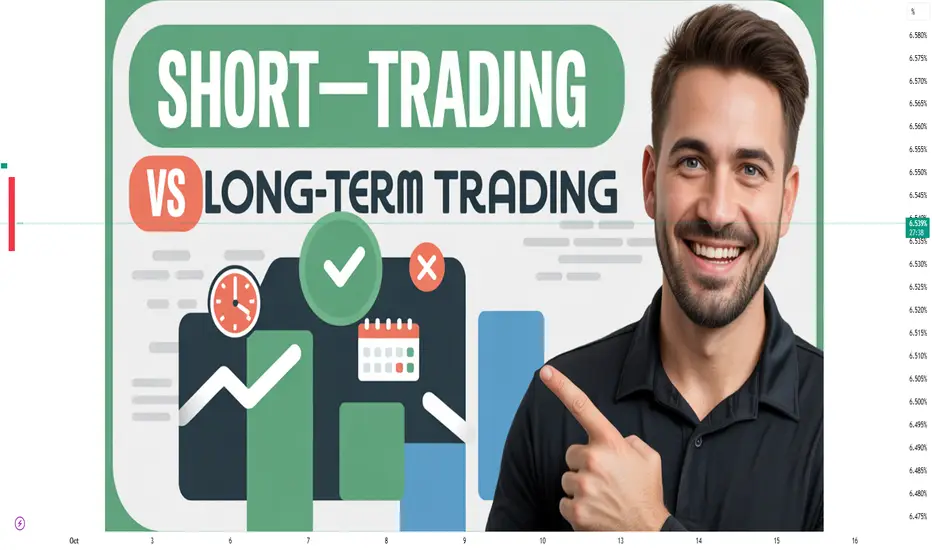
Short-Term Trading vs Long-Term Trading1. Introduction
Financial markets offer multiple avenues for wealth creation. From stocks, commodities, and currencies to derivatives and bonds, the market landscape is diverse. Two primary approaches dominate this landscape:
Short-Term Trading (STT): Trading where positions are held for hours, days, or weeks.
Long-Term Trading (LTT): Investing where positions are held for months, years, or even decades.
Choosing between these approaches is not merely a matter of preference; it involves evaluating capital availability, risk tolerance, skill level, and desired outcomes.
2. Short-Term Trading
2.1 Definition
Short-term trading refers to buying and selling financial instruments over a brief period to capitalize on price fluctuations. The goal is to profit from market volatility, irrespective of long-term market trends.
2.2 Types of Short-Term Trading
Intraday Trading:
Positions are opened and closed within the same trading day.
No overnight risk is taken.
Traders rely heavily on technical analysis, charts, and indicators.
Swing Trading:
Trades last from a few days to several weeks.
Aims to capture price swings within an intermediate trend.
Combines technical and fundamental analysis.
Scalping:
Ultra-short-term trading, often holding positions for minutes or seconds.
Focuses on micro price movements and liquidity.
2.3 Key Features of Short-Term Trading
Time Horizon: Minutes to weeks.
Analysis Tools: Technical analysis dominates; charts, volume, momentum, moving averages.
Capital Requirements: Moderate to high, depending on leverage and trade frequency.
Risk Level: High; price volatility can lead to substantial gains or losses.
Psychological Demands: High stress; requires constant monitoring and quick decision-making.
Transaction Costs: Frequent trades increase brokerage and taxes.
2.4 Advantages of Short-Term Trading
Quick capital turnover.
Multiple profit opportunities in volatile markets.
Ability to exploit technical market inefficiencies.
Flexibility to adjust positions rapidly.
2.5 Disadvantages of Short-Term Trading
High stress and emotional pressure.
Requires significant time commitment.
Transaction costs can erode profits.
High risk of losses during unexpected market events.
2.6 Strategies in Short-Term Trading
Trend Following: Riding the market trend until a reversal signal appears.
Counter-Trend: Betting against the current trend for short-term correction profits.
Breakout Trading: Entering trades when price breaks support or resistance levels.
Momentum Trading: Using indicators like RSI or MACD to capture strong price movements.
3. Long-Term Trading
3.1 Definition
Long-term trading, or investing, involves holding positions over extended periods, ranging from months to years, focusing on the fundamental value of an asset rather than short-term price fluctuations.
3.2 Types of Long-Term Trading
Position Trading:
Holding trades for months to years.
Focused on macroeconomic trends, corporate fundamentals, and industry growth.
Value Investing:
Buying undervalued stocks and holding until the market recognizes their true value.
Popularized by investors like Warren Buffett.
Dividend Investing:
Focused on income generation through dividends alongside capital appreciation.
3.3 Key Features of Long-Term Trading
Time Horizon: Months to decades.
Analysis Tools: Fundamental analysis dominates; financial statements, P/E ratios, cash flows.
Capital Requirements: Can start small but often requires patience to realize returns.
Risk Level: Generally lower; time helps smooth out market volatility.
Psychological Demands: Patience and discipline are essential; minimal day-to-day stress.
Transaction Costs: Lower due to fewer trades.
3.4 Advantages of Long-Term Trading
Benefits from compounding over time.
Less stress compared to short-term trading.
Lower transaction costs.
Less impacted by daily market volatility.
3.5 Disadvantages of Long-Term Trading
Requires patience and discipline.
Capital is tied up for longer periods.
Market shocks (e.g., recessions, policy changes) can affect returns temporarily.
3.6 Strategies in Long-Term Trading
Buy and Hold: Purchase quality assets and hold for long periods.
Dollar-Cost Averaging: Investing a fixed amount regularly to mitigate timing risks.
Growth Investing: Targeting companies with strong future growth potential.
Index Fund Investing: Diversifying risk through market indices like S&P 500 or Nifty 50.
4. Risk Management
Both approaches require risk management:
4.1 Short-Term Risk Management
Stop-loss orders to limit losses.
Position sizing based on volatility.
Diversifying trades to reduce market dependency.
Avoiding over-leverage.
4.2 Long-Term Risk Management
Portfolio diversification across sectors and assets.
Regularly reviewing fundamentals.
Maintaining emergency funds to avoid forced liquidation.
Hedging with derivatives or protective instruments if necessary.
5. Psychological Considerations
5.1 Short-Term Trading Psychology
Emotional control is critical; impulsive decisions can cause losses.
Fear and greed dominate daily trading.
Traders must develop a clear strategy and stick to it.
5.2 Long-Term Trading Psychology
Patience and resilience are key.
Avoid reacting to market noise.
Focus on long-term goals rather than short-term market movements.
6. Tools and Technology
Both trading types benefit from modern technology:
Short-Term Traders: Charting software, trading platforms, algorithmic tools, high-speed data feeds.
Long-Term Traders: Research platforms, financial news, fundamental databases, portfolio trackers.
7. Tax Implications
Taxation varies by country and can influence trading strategies:
Short-Term Trading: Usually taxed at higher rates as short-term capital gains.
Long-Term Trading: Often enjoys lower tax rates on long-term capital gains.
8. Case Studies
8.1 Short-Term Trading Example
Day trader using RSI and MACD indicators to trade Nifty futures within a single day.
Captures profit of 0.5%-1% per trade but executes 10-15 trades per week.
8.2 Long-Term Trading Example
Investor buys shares of a growing IT company and holds for 5 years.
Benefits from dividends and capital appreciation as the company expands.
Conclusion
Short-term and long-term trading represent different philosophies of engaging with the financial markets:
Short-Term Trading is action-oriented, volatile, and requires skill, discipline, and constant attention.
Long-Term Trading is patience-oriented, fundamentally driven, and benefits from compounding over time.
A comprehensive understanding of both allows traders to design a strategy that balances risk, reward, and personal lifestyle, ensuring sustainable financial growth in dynamic markets.
Part 1 Candle Stick Pattern1. Introduction to Options
Financial markets have always revolved around two broad purposes—hedging risk and creating opportunity. Among the tools available, options stand out because they combine flexibility, leverage, and adaptability in a way few instruments can match. Unlike simply buying a stock or bond, an option lets you control exposure to price movements without outright ownership. This makes options both fascinating and complex.
Option trading today has exploded globally, with millions of retail and institutional traders participating daily. But to appreciate their role, we need to peel back the layers—what exactly is an option, how does it work, and why do traders and investors use them?
2. What Are Options? (Call & Put Basics)
An option is a financial derivative—meaning its value is derived from an underlying asset like a stock, index, commodity, or currency.
There are two main types:
Call Option – Gives the holder the right (not obligation) to buy the underlying at a set price (strike) before or on expiration.
Put Option – Gives the holder the right (not obligation) to sell the underlying at a set price before or on expiration.
Example: Suppose Reliance stock trades at ₹2,500. If you buy a call option with a strike price of ₹2,600 expiring in one month, you’re betting the stock will rise above ₹2,600. Conversely, if you buy a put option with a strike price of ₹2,400, you’re betting the stock will fall below ₹2,400.
The beauty lies in asymmetry: you can lose only the premium you pay, but your potential profit can be much larger.
3. Key Terminologies in Option Trading
Options trading comes with its own dictionary. Some must-know terms include:
Strike Price – Predetermined price to buy/sell underlying.
Expiration Date – Last date the option is valid.
Premium – Price paid to buy the option.
In the Money (ITM) – Option has intrinsic value (profitable if exercised immediately).
Out of the Money (OTM) – Option has no intrinsic value, only time value.
At the Money (ATM) – Strike price equals current market price.
Lot Size – Standardized quantity of underlying in each option contract.
Open Interest (OI) – Number of outstanding option contracts in the market.
Understanding these is critical before trading.
4. How Options Work in Practice
Let’s say you buy an Infosys call option with strike ₹1,500, paying ₹30 premium.
If Infosys rises to ₹1,600, your option has intrinsic value of ₹100. Profit = ₹100 – ₹30 = ₹70 per share.
If Infosys stays below ₹1,500, the option expires worthless. Loss = Premium (₹30).
Notice how a small move in stock can create a large percentage return on option, thanks to leverage.
5. Intrinsic Value vs. Time Value
Option price = Intrinsic Value + Time Value.
Intrinsic Value – Actual in-the-money amount.
Time Value – Extra premium traders pay for the possibility of future favorable movement before expiry.
Time value decreases with theta decay as expiration approaches.
6. Factors Influencing Option Pricing (The Greeks)
Options are sensitive to multiple variables. Traders rely on the Greeks to measure this sensitivity:
Delta – Rate of change in option price per unit move in underlying.
Gamma – Rate of change of delta.
Theta – Time decay; how much value option loses daily.
Vega – Sensitivity to volatility.
Rho – Impact of interest rates.
Mastering Greeks is like learning the steering controls of a car—you can’t drive well without them.
7. Types of Option Contracts
Options extend beyond equities:
Equity Options – On individual company stocks.
Index Options – On indices like Nifty, Bank Nifty, S&P 500.
Commodity Options – On crude oil, gold, natural gas.
Currency Options – On USD/INR, EUR/USD, etc.
Each market has unique dynamics, liquidity, and risks.
8. Options Market Structure
Options can be traded in two ways:
Exchange-Traded Options – Standardized, regulated, and liquid.
OTC (Over-the-Counter) Options – Customized contracts between institutions, used for hedging large exposures.
Retail traders mostly deal with exchange-traded options.
PCR Trading Strategies1. The Psychology of Option Trading
Options magnify emotions: greed (unlimited gains) and fear (time decay, sudden loss). Many traders lose due to overleveraging, chasing cheap OTM options, or not respecting stop-loss. Psychological discipline is as vital as technical knowledge.
2. Option Chain Analysis
An option chain shows all available strikes, premiums, OI (open interest), IV, etc. Traders analyze max pain, OI build-up, and put-call ratio (PCR) to gauge market sentiment. Option chains are powerful tools for directional and volatility analysis.
3. Role of Market Makers in Options
Market makers provide liquidity by quoting bid-ask spreads. They profit from spreads and hedging but ensure smoother trading. Without them, option spreads would widen, making it harder for retail traders to enter/exit efficiently.
4. Index Options vs Stock Options
Index Options (e.g., Nifty, Bank Nifty): Cash-settled, high liquidity, lower manipulation risk.
Stock Options: Physical settlement (delivery), less liquid, but higher potential returns.
Retail traders prefer index options; institutions often hedge with stock options.
5. Option Writing as a Business
Many professional traders treat option writing like a business: selling high IV options, hedging risk, managing spreads. Profits come steadily from time decay, but big moves can wipe out capital if risk isn’t managed with stop-loss or hedges.
6. Options and Event Trading
Events like earnings, RBI policy, budget, elections, or global news drastically affect IV. Traders buy straddles/strangles pre-event, and sellers wait for IV crush post-event. Understanding event volatility cycles is key.
7. Taxation of Options Trading in India
Profits from option trading are treated as business income under Indian tax law. Traders must maintain proper records, pay GST in some cases, and file ITR with audit if turnover exceeds limits. This is often ignored by beginners.
8. Technology and Algo in Options
With algo trading, institutions dominate options using complex models (volatility arbitrage, delta-hedging). Retail traders now use option analytics platforms, scanners, and automation tools to compete. Speed and data-driven execution matter more today.
9. Common Mistakes in Option Trading
Buying cheap OTM lottery tickets.
Ignoring IV crush.
Selling naked options without hedge.
Overtrading on expiry days.
Neglecting stop-loss and money management.
Most retail losses come from these errors.
10. The Future of Option Trading
Option trading is growing rapidly in India with weekly expiries, retail participation, and technology. Innovations like zero-day options (0DTE) in the US may come to India. Education, discipline, and structured strategies will define success. The future promises wider accessibility but higher competition as retail meets institutional algos
Part 3 Institutional Trading Role of Options in Hedging
Options are commonly used to hedge portfolios against adverse market movements:
Protective Put for Stocks: Investors holding equities can buy puts to protect against downside risks.
Portfolio Insurance: Institutions use options to safeguard large portfolios against market crashes.
Income Generation: Covered call writing allows long-term holders to earn additional income while maintaining exposure.
Hedging with options is especially popular in volatile markets where risk management is critical.
Pricing Models and Market Mechanics
Professional traders often rely on option pricing models, like the Black-Scholes model, to determine fair premiums. These models factor in:
Current price of the underlying asset
Strike price
Time to expiration
Volatility
Risk-free interest rate
Options markets operate through exchanges with standardized contracts. Market makers provide liquidity, and the bid-ask spread reflects supply-demand dynamics. In OTC markets, options can be customized to suit specific investor requirements.
Advantages of Options Trading
Leverage: Control a larger position for smaller capital.
Flexibility: Strategies for bullish, bearish, or neutral markets.
Hedging: Effective risk management tool.
Profit in Any Market: Can profit in rising, falling, or sideways markets with the right strategy.
Defined Risk (for Buyers): Limited to premium paid.
Challenges and Considerations
Complexity: Options require understanding of multiple factors affecting pricing.
Time Sensitivity: Options lose value as expiration nears.
Volatility Risk: Price swings can be unpredictable.
Liquidity Issues: Not all options have sufficient trading volume.
Psychological Pressure: Rapid movements and leverage can lead to emotional decisions.
US 10Y Yield – Wave 4 Pause Before the Final SurgeDisclaimer: This analysis is for educational purposes only and does not constitute investment advice. Please do your own research (DYOR) before making any trading decisions.
The Setup
The US 10-year yield has been consolidating after topping near 5.021%. Price action since then has formed a contracting structure that looks very much like a Wave 4 triangle .
At present, yields hover near 4.0% — a crucial pivot.
Triangle view: Wave 4 is complete, setting the stage for Wave 5 higher.
Flat view: If yields break below 4.0%, Wave 4 may stretch deeper into a flat correction, potentially testing 3.6–3.7%.
Either way, the Elliott script points to one more advance: Wave 5 up .
What Wave 5 Could Mean
If the US 10-year yield really enters Wave ⑤ up, buckle up:
Bond prices tank → inverse relation, so Treasuries bleed.
Equities feel the heat → higher yields = expensive valuations, especially for growth stocks.
Dollar flexes → global FX could see USD strength.
Borrowing costs bite → mortgages, corporate loans, government debt servicing all tighten.
In short: Wave ⑤ = a macro “stress test .”
Why India Should Care
A breakout in US yields rarely stays a US-only story. For India, it means:
FII outflows as global funds chase safer US returns
INR under pressure , increasing imported inflation risks
Indian bond yields rising , even without RBI action
Equity market stress , especially in IT and rate-sensitive sectors
Final Thoughts
The triangle scenario points to an imminent breakout above 5.0%. A deeper flat only delays it. For traders and investors, this is the chart to watch — because Wave 5 in US yields isn’t just a bond market story, it’s a global macro shockwave .
Emerging Sectors in India1. Information Technology & Digital Economy
India’s IT sector has been the backbone of its global image for decades. But the story is evolving. It’s no longer just about outsourcing or call centers; today, India is building entire digital ecosystems. Cloud computing, SaaS (Software as a Service), big data analytics, and cybersecurity are driving a new phase of IT growth.
The adoption of 5G, Artificial Intelligence (AI), and Internet of Things (IoT) is expanding opportunities for IT firms. With global businesses increasingly looking for digital transformation partners, Indian IT companies like Infosys, TCS, Wipro, and HCL are evolving from service providers into strategic partners.
Moreover, India’s digital economy is expected to reach $1 trillion by 2030, with growth driven by digital payments, e-commerce, and digital infrastructure.
2. Fintech & Digital Payments
India has become a global leader in digital payments. The success of UPI (Unified Payments Interface) is a case study for the world, processing billions of transactions every month. Startups like PhonePe, Paytm, BharatPe, and Razorpay are revolutionizing how money moves across the economy.
Beyond payments, fintech innovation includes:
Digital lending platforms
Insurtech solutions
WealthTech & robo-advisory
Blockchain-based financial services
Government initiatives like Jan Dhan Yojana, Digital India, and financial inclusion policies have enabled fintech adoption even in rural India. By 2030, India’s fintech industry could surpass $200 billion in revenues.
3. E-commerce & Online Marketplaces
E-commerce is one of the fastest-growing consumer-facing sectors. With the world’s largest youth population and rising internet penetration, platforms like Amazon, Flipkart, Meesho, and Nykaa are driving a retail revolution.
Key drivers:
Growing middle-class consumption
Rapid adoption of online grocery & fashion retail
Expansion of logistics and supply chain tech
Rise of social commerce & direct-to-consumer (D2C) brands
By 2030, India’s e-commerce market is projected to reach $350–400 billion, making it the third-largest in the world after China and the US.
4. Electric Vehicles (EVs) & Green Mobility
India’s transportation sector is undergoing a green transformation. With rising pollution levels and energy dependence on oil imports, electric mobility has become a national priority.
Key developments:
Government subsidies under FAME (Faster Adoption and Manufacturing of Hybrid and Electric Vehicles)
PLI scheme for EV batteries
Entry of global players like Tesla (expected)
Domestic innovation by Ola Electric, Ather Energy, and Tata Motors
EV adoption in two-wheelers, buses, and delivery fleets is picking up faster than passenger cars, given India’s cost-sensitive market. By 2030, EVs could form 30% of all vehicle sales in India.
5. Renewable Energy & Clean Tech
India is one of the world’s largest consumers of energy. To reduce fossil fuel dependency, the government has set ambitious renewable energy targets: 500 GW of renewable capacity by 2030.
Solar and wind power dominate, but new areas like green hydrogen, battery storage, and waste-to-energy are gaining attention. Companies like Adani Green, ReNew Power, and NTPC are spearheading massive renewable projects.
With global ESG (Environmental, Social, Governance) investments rising, India’s renewable energy sector could attract trillions in foreign investment over the next two decades.
6. Biotechnology & Healthcare Innovation
India’s pharmaceutical industry is already known as the “pharmacy of the world”, but biotechnology and healthcare innovation are expanding the sector further.
Emerging areas:
Gene therapy and personalized medicine
Biotechnology in agriculture and food security
Telemedicine and digital health platforms
Medical devices and diagnostics
Startups in health-tech (Practo, 1mg, PharmEasy) are bridging gaps in healthcare access. With rising health awareness and global demand, India’s biotech industry could reach $150 billion by 2025.
7. EdTech (Education Technology)
India has one of the largest student populations in the world, creating huge demand for quality education. EdTech platforms like Byju’s, Unacademy, Vedantu, and PhysicsWallah are transforming how students learn.
Key innovations:
Live online classes
AI-based personalized learning
Skill development & upskilling platforms
AR/VR-based immersive education
Though growth slowed after the pandemic boom, long-term demand for hybrid and skill-focused education will keep EdTech a strong emerging sector.
8. Agritech & Food Processing
Agriculture still employs 40% of India’s workforce, but productivity is low. Agritech startups are using AI, IoT, blockchain, and drones to modernize farming.
Examples:
DeHaat, Ninjacart (farm-to-market supply chains)
Stellapps (dairy tech)
AgroStar (input advisory & marketplace)
Meanwhile, food processing is gaining momentum, with India moving from raw produce to value-added exports. This sector could generate millions of jobs and boost farmers’ income significantly.
9. Space Technology & Satellite Services
India’s space sector, led by ISRO, is opening up to private players. With the success of Chandrayaan-3 and Aditya-L1, global attention is on India’s space tech.
Private startups like Skyroot, Agnikul Cosmos, and Pixxel are innovating in satellite launch services, earth observation, and space-based applications.
The government’s IN-SPACe policy and privatization efforts could turn India into a global hub for affordable space technology.
10. Artificial Intelligence, Robotics & Automation
AI and automation are transforming multiple industries, from finance to healthcare to manufacturing. India’s AI market is expected to reach $17 billion by 2027.
Applications include:
AI in customer service (chatbots, voice assistants)
Robotics in manufacturing and logistics
AI-driven medical imaging
Smart cities and predictive governance
Indian IT and startups are actively adopting AI tools, with government initiatives supporting skill development in this field.
Conclusion
India stands at a historic crossroads. The emerging sectors described above are not just industries – they represent the aspirations of a young, ambitious nation aiming for global leadership. With strong policy support, rapid digital adoption, and entrepreneurial energy, India is building the foundations of a $5–10 trillion economy.
While challenges remain, the direction is clear: India’s growth story will be powered by emerging sectors that combine innovation, sustainability, and inclusivity.
India 10-Year Yields and Rupee – A Long-Term SetupThe Bond Yield Story
India’s 10-year government bond yield has been moving inside a long contracting triangle for more than 20 years.
The highs are getting lower.
The lows are getting higher.
Yields are now sitting near the middle, around 6.5%.
This triangle will not last forever. When it breaks, the move can be strong and last for years.
If yields break down: Bond prices go up, borrowing gets cheaper.
If yields break up: Borrowing costs rise, pressure builds on companies and the government.
The Rupee Story
The USD/INR chart shows a very clear uptrend since 2011 .
Every dip has made a higher low.
The line of support is still holding.
Today the rupee is near ₹88 per USD .
This means the rupee has been slowly losing value for many years.
Weak rupee: Imports (oil, gold, electronics) become costlier → inflation risk.
But: Exporters like IT and pharma get some advantage.
Fiscal Pressure
As per a Reuters update on TradingView’s news feed, the GST Council has approved tax cuts on many consumer goods starting September 22, 2025 .
This could boost consumption.
But it may also lead to a large revenue shortfall for the government.
Implication for markets:
Bond yields: More government borrowing could push yields higher.
Rupee: Fiscal stress may keep INR weak against USD.
(source : in.tradingview.com
)
Big Picture
Bond yields are stuck inside a long contracting triangle – a breakout is coming.
The rupee has been in a steady downtrend – the pressure is clear.
Fiscal moves like GST tax cuts add extra risk , tilting towards higher yields and weaker INR.
In short: The charts show yields coiling and rupee sliding . Fundamentals only add more weight to this setup.
Disclaimer: This analysis is for educational purposes only and does not constitute investment advice. Please do your own research (DYOR) before making any trading decisions.