Technical Analysis with AI ToolsWhat is Technical Analysis?
Technical Analysis (TA) is the study of price and volume data to forecast future market trends. It assumes that:
Price discounts everything – All information (news, sentiment, fundamentals) is already reflected in the price.
Prices move in trends – Uptrends, downtrends, and sideways trends persist.
History repeats itself – Price patterns and human psychology create repeatable patterns.
Traders use charts, indicators, and patterns like head and shoulders, triangles, trendlines, etc., to make trading decisions.
However, TA has limitations:
Subjectivity in pattern recognition
Reliance on lagging indicators
Difficulty adapting to real-time market shifts
That’s where AI-based tools step in.
💡 What is Artificial Intelligence in Trading?
Artificial Intelligence in trading refers to computer systems that can learn from data, identify patterns, and make trading decisions with minimal human intervention.
The key subfields of AI used in trading include:
Machine Learning (ML): Algorithms that improve through experience (e.g., linear regression, decision trees, neural networks)
Deep Learning (DL): Complex neural networks mimicking the human brain; used for advanced pattern recognition
Natural Language Processing (NLP): Used to analyze news sentiment, earnings reports, and social media
Reinforcement Learning: AI that learns through trial and error in dynamic environments (e.g., Q-learning in trading bots)
When applied to technical analysis, AI processes historical price, volume, and indicator data to detect hidden relationships and optimize trading signals in real time.
🤖 How AI Enhances Technical Analysis
1. Pattern Recognition at Scale
Traditional TA relies on human eyes or predefined rules to identify chart patterns.
AI, particularly deep learning (e.g., CNNs – Convolutional Neural Networks), can scan thousands of charts simultaneously and identify complex patterns (like cup-and-handle or flag patterns) faster and more accurately.
2. Backtesting with Intelligence
AI allows advanced backtesting of strategies using years of tick-by-tick or candle-by-candle data.
Unlike static rules, ML-based strategies can adapt their weights or parameters over time based on the evolving nature of the market.
3. Nonlinear Indicator Relationships
Classic TA uses indicators independently. But markets are nonlinear.
AI models learn nonlinear relationships among multiple indicators and create composite signals that outperform single-indicator strategies.
4. Sentiment-Infused Technical Models
AI tools can combine technical signals with NLP-based sentiment analysis from Twitter, Reddit, or news headlines.
This fusion helps predict breakouts or reversals that aren’t visible in price action alone.
5. Real-Time Decision Making
Traditional TA often suffers from lag.
AI-powered systems like algorithmic trading bots can respond to price movements in milliseconds, executing trades without delay.
🔧 AI Tools and Platforms for Technical Analysis
✅ 1. MetaTrader 5 with Python or MQL5 AI Modules
Integrates technical indicators with custom AI models
Python API allows users to run ML/DL models within MetaTrader
Widely used by forex and commodity traders
✅ 2. TradingView with AI-Based Scripts
Offers Pine Script for strategy development
Developers can integrate AI signals via webhook/API
Visual pattern recognition and crowd-shared AI scripts
✅ 3. QuantConnect / Lean Engine
Open-source algorithmic trading platform
Allows users to train ML models and backtest strategies
Supports data from equities, options, crypto, futures
✅ 4. Kaggle & Google Colab
Ideal for building AI-based technical analysis tools from scratch
You can train models using pandas, scikit-learn, TensorFlow, etc.
Excellent for custom strategies, like classifying candle patterns
✅ 5. Trade Ideas
Proprietary AI engine called “Holly” scans 60+ strategies daily
Uses ML to learn which trades worked yesterday and adjust accordingly
Includes real-time alerts, performance tracking, and automated trading
✅ 6. TrendSpider
AI-powered charting platform
Automatic trendline detection, dynamic Fibonacci levels, heat maps
Smart technical scanning and pattern recognition
🧠 AI Techniques Applied in Technical Analysis
1. Supervised Learning
Used when historical data is labeled with desired outcomes (e.g., up or down after a candle close).
Algorithms: Logistic Regression, Random Forest, Support Vector Machine (SVM)
Use Case: Predict next candle movement based on RSI, MACD, price, etc.
2. Unsupervised Learning
Used for pattern discovery in unlabeled data.
Algorithms: K-means, DBSCAN, Autoencoders
Use Case: Cluster similar stock behavior, detect anomalies, group market conditions
3. Reinforcement Learning
Learns from rewards/punishments in dynamic environments (e.g., financial markets).
Algorithms: Q-learning, Deep Q-Networks (DQN)
Use Case: Train bots to buy/sell based on profit performance in changing conditions
4. Deep Learning
Excellent for modeling time-series data and pattern recognition.
Algorithms: LSTM, GRU, CNN
Use Case: Predict future prices based on sequential price movements
🛠 How to Build an AI-Based Technical Analysis System (Simplified)
Step 1: Data Collection
Historical OHLCV data from sources like Yahoo Finance, Binance, Alpaca
Add technical indicators like RSI, MACD, ATR, etc.
Step 2: Feature Engineering
Normalize or scale features
Create additional features like percentage change, volatility
Step 3: Model Selection
Choose ML/DL models: Random Forest, XGBoost, LSTM
Train with price data labeled as “up”, “down”, or “flat”
Step 4: Backtesting
Simulate how the model would have performed in the past
Use performance metrics like Sharpe ratio, win rate, drawdown
🧾 Conclusion
Technical analysis has entered a new era, powered by Artificial Intelligence. Traders are no longer limited to static indicators or gut feeling. AI tools offer the ability to process vast amounts of data, detect patterns invisible to the human eye, and adapt strategies dynamically.
However, success doesn’t come automatically. To benefit from AI in technical analysis, traders must combine domain knowledge, data science skills, and market intuition. When used responsibly, AI can be an invaluable ally, not a replacement, in your trading journey.
Wave Analysis
Algo-Based Options Trading & AutomationIn the modern trading landscape, technology is not just a supporting tool—it’s the central force reshaping how markets function. Nowhere is this more visible than in options trading, where algorithmic trading (or “algo trading”) is taking over traditional manual strategies. With increased speed, accuracy, and scalability, automation in options trading is transforming retail and institutional participation alike.
This guide breaks down everything you need to know about algo-based options trading: what it is, how it works, what strategies are used, its pros and cons, and how automation is practically implemented in today's markets.
1. What is Algo-Based Options Trading?
Algo-based options trading involves using computer programs to execute options trades based on pre-defined rules and mathematical models. These programs analyze market data, identify trading signals, and place orders automatically—often much faster and more accurately than humans can.
The key components include:
Predefined logic or strategy (e.g., "Buy a call option when RSI < 30 and price is above 50-DMA")
Real-time market data feed
Execution engines that place and manage orders without manual intervention
Risk management modules to monitor exposure, margin, and stop-losses
2. Why Use Algo Trading in Options Instead of Manual Trading?
Options are complex instruments. Their prices are influenced by multiple variables like time decay, implied volatility, strike price, delta, gamma, and more.
Humans can’t always process this data fast enough, especially during high-volatility events. Here’s where algos shine:
Manual Trading Algo Trading
Emotion-driven Emotionless and consistent
Slower execution Millisecond-level speed
Prone to fatigue Runs 24/7 without breaks
Hard to backtest Easily backtested and optimized
Limited scalability Can manage thousands of trades simultaneously
3. Core Components of an Options Algo Trading System
To build or understand an automated options trading system, it’s essential to know its primary components:
A. Strategy Engine
This is the brain of the system. It defines:
Entry/Exit conditions (based on indicators like RSI, MACD, IV percentile, etc.)
Type of options to trade (call, put, spreads, straddles, etc.)
Timeframe (intraday, weekly, monthly)
Underlying asset and strike price selection logic
B. Data Feed & Market Scanner
Live option chain data from exchanges like NSE or brokers like Zerodha, Upstox
IV, OI, delta, gamma, theta, vega data
Historical data for backtesting
C. Order Management System (OMS)
This handles:
Order placement
Modifications (e.g., SL changes)
Cancel/re-entry logic
Smart order routing (SOR)
D. Risk Management Module
Risk management is critical. The automation should enforce:
Maximum daily loss limits
Exposure per trade
Position sizing based on capital
Portfolio hedging logic
E. Logging and Monitoring
Every trade, price, and action is logged for audit and improvement. Some systems send alerts via Telegram, email, or SMS.
4. Common Algo Strategies Used in Options Trading
1. Delta-Neutral Strategies
Goal: Profit from volatility while maintaining a neutral directional view.
Examples: Straddle, Strangle, Iron Condor
How Algos Help: Adjust delta automatically by hedging with futures or adding more legs
2. Trend Following with Options
Algos can detect breakouts and directional momentum and buy/sell options accordingly.
Example: Buy call when price crosses above 20-DMA and volume spikes
Add-ons: Use trailing SLs, exit when RSI > 70
3. Option Scalping
Used in very short timeframes (1m, 5m candles). Algo enters/exits trades rapidly to capture small moves.
Needs: Super-fast execution and co-location
Popular in: Weekly expiry trading
4. IV-Based Mean Reversion
Buy when Implied Volatility (IV) is abnormally low or sell when it’s high.
Algos monitor: IV percentile, skew, vega exposure
5. Open Interest & Volume Based Strategies
Breakout Strategy: Detect long buildup or short covering using OI change + price movement
Algo filters trades: Where volume > 2x average and OI shows new positions being created
5. Platforms and Tools for Algo Options Trading
Even retail traders can now access automation tools without knowing how to code.
No-Code Platforms:
Tradetron
Streak by Zerodha
AlgoTest
Quantiply
These platforms offer:
Drag-and-drop strategy builders
Live market connections
Backtesting features
Broker integrations
Custom Python/C++ Based Systems
Used by advanced retail or prop firms. These offer:
Full control and flexibility
Integration with APIs like:
Zerodha Kite Connect
Upstox API
Interactive Brokers
Summary and Final Thoughts
Algo-based options trading is not just for hedge funds anymore. With accessible platforms, cloud computing, and APIs, even retail traders can build, test, and deploy automated strategies.
However, success in algo trading depends on:
Solid strategy design (math + market logic)
Risk management above all
Continuous monitoring and iteration
Avoiding over-reliance on backtests
Staying compliant with broker and SEBI norms
Open Interest & Option Chain AnalysisIn the world of options trading, two of the most critical analytical tools are Open Interest (OI) and Option Chain Analysis. While price and volume are commonly used indicators, OI and the Option Chain give unique insights into market sentiment, strength of price movements, and likely support/resistance zones.
Let’s break down both concepts thoroughly and understand how you can use them to make smarter trading decisions.
1. What is Open Interest (OI)?
Open Interest (OI) refers to the total number of outstanding (open) option contracts that have not been settled or squared off. These contracts can be either calls or puts, and each open contract reflects a position that has been initiated but not yet closed.
Important: OI is not the same as volume.
Volume counts the number of contracts traded in a day.
OI shows how many contracts are still open and active.
Example:
If Trader A buys 1 lot of Nifty Call and Trader B sells it, OI increases by 1.
If later one of them exits the trade (either buy or sell), OI decreases by 1.
If the same contract is bought and sold multiple times in a day, volume increases, but OI remains the same unless a new position is created or closed.
2. Interpreting Open Interest Changes
Here’s how to interpret changes in OI:
Price Movement OI Movement Interpretation
Price ↑ OI ↑ Long Buildup (bullish)
Price ↓ OI ↑ Short Buildup (bearish)
Price ↑ OI ↓ Short Covering (bullish)
Price ↓ OI ↓ Long Unwinding (bearish)
This table is a cheat sheet for OI interpretation. Let’s break them down with simple language:
Long Buildup: Traders are buying calls/puts expecting further rise. (Positive sentiment)
Short Buildup: Traders are selling expecting fall. (Negative sentiment)
Short Covering: Sellers are closing their shorts due to rising prices. (Momentum shift to bullish)
Long Unwinding: Buyers are exiting as prices fall. (Loss of bullish strength)
3. What is Option Chain?
The Option Chain is a table or listing that shows all the available strike prices for a particular underlying (like Nifty, Bank Nifty, or a stock) along with key data:
Call & Put Options
Strike Prices
Premiums (LTP)
Open Interest (OI)
Change in OI
Volume
Implied Volatility (IV)
Structure of Option Chain
An Option Chain is usually divided into two sides:
Left Side → Call Options
Right Side → Put Options
In the middle, you have the Strike Prices listed.
4. Key Elements in Option Chain Analysis
A. Strike Price
The set price at which the holder can buy (Call) or sell (Put) the asset.
At the Money (ATM): Closest to current spot price
In the Money (ITM): Profitable if exercised
Out of the Money (OTM): Not profitable if exercised now
B. Open Interest (OI)
Shows how many contracts are still open for each strike. Higher OI means greater trader interest.
C. Change in OI
Shows how much OI has increased or decreased. This is critical for real-time sentiment tracking.
Increase in OI + Rising premium = Strength
Increase in OI + Falling premium = Resistance or Support forming
D. Volume
Number of contracts traded today. Shows activity and liquidity.
E. Implied Volatility (IV)
Indicates market expectation of future volatility. High IV means higher premiums.
5. How to Read Option Chain for Support & Resistance
One of the most powerful uses of Option Chain Analysis is identifying short-term support and resistance.
Highest OI on Call Side = Resistance
Highest OI on Put Side = Support
This happens because:
Sellers of Calls don’t want price to rise above their sold strike
Sellers of Puts don’t want price to fall below their sold strike
Example:
Let’s say:
19700 CE has 45 lakh OI
19500 PE has 40 lakh OI
This implies:
Resistance = 19700
Support = 19500
So, traders expect Nifty to remain between 19500–19700.
Conclusion
Open Interest and Option Chain Analysis are powerful tools to understand the mood of the market. They help traders:
Find real-time support and resistance
Gauge market direction and strength
Understand where big players (institutions) are placing their bets
Plan both intraday and positional trades with more accuracy
But remember, OI and Option Chain are not standalone indicators. Combine them with price action, volume, and technical levels for better results.
Retail Speculation & Margin Debt SurgeIntroduction
Retail speculation and the surge in margin debt are two intertwined phenomena that reflect the sentiment, behavior, and sometimes irrational exuberance of retail investors in financial markets. While speculation is not inherently negative, excessive speculative activity—especially when fueled by borrowed money—can amplify market volatility and contribute to asset bubbles and subsequent crashes. This essay delves into the mechanisms, historical context, driving forces, and implications of retail speculation and rising margin debt, using data and examples from key financial events, including the dot-com bubble, the 2008 financial crisis, and the post-COVID bull market.
Understanding Retail Speculation
Retail speculation refers to the activity of non-professional investors—often individuals trading for personal gain—who make investment decisions primarily based on price momentum, sentiment, hype, or news, rather than fundamental analysis. Speculators typically seek short-term gains, and in bullish markets, they are drawn to high-risk, high-reward assets such as penny stocks, cryptocurrencies, meme stocks, or options.
Characteristics of Retail Speculation
Short-term focus: Most retail speculators are not long-term investors. Their trades are usually driven by the hope of quick profits.
High-risk instruments: Options trading, leveraged ETFs, and volatile small-cap stocks are often preferred.
Influence of social media and forums: Platforms like Reddit (e.g., WallStreetBets), YouTube, and Twitter have become powerful tools for spreading speculation-driven narratives.
Emotional trading: Greed and fear dominate speculative behavior, often leading to herd mentality.
What Is Margin Debt?
Margin debt refers to money borrowed by investors from brokers to purchase securities. Buying on margin amplifies both gains and losses, making it a double-edged sword. When margin debt increases substantially during bull markets, it suggests rising confidence and risk appetite. However, it also raises the fragility of the financial system, as sharp downturns can trigger forced liquidations and margin calls.
How Margin Works
Investors must open a margin account and maintain a minimum margin requirement. They borrow funds against their existing holdings as collateral. If the value of their holdings drops below a certain threshold, they face a margin call—they must either deposit more funds or sell assets to cover losses.
Historical Context: Booms, Bubbles, and Crashes
Retail speculation and margin debt surges are not new. Throughout financial history, periods of easy money and technological disruption have often led to waves of speculative fervor, followed by painful corrections.
1. The 1929 Crash and the Great Depression
In the late 1920s, a surge in retail investing, fueled by margin loans, led to unprecedented levels of speculation. By 1929, over 10% of U.S. households owned stock, many with borrowed money. Margin requirements were often as low as 10%. The market crash in October 1929 wiped out millions of investors, and the excessive margin played a significant role in deepening the crash.
2. The Dot-Com Bubble (Late 1990s – 2000)
During the dot-com era, retail investors were drawn to internet startups with little or no earnings. Margin debt surged along with valuations. Many speculators bought tech stocks on margin, hoping to capitalize on exponential growth. When the bubble burst in March 2000, the NASDAQ lost nearly 80% of its value over the next two years, and investors faced massive margin calls.
3. The 2008 Financial Crisis
Although retail speculation played a smaller role than institutional excesses, margin debt was again at high levels before the collapse. Hedge funds and some retail investors used leverage to increase exposure to mortgage-backed securities and stocks. When Lehman Brothers collapsed, widespread deleveraging followed.
Implications and Risks
1. Amplification of Market Volatility
When large numbers of investors trade on margin, small price declines can lead to forced selling. This selling pressure pushes prices down further, triggering more margin calls—a vicious cycle that can exacerbate crashes.
2. Asset Bubbles
Speculative fervor often inflates asset prices beyond fundamental value. The tech bubble, meme stocks, and cryptocurrencies like Dogecoin (which had little intrinsic value but saw massive price spikes) are examples. When sentiment shifts, these assets often collapse in value.
3. Retail Investor Losses
While some retail traders made fortunes during speculative booms, the vast majority lost money, especially those who entered near the peak. Trading on margin magnifies losses, sometimes wiping out entire accounts.
4. Systemic Risk
Though retail investors are not as systemically significant as large institutions, high levels of leverage across many accounts can create systemic risks, especially when linked with broader market structures like derivatives and ETFs.
Risk Management and Investor Behavior
Retail investors often underestimate the risks of margin trading, especially during euphoric markets.
Best Practices
Understand margin mechanics: Know how margin calls work and the impact of volatility.
Limit exposure: Avoid using maximum leverage.
Diversify holdings: Spread investments across asset classes to reduce risk.
Set stop-losses: Automatically limit downside.
Stay informed: Monitor market trends, economic indicators, and company fundamentals.
Conclusion
Retail speculation and surges in margin debt are recurring features of financial markets. They reflect the optimism—and sometimes irrational exuberance—of individual investors who seek to ride market waves for profit. While such behavior can inject liquidity and vibrancy into markets, it also brings significant risks. When speculation is fueled by leverage, the consequences of a downturn can be severe, both for individuals and the broader financial system.
Momentum, Swing & Day Trading StrategiesTrading in financial markets offers a variety of strategies suited to different timeframes, risk appetites, and goals. Among the most popular trading methodologies are Momentum Trading, Swing Trading, and Day Trading. These strategies, while overlapping in some aspects, are distinct in their approach to capitalizing on market opportunities. Each appeals to a particular type of trader and requires different skills, tools, and psychological traits.
This guide provides a deep dive into these three trading styles, helping aspiring traders understand how they work, what tools are needed, and how to determine which might be the best fit for their goals.
1. Momentum Trading
Definition
Momentum trading is a strategy that seeks to capitalize on the strength of existing market trends. Momentum traders aim to buy securities that are moving up and sell them when they show signs of reversing—or go short on securities that are moving down.
The underlying belief is that stocks which are already trending strongly will continue to do so in the short term, as more traders jump on the bandwagon.
Core Principles
Trend Continuation: Assets that exhibit high momentum will likely continue in their direction for a while.
Volume Confirmation: High volume typically confirms the strength of momentum.
Short-term holding: Positions are held for a few minutes to several days.
Relative Strength: Comparing the performance of securities to identify leaders and laggards.
Example Strategy
Identify stocks with high relative volume (5x or more average volume).
Look for breakouts above recent resistance with strong volume.
Enter the trade once confirmation occurs (price closes above resistance).
Use a trailing stop-loss to ride the trend while locking in gains.
2. Swing Trading
Definition
Swing trading involves taking trades that last from a few days to a few weeks in order to capture short- to medium-term gains in a stock (or any financial instrument). Swing traders primarily use technical analysis due to the short-term nature of the trades but may also use fundamental analysis.
This strategy bridges the gap between day trading and long-term investing.
Core Principles
Trend Identification: Traders look for mini-trends within larger trends.
Support & Resistance: Entry and exit points are often based on technical levels.
Risk-to-Reward Ratios: Focus on setups with favorable risk/reward profiles (typically 1:2 or better).
Market Timing: Entry and exit are more strategic and less frequent than day trading.
Example Strategy
Scan for stocks in a clear uptrend or downtrend.
Wait for a pullback to a key moving average or support zone.
Enter on a bullish/bearish reversal candlestick pattern.
Set stop-loss just below support or recent swing low.
Set target profit at next resistance level or use a trailing stop.
3. Day Trading
Definition
Day trading is a strategy that involves buying and selling financial instruments within the same trading day. Traders aim to exploit intraday price movements and typically close all positions before the market closes to avoid overnight risks.
This strategy demands intense focus, fast decision-making, and a strong grasp of technical analysis.
Core Principles
Speed: Executing trades rapidly and precisely.
Volume & Liquidity: Only liquid assets are traded to ensure quick execution.
Leverage: Often used to increase potential profits (and losses).
Volatility: The more a stock moves, the better for day trading.
Example Setup
Identify a high-volume stock with a news catalyst.
Wait for an opening range breakout.
Enter long/short based on breakout with tight stop-loss.
Set profit targets based on support/resistance or risk-reward ratio.
Tools Commonly Used Across All Strategies
Regardless of the strategy, traders typically use the following tools:
Charting Platforms: TradingView, ThinkorSwim, MetaTrader, NinjaTrader.
Screeners: Finviz, Trade Ideas, MarketSmith.
News Feed Services: Benzinga Pro, Bloomberg, CNBC, Twitter/X.
Brokerage Platforms: Interactive Brokers, TD Ameritrade, E*TRADE, Fidelity.
Risk Management Software: Used to calculate position sizing, stop losses.
Risk Management: The Cornerstone of All Strategies
No matter the strategy, risk management is essential. Key practices include:
Position Sizing: Never risk more than 1–2% of capital per trade.
Stop-Loss Orders: Automatically exits a losing trade at a predefined level.
Risk-Reward Ratio: Most successful traders seek at least a 1:2 ratio.
Diversification: Avoid overexposing to one sector or asset.
Conclusion: Which Strategy is Right for You?
Choosing the right trading strategy depends on your:
Time availability: Can you watch the markets all day?
Capital: Can you meet margin and liquidity requirements?
Personality: Are you calm under pressure, or do you prefer slower decision-making?
Experience level: Some strategies are more forgiving and suitable for beginners.
Market Drivers: Trade Policy, Inflation, SpeculationFinancial markets are influenced by a wide array of forces—ranging from fundamental economic indicators to investor psychology. Among the most impactful and multifaceted market drivers are trade policy, inflation, and speculation. These elements can significantly sway the direction of asset prices, influence macroeconomic stability, and affect the broader global economic system.
I. Trade Policy as a Market Driver
A. Definition and Components
Trade policy refers to a country’s laws and strategies that govern international trade. It encompasses:
Tariffs: Taxes imposed on imported goods.
Quotas: Limits on the amount of a particular product that can be imported or exported.
Trade agreements: Bilateral or multilateral treaties that establish trade rules.
Subsidies and protections: Government support for domestic industries.
These measures are designed to either protect domestic industries or promote international trade, often balancing between nationalist and globalist economic perspectives.
B. Mechanisms of Influence
Trade policy impacts markets in several ways:
Cost Structures: Tariffs increase the cost of imported goods, which can impact company profits and consumer prices.
Supply Chains: Restrictions or incentives can alter how and where companies source their goods.
Investment Flows: Favorable trade policies can attract foreign direct investment (FDI), while protectionist policies might repel it.
Currency Valuation: Trade deficits or surpluses influenced by policy can strengthen or weaken a nation's currency.
II. Inflation as a Market Driver
A. Understanding Inflation
Inflation refers to the general increase in prices over time, eroding purchasing power. It is typically measured by indices such as:
Consumer Price Index (CPI)
Producer Price Index (PPI)
Personal Consumption Expenditures (PCE)
Inflation arises from various sources, commonly categorized as:
Demand-pull inflation: Too much money chasing too few goods.
Cost-push inflation: Rising costs of production inputs.
Built-in inflation: Wage-price spirals based on inflation expectations.
B. How Inflation Influences Markets
1. Interest Rates
Inflation directly impacts interest rate policy. Central banks, particularly the Federal Reserve in the U.S., adjust rates to control inflation. When inflation rises, central banks typically raise interest rates to cool demand and vice versa.
Market Reaction:
Bonds: Prices fall when interest rates rise because older bonds yield less than new ones.
Stocks: Generally suffer when inflation rises due to higher costs and tighter monetary policy.
Real Estate: Can benefit initially (due to higher asset values), but higher mortgage rates can dampen long-term demand.
2. Currency Value
A country experiencing high inflation will often see its currency depreciate. Investors demand higher yields to hold assets denominated in that currency, and purchasing power diminishes.
3. Commodities and Precious Metals
Gold, silver, and other commodities often rise in value during inflationary periods, serving as hedges against currency debasement.
III. Speculation as a Market Driver
A. What is Speculation?
Speculation involves trading financial instruments with the aim of profiting from short-term fluctuations rather than long-term value. While investing relies on fundamentals, speculation often relies on technical indicators, market psychology, and trends.
Speculators are prevalent in all markets: equities, forex, commodities, derivatives, and crypto-assets.
B. Types of Speculators
Retail Speculators: Individual traders using platforms like Robinhood or eToro.
Institutional Traders: Hedge funds, proprietary trading desks.
Algorithmic/Quant Traders: Firms using mathematical models and AI.
IV. Interplay Between Trade Policy, Inflation, and Speculation
While each driver can operate independently, they often interact in complex and reinforcing ways:
A. Trade Policy → Inflation
Protectionist policies (e.g., tariffs on steel or semiconductors) can raise input costs, contributing to inflationary pressure. Conversely, liberalized trade can reduce costs and enhance price stability through global competition.
B. Inflation → Speculation
Periods of low interest rates and high inflation can drive speculation as real returns on traditional savings erode. Investors seek higher yields in riskier assets like tech stocks or cryptocurrencies.
Example: The post-2020 environment of ultra-low interest rates and rising inflation led to massive speculative flows into growth stocks and digital assets.
V. Conclusion
Trade policy, inflation, and speculation are cornerstone forces shaping the modern financial landscape. Their impacts permeate across asset classes, economic sectors, and even political realms.
Trade policy can shift competitive advantages, trigger geopolitical tensions, and reshape supply chains.
Inflation, while a natural economic phenomenon, can destabilize markets if poorly managed.
Speculation, though vital for liquidity and efficiency, carries risks of distortion and systemic crises.
In an interconnected world, no market driver operates in isolation. Understanding their mechanisms, implications, and relationships is essential for investors, policymakers, and analysts alike.
As markets evolve, particularly with the rise of digital finance, global trade realignment, and new inflationary paradigms, these drivers will remain at the forefront of both opportunity and risk.
Trading Psychology & Risk Management🧠 Part 1: Trading Psychology
Trading psychology refers to the emotional and mental aspects that influence trading decisions. It includes traits like discipline, patience, confidence, and emotional control.
✅ Traits of Successful Traders
1. Discipline
Following your trading plan no matter what.
Not deviating due to emotions or "gut feelings".
2. Patience
Waiting for the right setup to occur.
Not chasing trades or forcing market entries.
3. Emotional Resilience
Being able to handle losses without emotional reactions.
Not reacting with fear, revenge, or frustration.
💼 Part 2: Risk Management
Risk management ensures that you survive and thrive in trading, even when the market moves against you. It’s not about avoiding losses — it’s about limiting them so that no single trade can wipe out your account.
🧮 Core Concepts in Risk Management
1. Risk Per Trade
Limit risk to 1–2% of total capital per trade.
For example, on a ₹1,00,000 account, risk only ₹1,000–₹2,000 per trade.
2. Position Sizing
Use your stop-loss level to determine how many shares/contracts to trade.
AI and Algorithmic TradingWhat Is Algorithmic Trading?
Algorithmic trading (or “algo trading”) involves using computer programs to follow a defined set of instructions — an algorithm — to place, manage, and close trades. These rules are based on parameters such as timing, price, volume, and even complex mathematical models.
Key Benefits of Algorithmic Trading:
Speed: Algorithms can analyze market data and execute trades in microseconds.
Accuracy: Eliminates human error in order placement.
Backtesting: Strategies can be tested on historical data before going live.
Emotionless Trading: Algorithms remove the influence of greed, fear, and hesitation.
The Rise of AI in Trading
Artificial Intelligence takes algorithmic trading a step further. Traditional algo trading relies on predefined rules, but AI allows a system to learn from data and adapt over time. This dynamic approach enables smarter trading decisions, especially in volatile or non-linear market environments.
AI Techniques Used in Trading:
Machine Learning (ML) – Supervised and unsupervised models for prediction and classification.
Deep Learning – Neural networks for recognizing patterns in complex data sets like candlestick charts, news feeds, and audio transcripts.
Natural Language Processing (NLP) – To analyze news, social media sentiment, earnings reports, and tweets.
Reinforcement Learning – Agents learn optimal actions through trial and error over time.
The Market SentimentPCR (Put-Call Ratio) – The Market Sentiment Radar
✅ What is PCR?
PCR stands for Put-Call Ratio, a popular sentiment indicator in the options market. It tells you whether traders are buying more puts (bearish bets) or more calls (bullish bets).
What is IV?
Implied Volatility (IV) is the market’s forecast of how volatile a stock or index might be in the future. It doesn’t tell direction, but only how fast or wild the moves could be.
✅ How does IV affect option prices?
Higher IV = Higher Option Premiums
Lower IV = Lower Option Premiums
Think of IV as the “air” in a balloon. More air (IV) = bigger premium (balloon).
✅ Why IV is Crucial:
Entry Timing: You want to buy options when IV is low (cheap premiums).
Exit Strategy: You want to sell options when IV is high (expensive premiums).
IV spikes before big events – like earnings, RBI policy, Budget, Fed meetings, etc.
✅ Example:
You buy a Nifty 20000 CE when IV is 14%. Then IV jumps to 22% even if price doesn’t move much.
Your option gains value because of IV expansion (called Vega Gain).
✅ IV vs HV:
IV: What market expects.
HV (Historical Volatility): What already happened.
When IV > HV = Overpriced Options.
When IV < HV = Underpriced Options.
VIX (Volatility Index) – The Fear Gauge of India
✅ What is VIX?
VIX is the Volatility Index, often called the "Fear Index". In India, we use India VIX, which measures expected volatility of Nifty 50 over the next 30 days.
✅ How is VIX calculated?
India VIX is derived from the option prices of Nifty 50 – mainly ATM (At-The-Money) options. It reflects market’s fear level or confidence.
✅ Interpretation:
VIX < 12 → Calm, low volatility (complacent market)
VIX 12–18 → Normal volatility
VIX > 20 → High fear, high volatility
🔁 VIX is inversely correlated with Nifty:
VIX rises → Nifty tends to fall
VIX falls → Nifty tends to rise
✅ Smart Usage of VIX:
Options Selling: When VIX is high, sell far OTM options (premium decay faster).
Options Buying: When VIX is low, buy options expecting breakout or event-driven moves.
Event Hedge: Spike in VIX signals market is anticipating big movement – ideal for straddle/strangle trades.
✅ Real Market Scenario:
During Budget day or unexpected geopolitical news, VIX may shoot up from 13 to 22 in a day.
Smart traders pre-position strangles or reduce exposure when VIX hits extremes.
🔷 Putting It All Together – Mastery Strategy
Let’s combine PCR, IV, and VIX for smart institutional-level setups.
🔹 1. PCR + VIX Confluence
PCR High + VIX High = Too much fear → Possible market bottom → Buy signal
PCR Low + VIX Low = Overconfidence → Possible correction → Sell signal
🔹 2. IV Crush Trade
Before event (high IV) → Sell options → Capture premium decay post-event
After event (low IV) → Buy directional options → Lower premium, better RR
🔹 3. Directional Bet with PCR + IV
Rising PCR + Rising IV = Building bearish pressure → Bearish bias
Falling PCR + Falling IV = Bullish optimism → Bullish bias
Technical Analysis Mastery🧠 What is Technical Analysis?
Technical Analysis (TA) is the skill of analyzing price charts and patterns to predict future movements of stocks, indices, commodities, forex, or cryptocurrencies. It’s like reading the mood and psychology of the market by observing price and volume.
Instead of studying company balance sheets or industry trends (that’s fundamental analysis), technical analysis assumes that everything important is already reflected in the price. It’s used by intraday traders, swing traders, and even investors to make smarter entries and exits.
📚 The Core Principle of Technical Analysis
There are three main beliefs that form the base of technical analysis:
Price Discounts Everything
All news, emotions, expectations, and fundamentals are already priced into the chart. So, instead of worrying about inflation or earnings, a technical analyst looks at price action.
Price Moves in Trends
Markets don’t move randomly. They trend – either up, down, or sideways. TA helps you identify the direction of the trend and when it might be changing.
History Repeats Itself
Market behavior is repetitive because human psychology is repetitive. Fear and greed create familiar patterns. Candlestick patterns, chart patterns, and indicators are all built on this belief.
🧭 Types of Market Trends
To master technical analysis, you need to understand trends first:
📈 Uptrend (Bullish): Higher highs and higher lows.
📉 Downtrend (Bearish): Lower highs and lower lows.
➡️ Sideways (Range-bound): Price moves within a horizontal range.
Your first job as a technical analyst is to identify the current trend. Once you know this, your job becomes easier:
Buy in an uptrend, sell in a downtrend, stay cautious in a sideways market.
📊 Reading Price Charts (The Visual Language)
The chart is your battlefield. Let’s break down the types:
1. Line Chart
Shows the closing price over time.
Clean and simple, but lacks detail.
2. Bar Chart
Shows open, high, low, close (OHLC).
More informative than a line chart.
3. Candlestick Chart (Most Popular)
Shows OHLC in a visually rich format.
Green (or white) candles = price went up.
Red (or black) candles = price went down.
Candlesticks reveal trader emotions and help spot patterns like Doji, Hammer, Engulfing, etc.
🔍 Support & Resistance – The Foundation
Support = A price level where demand is strong enough to stop the price from falling further.
Resistance = A level where selling pressure prevents the price from rising.
Imagine support as a floor and resistance as a ceiling. Once broken, these levels often flip roles (old resistance becomes new support).
Example:
If Nifty keeps bouncing back from 21,000 – it’s a support zone.
If it keeps failing near 22,000 – that’s resistance.
✍️ Chart Patterns – Visual Clues to Price Moves
Chart patterns are shapes formed by price on a chart, often signaling upcoming moves.
✅ Continuation Patterns
Price will likely continue in the same direction.
🔺 Flag & Pennant
🔻 Triangle (Symmetrical, Ascending, Descending)
📦 Rectangle
🔄 Reversal Patterns
Suggests trend may reverse.
👨🦲 Head and Shoulders
🧍♂️ Double Top / Bottom
🛑 Rounding Top / Bottom
These patterns help you plan trades with entry, stop loss, and target.
🧠 Candlestick Patterns – Market Psychology in Action
Candlestick patterns show short-term momentum and emotion.
🔥 Bullish Candles
Hammer: Long wick at bottom – buyers stepping in.
Bullish Engulfing: Green candle swallows previous red one.
Morning Star: A 3-candle reversal pattern.
🧊 Bearish Candles
Shooting Star: Long wick at top – sellers taking over.
Bearish Engulfing: Red candle engulfs previous green one.
Evening Star: Opposite of Morning Star.
Candlestick mastery = understanding buyer vs seller fight in every candle.
🧰 Indicators & Oscillators – Your Technical Tools
Indicators are formulas applied to price data to give more insight.
🛣️ Trend Indicators
Moving Averages (MA):
SMA: Simple Moving Average.
EMA: Exponential (gives more weight to recent price).
Used to identify and confirm trends.
MACD (Moving Average Convergence Divergence):
Measures momentum and crossover signals.
Parabolic SAR:
Gives entry/exit dots on chart.
📉 Momentum Indicators (Oscillators)
RSI (Relative Strength Index):
Measures overbought (>70) or oversold (<30).
Stochastic Oscillator:
Shows momentum, good for spotting reversal zones.
CCI (Commodity Channel Index):
Helps detect cyclical trends.
These are tools to confirm what you see on price action – never trade based on indicators alone.
🧪 Volume – The Fuel Behind Moves
Volume tells you how strong or weak a price move is.
Rising volume + rising price = strong uptrend.
Low volume + breakout = fakeout risk.
Volume spike at support/resistance = possible reversal or breakout.
Smart traders always watch volume with price action. It shows institutional interest.
🧱 Building a Trading Setup (Strategy Framework)
A solid technical trading setup has:
Market Context (Trend, Sentiment)
Entry Trigger (Pattern, Indicator, Breakout)
Stop Loss Level (Support/Resistance, ATR, Swing High/Low)
Target (Risk:Reward ratio, Resistance/Support, Fibonacci)
Volume Confirmation
Risk Management Plan
🧠 Psychological Mastery in TA
Even the best technical setup can fail without the right mindset.
Stick to Plan: Don’t react emotionally.
Accept Losses: TA gives probabilities, not guarantees.
Avoid Overtrading: Quality > Quantity.
Backtest Your Strategies: Practice builds confidence.
Mastering TA is not just about charts – it’s about mastering yourself.
🧪 Advanced Concepts in Technical Analysis
Once you’re comfortable with the basics, explore:
🔁 Fibonacci Retracement & Extensions
📏 Average True Range (ATR) for volatility
📈 Ichimoku Cloud for trend + momentum
🔎 Multi-Time Frame Analysis
🔄 Divergence (RSI/Price divergence for reversal signals)
These tools help fine-tune entries and exits.
🧩 Common Mistakes in Technical Analysis
Avoid these traps:
Trading every breakout – wait for confirmation.
Ignoring the trend – don’t go against it.
Using too many indicators – analysis paralysis.
Revenge trading – leads to big losses.
Disrespecting stop loss – small loss can become disaster.
✅ How to Master Technical Analysis?
Learn from real charts – theory alone won’t help.
Practice Daily – track 1-2 instruments closely.
Journal Your Trades – analyze what worked/failed.
Backtest Setups – check success over historical data.
Follow Experts – learn from professional TA traders.
Join Communities – share and get feedback.
Consistency is the key to mastery. 📈
🧠 Final Thoughts: Why Technical Analysis Works
Because humans behave in predictable patterns, and TA captures those behaviors in charts. Whether it’s fear of missing out or panic selling, the psychology leaves footprints on price action.
You don’t need to predict the future. You need to react smartly to what the chart is telling you.
Mastering technical analysis takes time, patience, and lots of screen time – but once you get it, it becomes a powerful edge in the market.
Options Trading vs Stock Trading👋 Introduction
If you've ever stepped into the world of the stock market, chances are you've heard about both stock trading and options trading. While they both exist under the umbrella of equity markets, they are fundamentally different beasts.
Imagine stock trading like buying a house — you own the asset. In contrast, options trading is like paying a small amount to rent the house with the option to buy it later — you get access, flexibility, and leverage, but also more complexity and risk.
In this guide, we’ll break it down in simple language, so you can understand:
What each involves
How they work
Risks vs rewards
Which one suits your trading style
📌 1. What Is Stock Trading?
Stock trading involves buying and selling shares of publicly listed companies on the stock exchange.
Example:
You buy 10 shares of TCS at ₹3,500, totaling ₹35,000. If the price rises to ₹3,800, and you sell, you make a ₹3,000 profit.
Key features:
Ownership: You become a partial owner of the company
No expiry: You can hold stocks forever
Dividends: You may earn income from dividends
Capital appreciation: Profit is made when price rises
Lower complexity: Ideal for beginners
📌 2. What Is Options Trading?
Options trading involves buying and selling contracts (not shares directly), that give you the right (but not the obligation) to buy or sell a stock at a specific price before a set date.
There are two main types of options:
Call Option: Betting that the price will go up
Put Option: Betting that the price will go down
Each contract typically covers 1 lot (e.g., 25 shares) of a stock or index.
Example:
You buy a Reliance 2800 Call Option for ₹50, and each lot = 250 shares. Your total cost = ₹12,500. If Reliance goes above ₹2800 and the premium rises to ₹100, you earn ₹12,500 profit.
Key features:
Leverage: Small capital, large exposure
Limited time: All options have expiry dates (weekly/monthly)
No ownership: You control a right, not the actual stock
Higher risk: Gains can be huge, losses can be total
Advanced strategy: Better for experienced traders
💥 3. Risk-Reward Trade-off
Stock Trading:
Lower volatility: Stock prices move gradually
Better for long-term wealth
Risk is limited to the price going down, but you still own the stock
Options Trading:
High leverage = high reward, high risk
Option premiums can decay rapidly due to time decay (theta)
Entire premium can become zero at expiry
Can be used for hedging or speculation
🧮 4. Margin & Capital Requirements
Stock Trading:
You pay the entire value of the stock upfront (unless using margin facilities)
Brokers may offer 5x margin for intraday, but that’s separate
Options Trading:
Option buyers pay only the premium
Option sellers (writers) require huge margin due to unlimited loss potential
Can start with as low as ₹500–₹5,000 per trade
🧠 5. Who Should Trade What?
You Are Prefer Stock Trading Prefer Options Trading
Beginner ✅ Yes ❌ No (unless trained)
Short-term trader ✅ Yes ✅ Yes
Investor ✅ Yes ❌ Not ideal
Hedger ❌ No ✅ Yes
Speculator ❌ Less ideal ✅ Perfect
🔁 8. Time Decay – The Invisible Killer in Options
One key concept in options is time decay (theta). As expiry nears, the premium loses value even if the stock doesn’t fall.
If you're long in options and your view is wrong or delayed, your option can become worthless.
Stock trading has no such concept — the price remains based on fundamentals and demand-supply.
🧮 6. Strategies Comparison
📈 Stock Trading:
Buy and Hold
Swing Trading
Intraday
🧩 Options Trading:
Buy Call / Buy Put (directional)
Sell Options (income)
Straddle / Strangle (neutral)
Iron Condor / Butterfly (advanced)
🧭 7. Regulatory Perspective
SEBI has increased margin requirements for option sellers due to high risk.
Recent data shows that:
90%+ retail option buyers lose money
85%+ option sellers make money, but require capital and strategy
Stock traders lose less on average, but make smaller % gains
💬 8. Psychological Factor
Stock trading is slower and requires patience
Options trading is fast, intense, and emotional — often leading to impulse trading
You must develop:
Strong discipline
Risk management
Understanding of Greeks (for options)
📚 9. Learning Curve
Area Difficulty (1 to 10)
Stock Trading 3–5
Options Trading 7–9
Options involve:
Understanding of strike prices, expiry, premium, Greeks (delta, theta, vega, gamma)
Quick decision-making under pressure
Multiple possibilities with the same price movement
Retail Trading vs Institutional Trading👋 Introduction
When we hear the term "trading," we often imagine someone sitting in front of a laptop buying and selling stocks — maybe even like you or me. But not all traders are the same.
There are two major types of traders in the stock market:
Retail Traders – Individual investors like students, salaried professionals, or small business owners.
Institutional Traders – Large organizations like mutual funds, hedge funds, pension funds, foreign investors, and banks.
Both operate in the same market but with very different tools, access, size, and influence.
Let’s break down the major differences between retail and institutional trading in a way that’s easy to understand and helps you think smarter as a trader.
📌 Who is a Retail Trader?
A retail trader is any individual who trades with personal money, not on behalf of others. These are regular people using platforms like Zerodha, Groww, Upstox, Angel One, etc.
Characteristics of Retail Traders:
Trade in small quantities
Use mobile apps or online platforms
Rely on technical indicators, news, social media, or trading courses
Face capital limitations (often under ₹1–5 lakhs or ₹10–20 lakhs for advanced ones)
Emotional decisions often play a bigger role
Impact on stock price is minimal due to small size
📌 Who is an Institutional Trader?
An institutional trader represents large financial institutions. They trade on behalf of clients, funds, or corporations with capital often running into crores or billions of rupees.
Examples:
FII (Foreign Institutional Investors)
DII (Domestic Institutional Investors)
Mutual Fund Houses (SBI MF, HDFC MF, ICICI Pru MF)
Insurance Companies (LIC)
Hedge Funds, Sovereign Funds, Investment Banks
Characteristics:
Trade in very large quantities (thousands to millions of shares)
Have dedicated research teams
Use high-frequency trading (HFT), algorithmic strategies, and block deals
Get priority access to stock allotments (like IPO anchor portions)
Influence stock prices due to their massive capital movements
🧠 How They Trade Differently
🔹 1. Entry Strategy:
Retail Trader: Buys based on chart breakout, news, or gut feeling.
Institutional Trader: Analyzes cash flow, management calls, macro factors, and even global risk.
🔹 2. Position Size:
Retail: Buys 10, 100, or 500 shares.
Institutional: May buy 1,00,000+ shares — sometimes slowly (accumulating) to avoid moving the price.
🔹 3. Holding Period:
Retail: Intraday, swing (few days), or positional.
Institutional: Depends — could be intraday (quant funds), quarterly, or multi-year holdings (pension funds).
🔹 4. Leverage:
Retail: Gets margin from broker, usually limited.
Institutional: Gets much larger and cheaper margin, due to strong balance sheets.
🔥 How Institutions Shape the Market
When a large FII like Vanguard or BlackRock enters or exits a stock, price reacts immediately. For example:
If FIIs buy ₹5000 crore worth of Infosys, it shows strength and attracts more buyers.
If Mutual Funds dump shares of Zomato in bulk, retail may panic and sell too.
So, institutions often act as market movers.
📈 Why Institutional Traders Perform Better (Generally)
They have teams of analysts, economists, risk managers
They avoid emotional mistakes — no panic buying or selling
They use models and simulations
They manage risk per trade very strictly
They get real-time global economic feeds
🙋 Why Do Retail Traders Lose More Often?
Studies show that over 85–90% of retail traders lose money, especially in F&O (Futures and Options). Why?
Lack of discipline – No stop-loss, random trading
Over-trading – Multiple trades a day without edge
Chasing news / tips – Not building conviction
No risk management – Betting all capital in one stock
Emotional trading – Fear & greed override logic
Meanwhile, institutions focus on:
Risk-to-reward
Long-term trends
Diversification
Hedging
Structured research
🛡️ Can Retail Traders Compete?
Yes — with proper knowledge and discipline.
Retail traders have some advantages too:
More flexibility: Can enter and exit faster due to small size
No committee pressure: Don’t answer to bosses or clients
Niche strategies: Can trade small-cap momentum where institutions avoid
Learning access: With internet, any trader can learn smartly today
🏁 Final Words: Use Institutional Moves to Your Advantage
Even if you’re a retail trader, you can follow institutional activity:
Track FII/DII flows daily (available on NSE)
Follow bulk/block deals
Use tools like Trendlyne, Screener, Moneycontrol to see where funds are buying/selling
Use this information to align your trades with "smart money", and avoid standing against institutional trends.
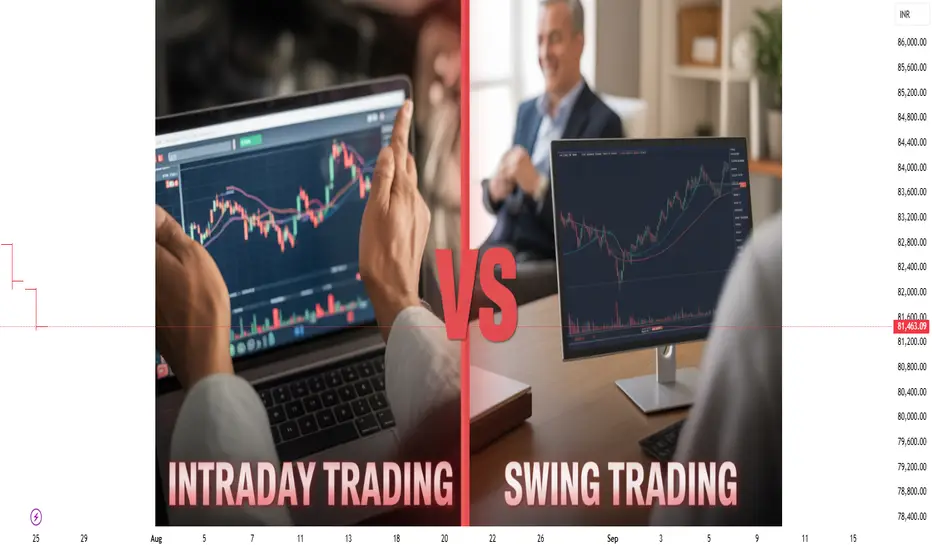
Intraday Trading vs Swing Trading🕐 1. What is Intraday Trading?
Intraday trading (also called day trading) is all about buying and selling stocks within the same day. That means you enter and exit the trade before the market closes—no matter what.
You're not holding positions overnight. You’re just capturing small price moves during the trading day.
Example:
Let’s say you buy 100 shares of Reliance at ₹2,800 at 10:00 AM and sell them at ₹2,820 by 1:30 PM. That’s an intraday trade—you made a quick profit in a few hours.
🕓 2. What is Swing Trading?
Swing trading means holding a trade for a few days to a few weeks. You’re not looking for quick moves, but for slightly longer trends in the stock price.
Swing traders try to catch a “swing” in price—that could be an upward trend or a downward trend.
Example:
Let’s say you buy HDFC Bank at ₹1,450 on Monday after seeing a bullish chart. Over the next 5 days, it moves up to ₹1,520. You sell it on Friday. That’s swing trading.
⚙️ 4. Tools & Strategies Used
🔸 Intraday Trading Tools:
5-min, 15-min candlestick charts
Indicators: VWAP, RSI, MACD, Supertrend
News-based scalping
Volume spikes
Price action patterns (breakouts, breakdowns)
🔹 Swing Trading Tools:
Daily & 1-hour charts
Indicators: RSI (14), MACD, Bollinger Bands
Chart patterns: Cup & Handle, Flag, Head & Shoulders
Support-resistance levels
Sector rotation or earning-based moves
📈 5. Pros & Cons of Intraday Trading
✅ Pros:
No overnight risk (no worries about global news hitting your stock overnight)
Frequent opportunities to make quick profits
Capital can be reused multiple times a day
Brokers offer high leverage (low capital, high exposure)
❌ Cons:
Very stressful and time-consuming
Needs fast decision-making and discipline
Big losses can happen quickly without proper stop-loss
Overtrading is a common trap
📊 6. Pros & Cons of Swing Trading
✅ Pros:
No need to watch charts all day
Ideal for people with jobs or other commitments
Less emotional pressure
More room for trend to play out
Works well in trending markets
❌ Cons:
Overnight risk from gap-ups or gap-downs
Requires patience—sometimes no trades for days
Wider stop-loss may mean higher losses if wrong
May miss fast intraday opportunities
💡 7. Who Should Choose What?
🧠 Choose Intraday Trading if:
You can dedicate 5–6 hours a day to watching the market
You are fast with decisions and execution
You can handle pressure, speed, and losses
You are ready to follow strict discipline and exit rules
You're okay with small profits (and small losses) daily
💼 Choose Swing Trading if:
You have a job or business and can't watch the market all day
You’re okay with holding stocks overnight
You prefer calm trading and less screen time
You're okay with waiting days or weeks for a trade to work out
You want to combine technical + some fundamental analysis
💸 8. Real-World Example
Imagine two friends, Rahul and Neha.
Rahul is an intraday trader. He sits in front of 3 screens from 9:15 to 3:30. He trades 5–10 times a day. Some days he makes ₹2,000, some days he loses ₹1,500. He needs to be sharp, fast, and emotionally strong.
Neha is a swing trader. She checks charts at night, finds 1–2 good stocks, and places limit orders. She holds her positions for 5–7 days. Her average profit is ₹5,000 per trade, but she takes fewer trades.
Both are traders, but with different lifestyles and psychology.
🧮 9. What About Brokerage and Tax?
Intraday trading has higher brokerage and STT (Securities Transaction Tax) due to frequent trades.
Swing trading involves delivery trades, so less brokerage but includes DP charges and short-term capital gains tax if held under 1 year.
🛠️ 10. Can You Do Both?
Yes! Many experienced traders use both styles:
Intraday for quick income and excitement
Swing for slower, more stable profits
But if you're a beginner, it’s best to pick one style and master it before mixing.
✅ Final Conclusion
There’s no winner between intraday and swing trading — both work when done with planning, discipline, and a solid strategy.
👉 Choose intraday if you enjoy speed, adrenaline, and real-time action.
👉 Choose swing if you prefer peace, patience, and flexibility.
Both require:
Risk management
Emotional control
Strategy and learning from mistakes
Your personality, time availability, and goal will tell you which path is best.
Advance Option Trading💼 Advance Option Trading
Advance Option Trading is the next level of trading options — where strategies go beyond simple buying of calls and puts. It involves using multi-leg strategies, understanding the Greeks, managing volatility, and hedging risk like professionals do.
This level of trading is used by experienced traders, institutions, and fund managers who want to take advantage of market complexity, pricing inefficiencies, and risk-reward opportunities in a calculated way.
🔧 What You Learn in Advanced Option Trading:
⚖️ Multi-leg strategies:
Spreads (Bull/Bear, Debit/Credit)
Iron Condors 🕊️, Butterflies 🦋, Straddles & Strangles 🔄
Calendar spreads 🗓️ and Diagonal spreads ➕
🧠 Options Greeks Mastery:
Delta (directional risk)
Theta (time decay)
Vega (volatility sensitivity)
Gamma & Rho (rate of change and interest rate risk)
📈 Volatility Trading:
Learn to trade Implied Volatility (IV) vs. Historical Volatility (HV)
Use volatility crush during earnings
Find edge in IV skew and term structure
🛡️ Hedging and Portfolio Management:
Use options to protect investments
Manage long-term positions with short-term trades
Build delta-neutral portfolios that profit in any direction
🧩 Why It’s Powerful:
🧮 Offers custom risk-reward setups
🔄 Allows you to profit in all market conditions (up, down, sideways)
🎯 Gives you precision control over market exposure
💰 Generates income through strategies like covered calls and credit spreads
🛡️ Helps hedge large portfolios or speculative positions safely
📌 In simple words:
Advanced Option Trading is like playing chess in the financial markets — it’s strategic, thoughtful, and designed to give you an edge over ordinary traders. You don’t just guess direction; you plan for every move the market can make.
Option Trading📘 Option Trading
Option Trading is a type of trading where you buy and sell contracts called options, instead of directly buying stocks. These contracts give you the right (but not the obligation) to buy or sell an asset at a set price within a specific time.
There are two main types:
🟢 Call Option – Right to buy the asset
🔴 Put Option – Right to sell the asset
Traders use options to:
📈 Make profits from price movements
🛡️ Hedge their investments
💰 Generate consistent income
⚖️ Manage risk with limited capital
Options are powerful because they offer leverage (small investment, big potential), but they also come with higher risks if not used carefully.
📌 In simple words:
Option Trading lets you bet on whether a stock will go up 📈 or down 📉, without owning it — and helps smart traders manage risk and reward like a pro.
Trading Master Class With Experts🎓 Trading Master Class With Experts
The Trading Master Class With Experts is a premium learning experience designed to take your trading skills to the next level by learning directly from market professionals – traders who’ve been in the game, seen the cycles, and built real strategies that work. 💼📈
In this expert-led masterclass, you will:
📊 Learn From Real Market Experts
🧠 Gain insights from institutional traders, analysts, and full-time professionals
🔍 Watch live trading sessions, analysis, and decision-making
🎯 Understand the logic behind high-probability trades
🔄 See how pros adapt to changing markets in real time
🔧 Master Advanced Trading Skills
📉 Deep dive into technical and fundamental analysis
💹 Learn options, futures, and multi-asset strategies
📍 Build a risk-managed trading system from scratch
⚙️ Use institutional tools: order flow, volume profiles, and price action
🛡️ Get Mentorship & Community
👥 Join a private trading community
💬 Get answers in live Q&A sessions
📈 Share progress, refine skills, and grow with a pro network
📌 In simple words:
The Trading Master Class With Experts is where serious traders learn the real rules of the game — directly from those who play it at the highest level.
Macro-Driven Risk Planning🔍 What is Macro-Driven Risk Planning?
At its core:
Macro-driven risk planning means managing your investment or trading risks by keeping the larger economic environment in mind.
You don’t just look at a stock or a chart — you ask:
What's happening with interest rates?
Is inflation rising or falling?
What’s the government doing with taxes or spending?
Is the US dollar strong or weak?
What are central banks like the RBI or the Federal Reserve up to?
These macroeconomic factors can make or break entire trades, portfolios, and even industries. So macro-driven risk planning is about aligning your strategies with the economic environment.
🧠 Why Is This Important?
Let’s say you’re trading in India.
If the US increases its interest rates sharply:
Foreign investors might pull money out of Indian markets.
INR might weaken.
Stock market might fall due to FII outflows.
If you're not paying attention to this macro signal, you might be trading blindly — even if your technicals are perfect.
🏦 Key Macro Factors That Drive Risk
Here’s a list of major macroeconomic indicators that smart investors and institutions track:
1. Interest Rates
Central banks (like the RBI or US Fed) control this.
📈 Rising Rates: Borrowing becomes expensive → Business slows → Markets may fall.
📉 Falling Rates: Loans become cheaper → Business expands → Markets may rise.
How to plan risk:
If rates are going up, shift from high-growth, high-debt companies to safer sectors like FMCG, pharma, utilities.
2. Inflation
This measures how fast prices are rising.
Moderate inflation = Normal
High inflation = Dangerous for consumers
Deflation = Danger of recession
Indicators: CPI (Consumer Price Index), WPI (Wholesale Price Index)
Risk Planning Tip:
In high inflation, avoid sectors that depend on raw material prices (like auto, FMCG) and look at commodities or inflation-protected assets (like gold, real estate).
3. GDP Growth (Economic Output)
Gross Domestic Product shows if the economy is expanding or shrinking.
📈 Strong GDP = Business confidence = Higher earnings
📉 Weak GDP = Caution = Lower valuations
Risk Strategy:
During GDP growth, take on slightly higher risk with cyclical stocks (like infra, banks). During slowdown, shift to defensive sectors (like pharma, IT).
4. Currency Movements (INR/USD, etc.)
Currency strength/weakness affects:
Imports/Exports
FII flows
Commodity prices (like oil)
Example: If INR weakens, oil imports become costly → Impacts inflation → May lead to rate hikes.
Plan risk: Export-based sectors (IT, pharma) benefit from weak rupee. Importers (oil, aviation) suffer.
5. Fiscal and Monetary Policies
This includes:
Government budgets (fiscal policy) – Taxes, subsidies, spending
Central bank actions (monetary policy) – Rate changes, money supply
Risk View:
A budget with heavy borrowing = inflation pressure
A tight monetary policy = reduced liquidity in markets
Keep eyes on RBI speeches, Fed meetings, union budgets.
6. Global Events
Even if you only trade in India, global news affects you:
US elections
Crude oil prices
Geopolitical tensions (e.g. China-Taiwan, Russia-Ukraine)
Supply chain issues
US Non-Farm Payroll (NFP) data
Macro-risk planning = Staying alert to these changes.
7. Bond Yields
Especially US 10-year bond yield.
Rising yield = Risk-off = Equities may fall
Falling yield = Risk-on = Equities may rise
Foreign investors use this as a guide. It directly affects FII flows.
📘 Real-Life Example: Macro Risk in Action
Case: COVID-19 Pandemic (2020)
Global economy shut down
Interest rates slashed to zero
Stimulus packages announced
Investors moved money into gold, tech stocks, pharma
Smart traders did this:
Moved into digital, pharma, and FMCG stocks
Stayed away from travel, aviation, real estate
Watched central bank actions daily
Used hedges (like buying puts or moving to cash)
This is macro-driven risk planning in real-time.
⚖️ How to Build a Macro Risk Management Plan
Here’s a step-by-step structure anyone can follow:
Step 1: Define Your Risk Tolerance
Are you a short-term trader or long-term investor?
Can you handle volatility?
Do you rely on leverage or trade with cash?
This tells you how much room you have to play with.
Step 2: Track Macro Indicators Weekly
Use sites like:
RBI website for policy updates
Trading Economics for inflation, GDP, interest rates
Bloomberg, CNBC, or Twitter for global headlines
Set alerts for:
Fed meeting dates
India CPI, GDP, IIP
Crude oil updates
Step 3: Use Hedging Tools
Advanced traders use:
Options (buying protective Puts)
Inverse ETFs (for global markets)
Gold or commodities
Diversification (across sectors, geographies)
Step 4: Stay Flexible
Macro conditions change fast. Stay open to:
Rotating your portfolio
Sitting on cash during uncertain times
Changing strategies with data, not emotions
🧭 Conclusion: Think Bigger, Trade Smarter
Macro-Driven Risk Planning is about being proactive, not reactive.
Markets aren’t moved by charts alone. They’re driven by:
Central banks
Government decisions
Global events
Economic data
So when you plan your next trade or invest in a stock, ask yourself:
“Am I moving with the economic current — or fighting against it?”
The more you understand macro trends, the better you’ll manage your risks and grow consistently.
Advance Option Trading🔶 What Is Advanced Options Trading?
Advanced Options Trading goes beyond buying and selling simple Calls and Puts. It’s about using multi-leg strategies, managing risk with precision, applying greeks and volatility, and aligning your trades with market conditions.
Advanced traders treat options like a math-based chess game. They don’t gamble—they strategize, hedge, spread, and use data-driven decisions to extract profits in all kinds of markets (bullish, bearish, sideways, volatile, calm).
🔍 Why Learn Advanced Options Trading?
While beginners just "buy options" hoping for a quick profit, advanced traders use options to:
Control risk
Earn consistent income
Capitalize on volatility
Trade sideways or range-bound markets
Create hedges for portfolios
Use smart capital deployment with defined risk
2️⃣ Implied Volatility (IV)
IV tells you how expensive or cheap options are.
📈 High IV = Options are expensive → Ideal for selling
📉 Low IV = Options are cheap → Ideal for buying
Advanced traders use:
IV Rank / IV Percentile
Volatility skew analysis
Volatility crush trades around earnings or events
3️⃣ Option Strategies
Here’s where real skills come in. Advanced trading uses multi-leg strategies to limit loss, increase odds, or make money in non-directional moves.
🔍 Strategy Example: Iron Condor
Sell 22000 CE
Sell 21800 PE
Buy 22100 CE (hedge)
Buy 21700 PE (hedge)
You’ll profit if the index stays between 21800 and 22000, and time decay works in your favor.
✅ Defined risk
✅ Limited profit
✅ Great for expiry week if market is range-bound
💹 Advanced Techniques for Smart Trading
Let’s now explore how pros operate:
🔸 A. Delta-Neutral Trading
Institutional or advanced traders often create delta-neutral positions—no directional bias.
Example:
Buy Call option (Delta +50)
Sell Put option (Delta -50)
Net Delta = 0 → Neutral. The position doesn’t care which way market moves—only volatility or time decay matters.
🔸 B. Hedging with Options
Advanced traders hedge their stock or futures positions using options.
Example:
You hold ₹5 lakh worth of Reliance shares
You buy Reliance PUT options to protect downside risk
Result? You keep profits if stock goes up and protect capital if it drops. It's like insurance.
🔸 C. Trading Earnings or Events
Options let you trade volatility, not just direction. Ahead of events like:
Earnings reports
RBI or Fed meetings
Budget announcements
You can use:
Straddles / Strangles (if expecting big move)
Iron Condors (if expecting no major move)
Calendar spreads (to exploit IV difference)
🔸 D. IV Crush Strategy
Before major events, IV rises. After the event, IV drops (called IV crush).
Advanced traders:
Sell options before events (high premium)
Buy options after IV crash (cheap premium)
They know when NOT to buy options just before news—because premium is inflated!
🔸 E. Adjusting Trades
Advanced traders don’t just “hope” for success. If a trade goes wrong, they adjust it:
Roll to a new strike
Convert from debit to credit spreads
Hedge with opposite positions
Manage Delta/Theta/Vega exposure
This proactive style protects capital and increases recovery chances.
🛠️ Tools Used by Advanced Option Traders
Opstra / Sensibull – Strategy builder, Greek analyzer
TradingView – Charting & technical levels
OI Analysis Platforms – For understanding institutional footprints
Python / Excel – Custom backtesting tools
Algo Platforms – For speed and logic-based execution
📌 Important Rules for Advanced Option Traders
Don't chase trades. Let trades come to you.
Always define risk before entering.
Use multi-leg setups, not naked options unless there's an edge.
Stay Theta positive in low volatility markets.
Only buy options when IV is low and breakout is expected.
✅ Final Thoughts
Advanced options trading is a skillset—not a shortcut.
If you:
Want consistent profits
Wish to trade like institutions
Hate gambling and want a plan
Love logic, numbers, and control
…then advanced option trading is your next big step.
It gives you the tools to win in all market types, not just trending ones.
Institutional Objectives in Options Trading🔷 What Are Institutions in the Market?
Before diving into their objectives, let’s first understand who institutions are:
Institutions are large, professional organizations that trade in the financial markets using massive amounts of capital. These include:
Mutual Funds
Hedge Funds
Pension Funds
Insurance Companies
Investment Banks
FIIs (Foreign Institutional Investors)
Proprietary Trading Firms
These players account for over 80-90% of daily turnover in options markets like NSE’s Bank Nifty and Nifty. Unlike retail traders, they don’t trade emotionally or randomly. Every move they make has a calculated reason behind it.
🎯 Why Do Institutions Use Options?
Options are powerful tools. Institutions don’t just trade them for direction; they use options to achieve multiple objectives:
✅ 1. Hedging Portfolios
🔍 Objective:
To protect their large equity/futures holdings from adverse market movements.
Institutions have huge long-term positions in stocks or indices. If the market falls sharply, these positions can suffer big losses. So, they use PUT options to hedge.
📈 Example:
A pension fund holds ₹500 crore worth of Nifty 50 stocks.
It buys Nifty 50 PUT Options at 22,000 strike.
If market crashes, the loss in stocks is offset by profit in PUTs.
📌 Result: Limited downside, peace of mind, capital protection.
✅ 2. Generating Additional Income (Option Writing)
🔍 Objective:
To generate consistent income from existing holdings through Covered Calls, Cash-secured Puts, or Iron Condors.
Institutions write options (sell) to earn premium—especially in sideways markets.
💡 Examples:
Covered Call: Own Reliance shares + Sell OTM Call option to earn income.
Short Strangles: Sell far OTM Put and Call if volatility is high.
Iron Condor: Sell call/put spreads to profit from time decay.
📌 Result: Generates passive income with controlled risk.
✅ 3. Arbitrage and Spread Trading
🔍 Objective:
To lock in risk-free or low-risk profits through price inefficiencies.
Institutions use Calendar Spreads, Box Spreads, or Volatility Arbitrage to exploit inefficiencies in option pricing.
🔧 Example:
Calendar Spread: Buy Nifty 22500 CE in August, sell Nifty 22500 CE in July.
Profit from IV differences or time decay.
📌 Result: Non-directional trading, but consistent profits with high capital.
✅ 4. Taking Directional Bets With Defined Risk
🔍 Objective:
To take high-conviction trades without exposing entire capital like futures.
Institutions use Debit Spreads, Straddles, or Long Options for directional views with limited risk.
💡 Example:
If expecting a bullish breakout, they might:
Buy 22000 CE
Sell 22200 CE
It caps both risk and profit. Perfect for risk-managed directional exposure.
📌 Result: Risk-defined entry into market trends without using futures.
✅ 5. Volatility Trading (Not Price Trading)
Institutions often trade volatility, not just price direction. They use Straddles, Strangles, Calendar Spreads to play IV.
💡 Example:
If implied volatility is low and an event is coming (like RBI policy):
Buy Straddle (ATM Call + Put)
Expect IV spike or a big move
📌 Result: Profit from volatility expansion or collapse, even if price stays in a range.
✅ 6. Managing Fund Exposure / Risk Neutralizing
Large funds have multiple exposures—options help them balance and adjust their overall risk (Delta-neutral, Vega-neutral, etc.).
They regularly:
Adjust positions using Gamma scalping
Balance portfolio Delta using options
Reduce Vega risk in high IV periods
📌 Result: A smooth, hedged, and controlled portfolio with minimal exposure to wild market moves.
✅ 7. Creating Synthetic Positions
Sometimes, instead of using equity or futures, institutions use options to replicate or create synthetic trades.
💡 Example:
Buy Call + Sell Put = Synthetic Long Future
Sell Call + Buy Put = Synthetic Short
This helps institutions:
Avoid STT, slippage
Better margin use
Higher flexibility with position sizing
📌 Result: Capital efficiency and strategic execution
📈 How to Spot Institutional Activity in Options?
You can decode institutional movement using these tools:
🔸 1. Open Interest (OI) Analysis
Spike in OI with price action = smart money at work
Build-up of OI near a strike = possible resistance/support zone
Use tools like Sensibull, Opstra
🔸 2. Volume + Price Movement
Sudden spike in volume in far OTM options = Institutional hedging or setup
Buy-Sell flow data shows positioning
🔸 3. Put-Call Ratio (PCR)
Used to detect market sentiment and institutional net positioning
🔸 4. IV Charts / Skew
Institutional volatility strategies are visible through steep IV skew or unusual IV changes
🔐 Final Thoughts
Institutional trading in options is not speculation. It is a scientific approach to manage:
Capital exposure
Risk control
Income generation
Volatility protection
Their objectives are not just to win trades, but to:
Protect capital
Optimize returns
Stay profitable in all market conditions
Advanced Option StrategiesWhat are Options?
Before we dive into advanced stuff, here’s a quick refresher.
An Option is a contract that gives you the right (but not the obligation) to buy or sell a stock/index at a certain price, on or before a certain date.
There are 2 types:
Call Option – Right to BUY
Put Option – Right to SELL
Buyers pay a premium. Sellers receive a premium and take on the obligation.
💼 Why Use Advanced Strategies?
If you only buy calls or puts, you might:
Lose 100% of your capital quickly
Get the direction right, but still lose due to time decay
Suffer from high premiums or volatility crush (IV crush)
Advanced strategies help you:
✅ Reduce risk
✅ Lock-in profits
✅ Earn from sideways markets
✅ Trade during high volatility events
✅ Create income strategies
🧠 1. Bull Call Spread – Directional but Risk-Defined
Used when: You’re moderately bullish, but don’t want to spend too much on a call.
How it works:
Buy 1 ATM Call
Sell 1 higher strike OTM Call
Example:
Nifty at 22000
Buy 22000 CE @ ₹100
Sell 22200 CE @ ₹40
Net Cost = ₹60
Max Profit: ₹200 (22200–22000) – ₹60 = ₹140
Max Loss: ₹60 (net premium paid)
👉 This strategy caps your risk and reward but is cost-efficient and smart in range-bound bull moves.
🧠 2. Bear Put Spread – Controlled Downside Betting
Used when: You’re mildly bearish and want to control losses.
How it works:
Buy 1 ATM Put
Sell 1 lower strike Put
Example:
BankNifty at 48500
Buy 48500 PE @ ₹120
Sell 48000 PE @ ₹60
Net Cost = ₹60
Max Profit: ₹500 – ₹60 = ₹440
Max Loss: ₹60
👉 Ideal for limited downside moves — cheaper than naked Put.
🧠 3. Iron Condor – The Sideways Market King
Used when: Market is flat or expected to stay in a range.
How it works:
Sell 1 OTM Call + Buy 1 higher OTM Call
Sell 1 OTM Put + Buy 1 lower OTM Put
You make money if market stays between the 2 sell strikes.
Example:
Nifty is at 22500
Sell 22800 CE, Buy 23000 CE
Sell 22200 PE, Buy 22000 PE
👉 You collect premiums from both sides.
Max Profit = Net Premium
Max Loss = Difference between strikes – Net Premium
👉 Works great in expiry week or low-volatility phases.
🧠 4. Straddle – Big Move Expected, Direction Unknown
Used when: A major move is expected (news, event, earnings), but unsure about direction.
How it works:
Buy ATM Call and ATM Put of the same strike & expiry.
Example:
Stock at ₹500
Buy 500 CE @ ₹20
Buy 500 PE @ ₹25
Total Cost = ₹45
If stock moves big — say ₹60 or more either way — you profit.
👉 High risk due to premium decay if market stays flat.
Need volatility to spike.
🧠 5. Strangle – Cheaper than Straddle, Wider Range
Used when: You expect a big move but want lower cost than a straddle.
How it works:
Buy OTM Call and OTM Put (strikes wider apart than ATM).
Example:
Nifty at 22500
Buy 22800 CE @ ₹12
Buy 22200 PE @ ₹10
Total Cost = ₹22
You profit if the move crosses either strike + premium.
👉 Needs bigger move than straddle but less premium at risk.
🧠 6. Calendar Spread – Play with Time
Used when: You expect price to stay near a level short term, but may move later.
How it works:
Sell near-term option
Buy far-term option (same strike)
Example:
Sell 22500 CE (weekly) @ ₹50
Buy 22500 CE (monthly) @ ₹70
Net Cost = ₹20
👉 You make money if price stays near 22500 by expiry of short leg.
Profits from time decay of the short leg.
🧠 7. Ratio Spreads – Advanced Directional with a Twist
Used when: You expect a move in one direction, but want to reduce cost.
Bull Call Ratio Spread
Buy 1 lower Call
Sell 2 higher Calls
Example:
Buy 22000 CE @ ₹100
Sell 2× 22200 CE @ ₹60 each
Net Credit = ₹20
If market moves moderately up — you profit.
But if it rises too fast — risk increases.
👉 Suitable for experienced traders only — manage risk carefully.
🧠 8. Covered Call – Income Strategy for Investors
Used when: You hold stocks and want to earn extra income.
How it works:
Hold 100 shares of a stock
Sell 1 OTM Call
Example:
You own 100 shares of Reliance @ ₹2500
Sell 2600 CE @ ₹20
If Reliance stays below ₹2600, you keep the premium.
If it rises above ₹2600, your shares get sold, but you still profit.
👉 Perfect for long-term investors.
🧠 9. Protective Put – Insurance for Your Stock
Used when: You own shares but want downside protection.
How it works:
Hold stock
Buy 1 ATM/OTM Put
Example:
Own Infosys @ ₹1500
Buy 1480 PE @ ₹20
If stock falls below ₹1480, your loss is capped.
👉 It’s like buying insurance for your portfolio.
🧠 10. Butterfly Spread – Range-Bound Precision Strategy
Used when: You expect minimal movement and want low-risk, high-RR trade.
How it works (Call Butterfly):
Buy 1 lower strike Call
Sell 2 middle strike Calls
Buy 1 higher strike Call
Example:
Buy 22000 CE
Sell 2× 22200 CE
Buy 22400 CE
You earn if market expires at the middle strike.
Max loss = Net debit
Max profit = At middle strike
👉 Best for expiry day premium decay strategies.
Common Mistakes to Avoid
Not understanding strategy risk
Using high-margin strategies without protection
Overtrading in expiry week
Not adjusting trades as market moves
Ignoring volatility impact (IV crush)
🛠 Tools to Use
Option Chain (for strike selection)
IV (Implied Volatility) data
Open Interest (OI)
Strategy Builder platforms (e.g. Sensibull, Opstra, or TradingView)
🎯 Final Thoughts
Advanced options trading isn’t gambling — it’s about smart risk management.
These strategies:
Give you control
Limit losses
Provide flexibility across different market types
Learn Institutional Trading📌 What is Institutional Trading?
Institutional trading refers to trading done by large financial organizations like:
Hedge Funds
Mutual Funds
Foreign Institutional Investors (FIIs)
Domestic Institutional Investors (DIIs)
Insurance Companies
Proprietary Trading Firms (Prop Desks)
Investment Banks
🧭 Why Should You Learn Institutional Trading?
Most retail traders:
Enter trades based on emotions or random indicators
Chase price or react late
Trade without understanding who controls the market
But institutions:
Trade with logic, precision, patience, and volume
Follow clear rules based on liquidity, risk, and timing
Use data-driven strategies and structure-based entries
Learning institutional trading means:
✅ You no longer follow retail traps
✅ You align your trade with the market’s real direction
✅ You understand where and why price truly moves
🧱 Key Concepts to Learn in Institutional Trading
1. Market Structure (MS)
Institutional traders analyze price based on structure, not indicators.
They study:
Higher Highs / Higher Lows (HH/HL)
Lower Highs / Lower Lows (LH/LL)
Break of Structure (BOS)
Change of Character (CHOCH)
💡 Pro Tip: Price never moves randomly — it follows structure. Learning how price breaks previous structure shows when the trend is shifting.
2. Liquidity & Smart Money Concepts
Institutions need liquidity to place big orders. So, they look for:
Retail stop-loss zones
Breakout traders’ entries
Obvious support/resistance
Then, they:
Create fake breakouts to grab liquidity
Enter in the opposite direction
Leave behind “footprints” like Order Blocks or FVGs
📌 Important Concepts:
Liquidity Pools
Inducement Zones
Order Blocks (last candle before the move)
Fair Value Gaps (FVG)
Mitigation Zones
📊 Institutions don’t chase price — they manipulate it. Learn to trade where they are entering, not where retailers are exiting.
3. Volume Analysis & Order Flow
Institutions trade with massive capital, so their footprints show up in:
Volume spikes
Imbalance between buyers/sellers
Absorption (when large orders block the market)
Rejections at key zones
🔧 Tools used:
Volume Profile
Delta Volume / Footprint Charts
VWAP (Volume Weighted Average Price)
4. Options Data & Open Interest (OI)
Institutions use option chains to trap or hedge retail participants. They track:
Open Interest Build-up (Call or Put side)
Max Pain Level (where most options lose value)
Put/Call Ratio (PCR)
Option Writers’ Zone (where institutions want expiry)
💡 Example: If 80% OI is built on 22,000CE and price is near it, chances are high that institutions will protect that zone and keep price below it.
5. Institutional Tools & Analysis
Institutions use:
Multi-Timeframe Analysis (MTA)
News + Event Flow
Economic data + earnings
Position sizing based on volatility
Algo-driven execution
Retail traders often focus only on technical indicators — institutions use a combination of fundamentals, sentiment, macroeconomics, and flow.
🧠 Skills Needed to Trade Like Institutions
Chart Reading Without Indicators
Master price action
Understand structure, CHOCH, BOS
Supply and Demand Zone Identification
Mark strong OBs (Order Blocks)
Confirm with imbalance or FVG
Liquidity Mapping
Where will retail place SL?
What’s the inducement?
Volume + OI Reading
Use OI charts to avoid traps
Match price with volume for confirmations
Emotional Discipline
Trade with confidence
Trust your setup — not noise or tips
Risk Management
Fixed % per trade (0.5% to 1%)
SL below valid structure
📈 Example of an Institutional Setup (Bank Nifty)
Structure: Market is in a strong uptrend (HH-HL forming)
Liquidity: Price dips below previous swing low — stop-hunt likely
Order Block: 15-minute bullish OB forms with FVG
Volume: Spike seen + high OI on 49,500 PE
Entry: Bullish candle close in OB
SL: Just below OB
Target: Next liquidity zone or supply area
🔁 RR Ratio: 1:3 or better
🛠️ Tools You Can Use to Learn Institutional Trading
TradingView – Charting, structure, OBs
Chartink / Trendlyne – Option OI analysis
Sensibull / Obstra / Quantsapp – Option strategy + data
Volume Profile – Spot accumulation/distribution
ForexFactory / Investing.com – Economic calendar
Smart Money YouTube / Discord / Telegram Groups – Practice setups
🧩 Step-by-Step Plan to Learn Institutional Trading
Foundation: Learn market structure + price action
Deep Dive: Understand liquidity & smart money concepts
Tools Mastery: Volume, VWAP, OI, Option Chain
Live Practice: Backtest institutional setups
Risk System: Use proper SL, position sizing, and journaling
Mindset: Stay patient and emotion-free
Repeat: Improve setup confidence & refine edge
🚀 Final Thoughts: Trade Like an Institution, Not a Retailer
If you trade based on what’s obvious — you’re likely wrong.
If you trade based on what’s behind the move — you trade like the pros.
Institutional trading is not about complexity.
It’s about thinking ahead, managing risk, and waiting for real opportunities — not noise.
Trading Master Class With Experts🎯 Objective of the Master Class
To turn intermediate or beginner traders into independent, high-probability traders.
To teach institutional strategies, advanced technical analysis, and options trading mechanics in a structured manner.
To prepare you to read price action, understand market psychology, and act with professional-level discipline.
🧑🏫 Who Are the Experts?
The instructors in a true master class are:
Institutional Traders
Full-time Professional Derivatives Traders
Algo Strategists
Portfolio Managers
Ex-Prop Desk Heads or FIIs Participants
These experts bring real P&L experience, not just theoretical certifications. They share their actual setups, mental models, risk frameworks, and do’s and don’ts from years of screen time.
📦 What You Will Learn – Detailed Modules
Module 1: Market Structure Mastery
Institutional order flow
Supply-demand vs. retail S/R
Liquidity traps and smart money movement
Module 2: Price Action + Volume Profiling
Multi-timeframe analysis
Candle psychology + Volume interpretation
How institutions "hide" their entries
Module 3: Advanced Options Trading
Intraday & positional strategies
Greeks mastery: Delta, Vega, Theta, Gamma
Hedging tactics used by professionals
Nifty & Bank Nifty strategy building
Module 4: Institutional Strategy Replication
Intraday straddle/strangle writing
IV crush exploitation during events
Option chain decoding for retail edge
Module 5: Trade Management & Psychology
Risk per trade, max drawdown, win/loss ratio
Building discipline like a hedge fund
Overcoming emotional sabotage in trading
Module 6: Live Market Sessions
Daily planning with expert insights
Live trades with explanation
Review of success/failure transparently
⚙️ Tools & Platforms You’ll Use
Option Chain Analyzers (like Sensibull, Opstra, or Greek tools)
TradingView & charting setup with expert templates
Journaling tools (Edgewonk, Notion)
Algo tools (optional module)
🧩 Who Should Join?
✅ Aspiring Traders (with some basic knowledge)
✅ Traders struggling with consistency
✅ Intraday or options traders wanting a structured framework
✅ Professionals looking to shift to full-time trading
✅ Students of finance or markets seeking practical skills
🏆 Key Benefits
Real strategies shared by real traders
Mentorship: Learn not just from books, but from mistakes and success of mentors
Live sessions to build confidence under pressure
Lifetime recording access in most premium programs
Community access for continuous growth & trade sharing
💼 Career & Income Impact
After attending this masterclass, traders often:
Gain clarity on their trading edge
Improve win-rate and risk-adjusted returns
Start coaching others or creating communities
Join or create proprietary trading setups
📅 Duration & Format
Duration: 1 Week to 6 Weeks (varies by provider)
Format: Live Zoom + Recorded + Assignments
Support: Telegram/Slack group, weekly Q&A, live trading calls
🔚 Final Thoughts
The “Trading Master Class with Experts” is not just another online program. It's a live, applied, market-tested mentorship where real experts guide you step-by-step in mastering trading psychology, strategy, and discipline.
If you're serious about scaling your trading journey, this is the fastest shortcut to reach professional-level execution and understanding.
Institution Option Trading🏢 Who Are These Institutions?
Institutions involved in option trading include:
🏦 Hedge Funds
🏢 Proprietary (Prop) Trading Firms
💼 Investment Banks
🌍 FIIs/DIIs
🧠 Pension Funds & Insurance Companies
They trade options across equities, indices (like Nifty/Bank Nifty), commodities, and currencies, often managing portfolios worth hundreds of crores.
🔍 Institutional Option Trading Strategies
1. Delta Neutral Strategy (Market-Neutral)
Example: Sell ATM straddle and hedge with futures.
Objective: Profit from time decay (theta) while keeping position neutral to price movement.
2. Volatility Arbitrage
Institutions bet on difference between implied and actual volatility.
Buy options when IV is low, sell when IV is high.
3. Calendar Spreads
Sell near expiry option, buy longer expiry of the same strike.
Used when institutions expect IV to rise but minimal short-term price movement.
4. Iron Condors and Butterflies
Multi-leg strategies for range-bound markets.
Used with large capital to generate steady income with limited risk.
5. Protective Puts / Covered Calls
Portfolio hedging: buy puts to protect against downturns, sell calls to earn extra income.
Very common among mutual funds and long-term portfolios.
📈 Option Chain Reading – Institutional Footprint
When institutions enter or adjust option positions, they leave footprints in the option chain. You can spot them by watching:
Sudden spike in OI (Open Interest) at specific strikes
Sharp rise in IV without much price movement
Heavy Put or Call writing near resistance/support zones
Unusual option activity (UOA) before key events
⚠️ How Retail Traders Can Learn From Institutional Option Trading
Track Option Chain + OI Changes Daily
Learn to Read Greeks Before Taking a Trade
Watch How IV Shifts Before & After Events
Backtest Simple Institutional Strategies (e.g. ATM Straddles)
Focus on Consistency and Capital Protection
🛑 Common Retail Mistakes in Options (Avoided by Institutions)
Buying deep OTM options blindly
Overtrading in low-volume strikes
Selling naked options without hedge
Ignoring IV or theta decay
Trading without stop-loss or adjustment plans
🧘 Conclusion: Why Mastering Institutional Option Trading Matters
Understanding how institutions trade options allows you to:
✅ Avoid emotional traps
✅ Trade with the flow of smart money
✅ Use real risk management
✅ Build income and protection strategies
✅ Improve win-rate and longevity in trading