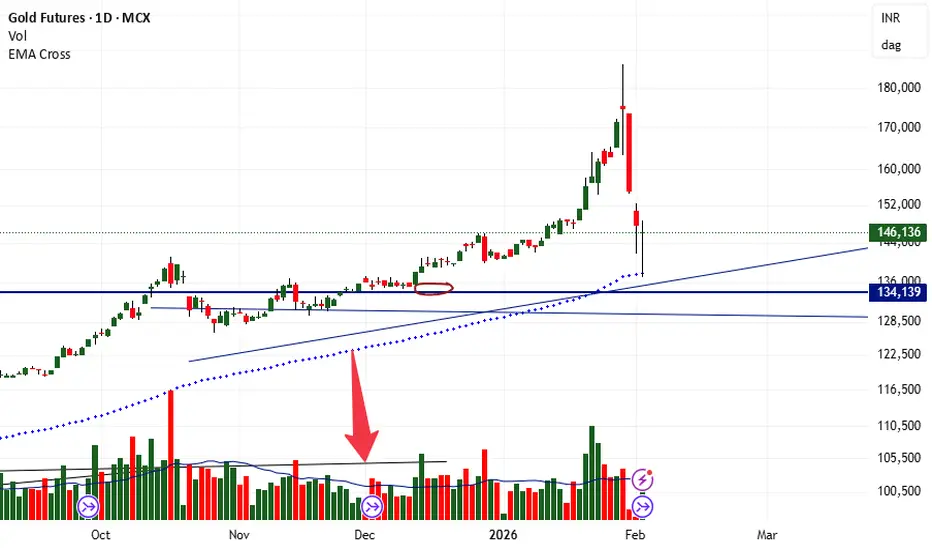
Just an explanation on 15min1. Market Context: A Year of Record Highs
This chart captures Gold during a historic period. By late December 2025, Gold had surged approximately 70% year-to-date, repeatedly hitting new all-time highs.
Fundamental Drivers: The rally was fueled by escalating geopolitical risks (specifically US-Vene
Futures market
Gold 15-Min Chart: Previous Support should act as Resistance nowHello everyone, Guy's Gold has made a sharp recovery after the recent drop, but i am expecting gold should take resistance in this area. This level has already shown rejection in the past, making it a critical decision area for the market.
The rejection near this zone suggests that sellers are stil
Gold (XAUUSD): RSI Cooling Is Not WeaknessGold’s recent price action may appear volatile on lower timeframes, but structurally the market is behaving exactly as a healthy trend should. The current pause is not a sign of exhaustion — it is a necessary reset within a larger impulsive advance.
The Bigger Picture: Trend Comes First
From the
XAU/USD – Strong Bullish Expansion, Focus on Pullback BuysMarket Context
Gold has delivered a strong bullish expansion after breaking out of the previous consolidation range. The impulsive move confirms aggressive buy-side participation, suggesting that the market is now in a trend-continuation phase rather than distribution.
From a macro perspective, ex
Gold Trading Strategy for 23rd December 2025🟡 GOLD TREND TRADING PLAN ($)
📈 BUY SETUP
🟢 Entry:
Buy only if the 1-Hour candle closes above 4483
🎯 Targets:
T1: 4494
T2: 4505
T3: 4518
🛑 Stop-Loss:
Below 1-Hour candle low
Or fixed SL: 4468
📉 SELL SETUP
🔴 Entry:
Sell only if the 1-Hour candle closes below 4410
🎯 Targets:
T1: 4395
T2: 4380
T3: 43
Gold 1H – Traps form near 4500–4420.Gold 1H – Liquidity Compression Sets Traps Around 4500–4420
🟡 XAUUSD – Intraday Smart Money Plan | by Ryan_TitanTrader (23/12)
📈 Market Context
Gold is trading inside a strong bullish structure after a clean impulsive expansion, currently hovering in a premium zone near recent highs. With pric
US OIL Intraday AnalysisOverview: WTI has rebounded sharply from the lower channel support near 55.00, forming a short-term base and printing higher lows. Price is now reclaiming the mid-Bollinger band around 57.00, indicating improving bullish momentum. A sustained move above 57.50 can open upside toward 58.10–58.50 resis
Xagusd SilverXagusd chart Analysis .........24/12/2025
The XAGUSD XABCD harmonic target is at the 73.4 level. You can book your profits here, and if a reversal candle forms, you can also consider taking a short position with a stop-loss above the high of that candle.
ENJOY !
Note: This is my analysis for educ
See all popular ideas
Quotes
Futures collections
Frequently Asked Questions
A futures contract is a legal agreement to buy or sell an asset (such as a commodity or security) at a set price on a specific future date. The buyer agrees to purchase and receive the asset when the contract expires, while the seller agrees to deliver it at that time.
Most futures contracts are traded through centralized exchanges like the Chicago Board of Trade and the Chicago Mercantile Exchange (CME). But there's no need to leave TradingView to trade futures — you can do it right from your charts. Just check out the list of our integrated brokers and find the best one for your needs and strategy.
Before you start, it's crucial to do you research: perform technical analysis on the chart, evaluate risks, and test your strategy.
Energy futures are contracts tied to energy commodities — they're aimed at facilitating the trading of specific quantities of crude oil, natural gas, gasoline, etc. Energy futures allow producers, consumers, and traders to manage price volatility in energy markets or capitalize on future price movements.
Explore a wide range of energy futures with detailed stats directly on TradingView.
Agricultural futures are derivative contracts with agricultural commodities (wheat, corn, soybeans, etc.) as the underlying. They're widely used to trade standardized quantities of commodities, allowing farmers, food producers, and traders to hedge against price fluctuations or to profit from expected price changes in the agricultural market.
Browse a full list of agricultural futures with detailed stats directly on TradingView.
Futures market is a bustling place with many interested parties. Here are some key participants to keep in mind:
- Hedgers (traders using futures to protect their existing positions or trades from risk caused by market volatility or direction)
- Speculators (traders executing trades based on their price predictions)
- Arbitrageurs (traders trying to win from market inefficiency and price difference by buying and selling the underlying in different markets)
- Institutional investors
- Retail investors
- Hedgers (traders using futures to protect their existing positions or trades from risk caused by market volatility or direction)
- Speculators (traders executing trades based on their price predictions)
- Arbitrageurs (traders trying to win from market inefficiency and price difference by buying and selling the underlying in different markets)
- Institutional investors
- Retail investors
Futures markets are platforms where traders gather to buy and sell futures contracts. In the past, trading was performed physically: traders would come to a 'pit' in the trading floor and conduct trading by shouting and actively gesturing. But today, this is all done electronically.
In a futures market, buyers and sellers post margin to secure their positions, and profits or losses are settled daily through mark-to-market. At expiration, contracts are settled in cash or through physical delivery, though most traders close positions beforehand. Since futures offer flexibility and leverage, futures markets attract diverse participants: hedgers, speculators, arbitrageurs, institutional and retail investors.
Some of the largest futures markets today are the New York Mercantile Exchange (NYMEX), the Chicago Mercantile Exchange (CME), the Chicago Board of Trade (CBoT), and the Cboe Options Exchange (Cboe). They're registered with the Commodity Futures Trading Commission (CFTC), the main body in charge of futures markets regulation in the US. In other countries, futures markets are regulated by a corresponding national body.
In a futures market, buyers and sellers post margin to secure their positions, and profits or losses are settled daily through mark-to-market. At expiration, contracts are settled in cash or through physical delivery, though most traders close positions beforehand. Since futures offer flexibility and leverage, futures markets attract diverse participants: hedgers, speculators, arbitrageurs, institutional and retail investors.
Some of the largest futures markets today are the New York Mercantile Exchange (NYMEX), the Chicago Mercantile Exchange (CME), the Chicago Board of Trade (CBoT), and the Cboe Options Exchange (Cboe). They're registered with the Commodity Futures Trading Commission (CFTC), the main body in charge of futures markets regulation in the US. In other countries, futures markets are regulated by a corresponding national body.
Open interest is the total number of active futures contracts that haven’t been closed or expired. It reflects how much interest or participation exists in a market.
Traders use open interest to gauge market strength. For example, declining open interest often signals that traders are closing positions — a possible sign of a weakening trend.
Futures prices are mainly driven by supply and demand, economic indicators, and central bank policies. Disruptions like droughts or geopolitical tensions can affect supply, while inflation or interest rate changes shape investor expectations. These shifts influence how traders value future prices relative to current conditions.
Market sentiment and speculation also play a big role, with traders often reacting to news or forecasts before fundamentals change. Factors like storage costs, inventory levels, and contract expiration impact pricing too, especially in commodities. Seasonal trends, government policies, and even new technologies can further sway futures markets.
It's always best to test you skills in futures trading before going to the real markets. You can do it right on TradingView thanks to our Paper Trading functionality — just find the Paper trading icon on the trading panel and put your ideas to the test. You can also check out our Bar Replay feature — it simulates past price movements for strategy testing.