Every Trader Has a Profitable Setup-Few Have the Mind to ExecuteHello Traders!
Most traders spend years searching for the perfect strategy.
They change indicators, timeframes, mentors, and markets again and again.
But here’s the uncomfortable truth most people avoid:
The problem is rarely the setup.
The problem is execution.
1. A Good Setup Is Useless Without Discipline
Many traders already have a setup that works on paper.
Backtesting shows profits, but live trading tells a different story.
Why? Because discipline disappears when real money is on the line.
A setup only works when it is followed exactly as designed.
2. Fear and Doubt Kill Execution
Fear makes traders exit early.
Doubt makes traders skip valid entries.
Overthinking makes traders add unnecessary confirmations.
The setup did not fail.
The mind interfered.
3. Traders Change Strategies to Escape Responsibility
After a loss, it feels easier to blame the strategy.
Switching setups feels productive, but it avoids the real issue.
Consistency cannot be built on constant change.
Execution improves only when responsibility is accepted.
4. The Market Rewards Repetition, Not Intelligence
You do not need to be smarter than the market.
You need to execute the same rules again and again.
Edge comes from repetition, not creativity.
Professional traders win because they do fewer things, not more.
5. The Real Edge Is Psychological Stability
Sticking to rules during losing streaks.
Not increasing risk after winning streaks.
Treating every trade as just one of many.
This is what separates consistent traders from emotional traders.
Rahul’s Tip:
Before searching for a new strategy, ask yourself one honest question:
“Did I execute my current setup exactly as planned for the last 50 trades?”
Most traders already know the answer.
Conclusion:
Every trader eventually finds a setup that can make money.
Very few traders develop the mindset required to execute it calmly, repeatedly, and without emotion.
Profitability begins the day you stop changing strategies and start mastering execution.
If this post resonated with your trading journey, like it, share your thoughts in the comments, and follow for more mindset driven trading education.
Community ideas
Inflation Nightmare Continues1. Understanding the Inflation Nightmare
Inflation refers to a sustained rise in the general price level of goods and services, reducing the purchasing power of money. When inflation remains high for a prolonged period and becomes difficult to control, it turns into an “inflation nightmare.” This nightmare is characterized by persistent cost pressures, declining real incomes, policy dilemmas, and economic uncertainty. In many economies, inflation has stopped being a short-term shock and has become a structural problem, affecting households, businesses, and governments alike.
2. Persistent Rise in Cost of Living
One of the most visible effects of continuing inflation is the relentless rise in the cost of living. Prices of essential items such as food, fuel, housing, healthcare, and education continue to increase faster than income growth. Middle-class and lower-income households suffer the most, as a larger portion of their earnings goes toward necessities. Even salaried individuals with stable jobs find it increasingly difficult to maintain their previous standard of living.
3. Erosion of Purchasing Power
High inflation steadily erodes purchasing power. Money saved today buys fewer goods and services tomorrow. Fixed-income groups such as pensioners, retirees, and low-wage workers are hit hardest because their incomes do not adjust quickly to rising prices. Over time, this erosion discourages savings and pushes people toward risky investments just to preserve wealth.
4. Food Inflation and Supply-Side Pressures
Food inflation plays a central role in prolonging the inflation nightmare. Factors such as climate change, erratic monsoons, droughts, floods, rising fertilizer costs, and supply chain disruptions push food prices higher. Since food constitutes a significant share of household expenditure, especially in developing economies, even moderate food inflation causes severe social and political stress.
5. Energy Prices and Fuel Shock
Energy prices remain a major driver of inflation. Rising crude oil, natural gas, and electricity costs increase transportation, manufacturing, and logistics expenses. These higher input costs are passed on to consumers, creating second-round inflation effects. Fuel inflation also affects public transport fares and freight costs, amplifying price pressures across the economy.
6. Global Factors Fueling Inflation
The inflation nightmare is not limited to one country; it is global in nature. Geopolitical conflicts, trade disruptions, sanctions, and de-globalization trends have increased the cost of imports and reduced supply efficiency. Currency depreciation in emerging markets further worsens inflation by making imported goods more expensive, particularly energy and technology-related products.
7. Wage-Price Spiral Risk
As inflation persists, workers demand higher wages to cope with rising living costs. While wage hikes are necessary for survival, they can lead to a wage-price spiral. Businesses facing higher wage bills raise product prices, which in turn triggers fresh wage demands. This self-reinforcing cycle makes inflation harder to control and prolongs the nightmare.
8. Impact on Businesses and Profit Margins
Businesses face rising input costs, higher borrowing rates, and uncertain demand. Small and medium enterprises (SMEs) are particularly vulnerable because they have limited pricing power and thinner margins. Many companies are forced to either reduce output, compromise on quality, or pass costs onto consumers, further fueling inflationary pressures.
9. Central Bank Policy Dilemma
Central banks play a critical role in fighting inflation, but persistent inflation puts them in a policy dilemma. Raising interest rates helps control inflation but slows economic growth, increases unemployment, and raises borrowing costs. Keeping rates low supports growth but risks allowing inflation to spiral out of control. This delicate balance makes policy decisions more complex and politically sensitive.
10. High Interest Rates and Borrowing Stress
To curb inflation, central banks often increase interest rates. While this helps cool demand, it also raises EMIs on home loans, personal loans, and business credit. Households delay spending, and companies postpone expansion plans. High interest rates can eventually lead to economic slowdown or even recession, deepening public anxiety.
11. Government Fiscal Challenges
Inflation increases government expenditure on subsidies, welfare schemes, and interest payments on debt. At the same time, governments face pressure to reduce taxes or provide relief to citizens. Balancing fiscal discipline with social support becomes increasingly difficult, especially for developing economies with limited resources.
12. Rising Inequality
Persistent inflation worsens income and wealth inequality. Wealthier individuals often hold assets like real estate, equities, or commodities that appreciate with inflation, while poorer households rely on cash incomes and savings that lose value. As a result, the gap between rich and poor widens, leading to social tension and dissatisfaction.
13. Decline in Consumer Confidence
When inflation remains high, consumer confidence weakens. People become cautious, postpone discretionary spending, and focus only on essentials. Reduced consumption affects business revenues, slows economic growth, and increases the risk of stagflation—a situation where high inflation coexists with low growth.
14. Impact on Financial Markets
Inflation uncertainty creates volatility in financial markets. Equity markets struggle as higher interest rates reduce corporate earnings valuations. Bond prices fall as yields rise. Investors constantly rebalance portfolios to hedge against inflation, often favoring commodities, gold, or inflation-protected assets, which further shifts capital flows.
15. Long-Term Economic Damage
If the inflation nightmare continues unchecked, it can cause long-term economic damage. Investment slows, productivity growth weakens, and innovation suffers. Economic planning becomes difficult for both households and businesses, reducing overall efficiency and confidence in the system.
16. Psychological and Social Stress
Beyond economics, inflation creates psychological stress. Constant worry about rising expenses affects mental health, family stability, and social harmony. Public frustration often manifests in protests, political pressure, and demands for policy changes, increasing social instability.
17. The Road Ahead
Ending the inflation nightmare requires coordinated efforts. Structural reforms, supply-side improvements, stable monetary policy, fiscal discipline, and global cooperation are essential. Short-term relief measures must be balanced with long-term solutions to ensure sustainable price stability without sacrificing growth.
18. Conclusion
The continuation of the inflation nightmare is one of the most pressing challenges facing modern economies. It affects every layer of society—from households and businesses to governments and financial markets. Persistent inflation erodes purchasing power, fuels inequality, distorts investment decisions, and creates policy dilemmas. Addressing it requires patience, credibility, and well-coordinated economic strategies. Until inflation is firmly under control, the nightmare remains far from over.
Overtrading Gold – Biggest Account KillerOvertrading Gold – Biggest Account Killer
🧠 What Overtrading REALLY Means in Gold
Overtrading is not just trading too often — it’s trading without edge, patience, or contextual alignment.
In XAUUSD, overtrading usually looks like:
Multiple entries in the same range
Chasing price after impulsive candles
Trading every wick, every breakout, every news spike
📌 Gold gives the illusion of opportunity every minute — but institutions trade very selectively.
🧨 Why Gold Is the Perfect Trap for Overtraders
Gold is engineered (by behavior, not conspiracy) to punish impatience 👇
🔥 Extreme volatility
🔥 Fast candles & long wicks
🔥 Sudden reversals
🔥 News-driven manipulation
🔥 Liquidity sweeps above & below range
💣 Result?
Retail traders feel forced to trade — and end up trading against structure and liquidity.
🧩 The Overtrading Cycle (Account Destruction Loop)
Most gold traders repeat this cycle unknowingly ⛓️
1️⃣ Enter early (no confirmation)
2️⃣ Stop-loss hit by wick
3️⃣ Re-enter immediately (revenge)
4️⃣ Increase lot size
5️⃣ Ignore bias & HTF context
6️⃣ Emotional exhaustion
7️⃣ Big loss → account damage
📉 This cycle has nothing to do with strategy — it’s pure psychology.
🧠 Why Strategy Stops Working When You Overtrade
Even a 60–70% win-rate strategy will fail if:
❌ Trades are taken outside optimal time
❌ Entries ignore higher-timeframe direction
❌ Risk increases after losses
❌ Rules are bent “just this once”
📌 Gold exposes discipline weakness faster than any other market.
⏰ Time Is the Hidden Edge in Gold
Gold does NOT move efficiently all day ⏱️
🟡 Asian Session → Range & traps
🟡 London Open → Liquidity grab
🟢 New York Session → Real direction
Overtraders:
❌ Trade Asian noise
❌ Enter mid-range
❌ Chase NY expansion late
Smart traders:
✅ Wait for liquidity first
✅ Trade after manipulation
✅ Enter once direction is clear
📉 Statistical Damage of Overtrading
Let’s talk numbers 📊
🔻 More trades = more spread & commission
🔻 Lower average R:R
🔻 Lower win probability
🔻 Higher emotional stress
🔻 Faster drawdowns
💡 One A-grade setup can outperform 10 random gold trades.
🧠 Psychology: The Real Root Cause
Overtrading is driven by internal pressure 👇
😨 Fear of missing out
😡 Anger after stop-loss
😄 Overconfidence after win
😴 Boredom during ranges
Gold feeds emotions — and then punishes them.
📌 Institutions wait. Retail reacts.
🛑 How Professionals Control Overtrading
Real solutions — not motivational quotes 👇
✅ Maximum 1–2 trades per session
✅ Trade only at predefined time windows
✅ Fixed risk per trade (no exceptions)
✅ Daily stop after 2 losses max
✅ Journal every impulsive entry
📘 If it’s not planned before price moves, it’s emotional.
🏆 Golden Rule of XAUUSD
💎 Gold is not hard because it’s random
💀 Gold is hard because it exposes impatience
You don’t need more trades.
You need more discipline.
📌 Final Truth
Most XAUUSD accounts don’t blow because of:
❌ Bad indicators
❌ Bad analysis
❌ Bad strategy
They blow because of overtrading driven by emotion.
📉 Overtrading is the biggest account killer in gold trading.
Option Trading Strategies Basic Directional Option Strategies
1.1 Long Call Strategy
A long call involves buying a call option with the expectation that the underlying asset will rise significantly before expiration.
Market View: Bullish
Risk: Limited to premium paid
Reward: Unlimited
Best Used When: Strong upward momentum is expected
This strategy benefits from rising prices and increasing volatility. Time decay works against the buyer, so timing is crucial.
1.2 Long Put Strategy
A long put involves buying a put option expecting the price to fall sharply.
Market View: Bearish
Risk: Limited to premium paid
Reward: Substantial if price falls sharply
Best Used When: Strong downtrend or breakdown expected
Long puts are also used as insurance against falling markets.
Part 2 Ride The Big Moves Risk Management in Option Trading
Successful option trading depends heavily on risk management:
Position sizing
Defined stop-loss
Avoid over-leveraging
Understand implied volatility
Trade liquid instruments
Never risk large capital on naked option selling without protection.
Part 10 Trade Like Institutions Role of Option Greeks
Option Greeks help traders measure risk:
Delta: Sensitivity to price movement.
Gamma: Rate of change of delta.
Theta: Impact of time decay.
Vega: Sensitivity to volatility.
Rho: Sensitivity to interest rates.
Understanding Greeks enables better strategy selection and position adjustment.
Part 9 Trading master ClassRisk Management in Option Trading
Successful option traders focus heavily on risk control:
Use defined-risk strategies.
Limit position size per trade.
Avoid overleveraging.
Understand option Greeks (Delta, Gamma, Theta, Vega).
Maintain discipline with stop-loss and exit rules.
Risk management is often more important than strategy selection.
Part 8 Trading Master Class Rewards of Option Trading
Despite risks, options offer compelling advantages:
a) Limited Risk (for Buyers)
Option buyers know their maximum loss upfront—the premium paid.
b) High Return Potential
Small price movements in the underlying can result in substantial percentage gains.
c) Income Generation
Option sellers can generate consistent income through strategies like covered calls and iron condors.
d) Flexibility
Options allow traders to profit in bullish, bearish, or range-bound markets.
e) Capital Efficiency
Options require lower capital compared to buying underlying assets outright.
Part 7 Trading Master ClassIntermediate Strategies
1. Bull Call Spread
Buying a call at a lower strike and selling another at a higher strike. This reduces cost but limits maximum profit.
2. Bear Put Spread
Buying a higher strike put and selling a lower strike put. It profits from moderate downside movement with controlled risk.
3. Straddle
Buying a call and a put at the same strike and expiry. This strategy profits from high volatility regardless of direction.
4. Strangle
Similar to a straddle but uses different strike prices, making it cheaper but requiring larger price movement.
Part 6 Institutional Trading Common Option Trading Strategies
a) Basic Strategies
1. Long Call
Used when a trader expects strong upside movement. Risk is limited to the premium paid, while reward potential is theoretically unlimited.
2. Long Put
Used when expecting a sharp decline. Risk is limited to the premium, and profits increase as the underlying falls.
3. Covered Call
Involves holding the underlying stock and selling a call option. It generates regular income but caps upside potential.
4. Protective Put
Buying a put option against an existing long position. This acts as insurance, limiting downside risk.
Part 4 institutional Trading Why Traders Use Options
Option trading serves multiple purposes:
Speculation: Leveraged bets on price direction.
Hedging: Protecting portfolios against adverse price movements.
Income Generation: Earning premiums through option selling.
Risk Management: Structuring trades with defined risk and reward.
Because options can be combined in various ways, traders can design strategies suited for bullish, bearish, or sideways markets.
Part 3 Institutional Trading Understanding Option Trading
An option is a derivative financial contract that gives the buyer the right, but not the obligation, to buy or sell an underlying asset (such as stocks, indices, commodities, or currencies) at a predetermined price (strike price) on or before a specific date (expiry date).
There are two main types of options:
Call Option: Gives the right to buy the underlying asset at the strike price.
Put Option: Gives the right to sell the underlying asset at the strike price.
The buyer pays a premium to the option seller (writer). This premium represents the maximum loss for the buyer and the maximum gain for the seller.
Key components of options include:
Underlying Asset
Strike Price
Expiry Date
Premium
Lot Size
Intrinsic Value and Time Value
Options derive their value from price movement, volatility, time decay, and interest rates, making them multi-dimensional instruments.
Retail Trading vs Institutional Trading1. Who Are Retail Traders?
Retail traders are individual participants who trade financial instruments such as stocks, commodities, forex, cryptocurrencies, or derivatives using their own capital. They usually trade through online brokerage platforms and operate independently.
Key Characteristics of Retail Trading
Capital Size: Small to medium. Most retail traders trade with limited funds compared to institutions.
Access to Markets: Via discount brokers, trading apps, and online platforms.
Decision Making: Personal judgment, often influenced by technical analysis, news, social media, and market sentiment.
Time Horizon: Ranges from intraday trading to long-term investing.
Technology: Basic charting tools, indicators, and retail-level analytics.
Retail trading has grown rapidly due to easy internet access, low brokerage fees, mobile trading apps, and financial education available through online platforms.
2. Who Are Institutional Traders?
Institutional traders are large organizations that trade on behalf of clients or for their own accounts. These include mutual funds, hedge funds, pension funds, insurance companies, banks, proprietary trading firms, and foreign institutional investors (FIIs).
Key Characteristics of Institutional Trading
Capital Size: Very large, often running into millions or billions.
Access to Markets: Direct market access (DMA), dark pools, and over-the-counter (OTC) markets.
Decision Making: Team-based, involving analysts, economists, risk managers, and traders.
Time Horizon: From high-frequency trading (milliseconds) to long-term investing (years).
Technology: Advanced algorithms, high-frequency trading systems, AI models, and proprietary data.
Institutions are the dominant force in most financial markets and are responsible for the majority of trading volume.
3. Capital and Position Size Differences
One of the most significant differences between retail and institutional trading is capital size.
Retail traders typically trade small quantities due to limited funds and higher risk exposure.
Institutional traders trade in large volumes, which can influence price movements, liquidity, and volatility.
Because of their size, institutions must be careful when entering or exiting positions. They often break large orders into smaller ones to avoid moving the market too aggressively, a process known as order slicing.
4. Information and Research Access
Retail Traders
Depend on publicly available information: news, earnings reports, charts, and social media.
Use standard indicators like RSI, MACD, moving averages, and candlestick patterns.
Often react to market news after it becomes public.
Institutional Traders
Have access to deep research, including industry reports, macroeconomic models, and company management interactions.
Employ dedicated research teams and sometimes alternative data such as satellite data, supply chain analysis, or consumer behavior data.
Can anticipate trends earlier due to superior information processing.
This information asymmetry gives institutions a strong edge over retail participants.
5. Trading Strategies and Styles
Retail Trading Strategies
Intraday trading
Swing trading
Positional trading
Options buying (calls and puts)
Momentum and breakout strategies
Retail traders often focus on short-term price movements and technical patterns. Emotional decision-making and overtrading are common challenges.
Institutional Trading Strategies
Long-term portfolio allocation
Arbitrage strategies
Statistical and quantitative trading
Market making
Hedging using derivatives
High-frequency trading (HFT)
Institutions focus heavily on risk-adjusted returns, diversification, and consistency rather than frequent speculative trades.
6. Risk Management Practices
Risk management is another major area of difference.
Retail traders often risk a large percentage of their capital on single trades, sometimes due to lack of discipline or experience.
Institutional traders follow strict risk management rules, including position limits, stop-loss frameworks, portfolio diversification, and regulatory compliance.
Institutions prioritize capital preservation, whereas many retail traders focus primarily on profit, sometimes ignoring downside risk.
7. Emotional vs Systematic Trading
Retail traders are more prone to:
Fear and greed
Revenge trading
Overconfidence after wins
Panic during drawdowns
Institutional trading is largely systematic and rule-based. Decisions are backed by models, committees, and predefined rules, reducing emotional bias.
This psychological discipline is a major reason institutions outperform most retail traders over the long term.
8. Market Impact and Liquidity
Retail traders usually have negligible market impact due to small trade sizes. Their trades rarely move prices significantly.
Institutional traders, on the other hand:
Create liquidity in some cases (market makers).
Cause sharp price movements when large orders hit the market.
Influence trends, breakouts, and major support-resistance levels.
Many price movements that retail traders react to are actually initiated by institutional activity.
9. Costs, Fees, and Execution
Retail traders:
Pay brokerage fees, taxes, and slippage.
Often experience slower execution and wider spreads.
Institutional traders:
Enjoy lower transaction costs due to high volumes.
Get better execution quality and tighter spreads.
Use smart order routing to minimize costs.
Lower costs significantly improve institutional profitability over time.
10. Regulatory Environment
Institutional traders operate under strict regulatory oversight, including reporting requirements, compliance audits, and risk disclosures.
Retail traders face fewer regulations but also have fewer protections in terms of information and execution advantages.
11. Why Retail Traders Often Lose
Studies across global markets show that a large percentage of retail traders lose money. Key reasons include:
Lack of education and realistic expectations
Poor risk management
Emotional trading
Overtrading
Competing against well-capitalized institutions
This does not mean retail traders cannot succeed, but success requires discipline, patience, and continuous learning.
12. How Retail Traders Can Compete Smarter
Retail traders can improve their chances by:
Following institutional footprints like volume, open interest, and price action
Focusing on risk management over profits
Trading fewer, high-quality setups
Avoiding excessive leverage
Aligning trades with higher-timeframe trends
Instead of fighting institutions, smart retail traders try to trade alongside institutional direction.
Conclusion
Retail trading and institutional trading operate in the same markets but under vastly different conditions. Retail traders bring flexibility, speed, and independence, while institutional traders dominate with capital, technology, research, and discipline. Markets are largely shaped by institutional behavior, and retail traders who understand this dynamic stand a better chance of survival and success.
Big Accounts, Big Gains: How Capital Size Shapes Trading SuccessThe Power of Capital in Trading
A large trading account provides flexibility. With higher capital, traders can diversify across multiple assets, sectors, and strategies simultaneously. Instead of relying on a single stock or trade idea, a big account holder can spread risk over equities, derivatives, commodities, currencies, and even alternative assets like crypto. This diversification reduces the impact of any one losing trade and helps smooth overall returns.
Capital also allows traders to take advantage of opportunities that require scale. For example, certain options strategies—such as iron condors, calendar spreads, or volatility-based trades—are more effective when executed with size. Similarly, institutional-style trades like arbitrage, block trades, or statistical strategies often require substantial capital to be meaningful after transaction costs.
Compounding Works Faster with Big Accounts
One of the greatest advantages of a large account is the power of compounding. While percentage returns may look similar across account sizes, the absolute gains differ dramatically. A 10% return on a ₹1 crore account is far more impactful than the same return on a ₹1 lakh account. This allows big account traders to grow wealth faster without necessarily taking on higher risk.
Importantly, large accounts do not need to chase aggressive returns. Even modest, consistent performance can lead to significant wealth creation. This reduces emotional stress and discourages overtrading, which is one of the most common reasons smaller accounts fail.
Better Risk Management and Position Sizing
Risk management becomes more effective with scale. Big accounts can risk smaller percentages per trade while still achieving meaningful profits. For instance, risking 0.5% or 1% per trade in a large account can generate solid absolute returns while keeping drawdowns under control.
Large accounts also allow for more precise position sizing. Traders can scale in and out of positions gradually, reducing slippage and emotional pressure. Instead of going “all in” on a single idea, capital can be allocated strategically across time and price levels.
Access to Premium Opportunities
Big accounts often gain access to tools and opportunities unavailable to smaller traders. These include lower brokerage fees, tighter spreads, priority execution, advanced trading platforms, professional data feeds, and research services. Some investment opportunities—such as private placements, pre-IPO deals, structured products, or hedge fund strategies—require high minimum capital thresholds.
In derivatives markets, margin efficiency also improves with size. Portfolio margining, cross-margin benefits, and better leverage terms can significantly enhance capital efficiency for large accounts when used responsibly.
Psychological Edge of a Large Account
Psychology plays a crucial role in trading success. Traders with small accounts often feel pressured to “grow fast,” leading to overleveraging and emotional decisions. Big account traders, on the other hand, can afford patience. They do not need to trade every day or chase every market move.
This psychological comfort allows better decision-making. Trades are taken based on logic and probability rather than desperation. Losses, when they occur, are viewed as part of the process rather than personal failures, making them easier to manage emotionally.
The Hidden Challenges of Big Accounts
Despite their advantages, big accounts come with unique challenges. Liquidity becomes a concern when position sizes grow large. Entering or exiting trades can move prices, especially in mid-cap or low-liquidity stocks. Slippage and market impact can reduce profitability if not managed carefully.
Large accounts also demand discipline. A single careless decision can result in substantial losses in absolute terms. Ego can become a problem—traders may feel invincible due to past success or capital size, leading to complacency and rule-breaking.
Additionally, scaling a strategy that works for small capital does not always work for large capital. What works with ₹5 lakh may not work with ₹5 crore. Strategies must evolve, often becoming more systematic, diversified, and risk-focused as capital grows.
Big Accounts vs Smart Accounts
It is important to note that big gains do not come from big accounts alone—they come from smart management of big accounts. Capital amplifies both skill and mistakes. A disciplined trader with a solid strategy can use a large account to build sustainable wealth. An undisciplined trader, however, can lose large sums just as quickly.
This is why many successful traders focus on process rather than profits. They emphasize risk control, consistency, and long-term thinking. Big accounts reward patience, planning, and professionalism more than aggression.
The Path from Small to Big
Most big accounts start small. They grow through years of learning, disciplined execution, and reinvestment of profits. Traders who survive early losses, respect risk, and focus on skill development eventually reach a stage where capital works for them rather than against them.
The key lesson is not to rush. Chasing “big gains” with a small account often leads to failure. Building a foundation of discipline and consistency prepares a trader to handle larger capital responsibly when the time comes.
Conclusion
“Big accounts, big gains” is a powerful idea, but it is only half the story. Large capital provides advantages—diversification, compounding, risk efficiency, and access—but it also demands maturity, discipline, and respect for risk. In trading, money is a tool, not a shortcut. When combined with skill, patience, and a professional mindset, big accounts can indeed lead to big gains—not through reckless bets, but through smart, consistent, and well-managed trading decisions.
Trade with Crypto Smartly: A Complete Guide1. Understand the Nature of Crypto Markets
Crypto markets are fundamentally different from traditional stock markets. They operate 24/7, are highly volatile, and are strongly influenced by sentiment, news, and global liquidity. Prices can move 5–10% in minutes, especially in smaller altcoins.
Smart traders accept that:
Volatility is normal, not exceptional
Sharp rallies and crashes are part of the ecosystem
Market manipulation and whale activity exist
Instead of fearing volatility, smart traders plan for it using proper position sizing and stop-losses.
2. Build the Right Trading Mindset
Psychology is more important than strategy. Many traders fail not because of poor knowledge, but because of emotions like fear, greed, and overconfidence.
Key mindset principles:
Patience: Wait for high-probability setups
Discipline: Follow your trading plan strictly
Emotional control: Avoid revenge trading after losses
Realistic expectations: Consistent small gains beat lottery-style trades
Smart traders focus on process over profits. Profits are a by-product of good decisions.
3. Choose the Right Cryptocurrencies
Not all crypto assets are suitable for trading. Smart traders focus on:
High liquidity (Bitcoin, Ethereum, top altcoins)
Strong volume and tight spreads
Clear price structure and trends
Avoid low-liquidity “pump and dump” tokens, especially those promoted aggressively on social media. For beginners, trading BTC, ETH, and a few large-cap altcoins is far safer than chasing unknown coins.
4. Master Technical Analysis
Technical analysis (TA) is the backbone of smart crypto trading. It helps traders identify trends, entries, exits, and risk levels.
Important tools include:
Support and Resistance: Key price zones where buying or selling pressure appears
Trendlines and Channels: To identify market direction
Moving Averages: For trend confirmation
RSI and MACD: To assess momentum and overbought/oversold conditions
Volume Analysis: To confirm price movements
Smart traders do not overload charts with indicators. They use a few reliable tools consistently.
5. Use Multiple Time Frame Analysis
One of the smartest trading techniques is analyzing multiple time frames:
Higher time frame (daily/weekly): Overall trend
Medium time frame (4H/1H): Trade setup
Lower time frame (15m/5m): Entry timing
Trading in the direction of the higher time frame trend significantly improves success probability.
6. Risk Management: The Core of Smart Trading
Risk management separates professionals from gamblers. Even the best strategy fails without proper risk control.
Smart risk rules:
Risk only 1–2% of capital per trade
Always use a stop-loss
Maintain a risk-reward ratio of at least 1:2
Never go “all in” on a single trade
Preserving capital is more important than making profits. If you survive, you can trade another day.
7. Avoid Overtrading and Leverage Abuse
Crypto exchanges offer high leverage, which is dangerous for most traders. Smart traders:
Use low or no leverage
Trade only when conditions are favorable
Avoid trading out of boredom
Overtrading leads to emotional decisions and unnecessary losses. Quality trades matter more than quantity.
8. Combine Fundamentals with Technicals
While technical analysis is crucial, ignoring fundamentals is a mistake. Smart traders stay aware of:
Network upgrades and hard forks
Regulatory news
Macro events (interest rates, liquidity cycles)
Bitcoin dominance and market cycles
Fundamentals help traders understand why the market moves, while technicals help decide when to enter or exit.
9. Have a Clear Trading Plan
A smart trader never trades randomly. A trading plan includes:
Market selection
Entry criteria
Stop-loss rules
Take-profit targets
Risk per trade
Maximum daily or weekly loss
Writing down your plan and reviewing trades regularly builds consistency and discipline.
10. Learn from Data and Journaling
Keeping a trading journal is one of the smartest habits. Record:
Entry and exit reasons
Emotional state
Trade outcome
Mistakes and lessons
Over time, this reveals patterns in your behavior and strategy performance, allowing continuous improvement.
11. Protect Your Capital and Security
Smart crypto trading also means protecting assets:
Use reputable exchanges
Enable two-factor authentication
Store long-term holdings in cold wallets
Avoid sharing private keys or clicking unknown links
Security mistakes can wipe out profits faster than bad trades.
12. Avoid Common Crypto Trading Mistakes
Some frequent mistakes include:
Chasing pumps
Trading based on rumors
Ignoring stop-losses
Increasing position size after losses
Believing every influencer prediction
Smart traders rely on data, discipline, and experience, not hype.
Conclusion
Trading crypto smartly is a long-term skill, not a shortcut to quick riches. It requires the right mindset, solid technical knowledge, strict risk management, and emotional discipline. The smartest traders focus on consistency, capital preservation, and continuous learning. In a market as volatile as crypto, survival is success—and profits follow those who trade with patience, logic, and respect for risk.
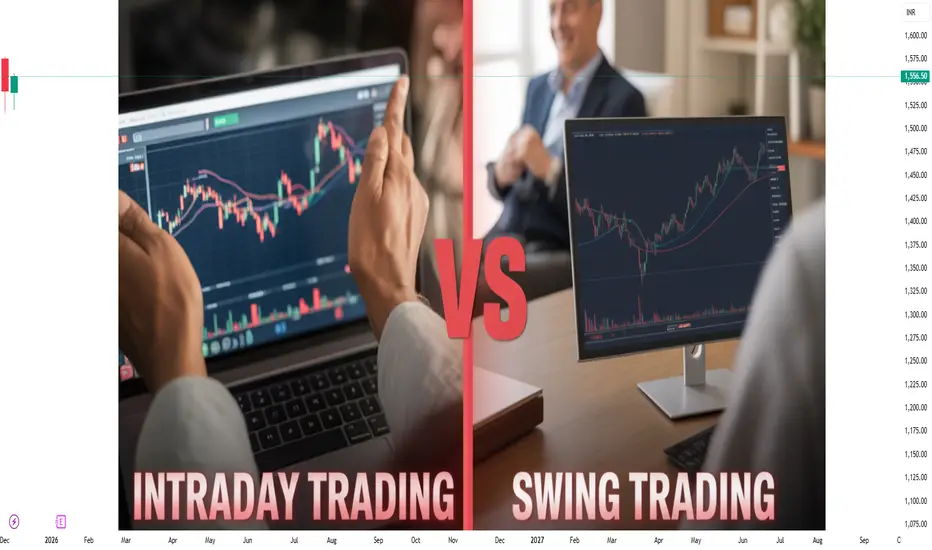
Intraday Trading vs Swing Trading1. What is Intraday Trading?
Intraday trading, also known as day trading, involves buying and selling financial instruments—such as stocks, indices, commodities, or currencies—within the same trading day. All positions are closed before the market closes, and no trades are carried forward to the next day.
Key Characteristics of Intraday Trading
Time frame: Minutes to hours
Holding period: Same day only
Charts used: 1-minute, 5-minute, 15-minute
Objective: Capture small price movements
Frequency: High number of trades
Intraday traders focus on short-term volatility. Even small price changes can result in profits when traded with proper position sizing and leverage.
2. What is Swing Trading?
Swing trading aims to capture short- to medium-term price movements, typically lasting from a few days to several weeks. Traders hold positions overnight and sometimes through market fluctuations to benefit from a “swing” in price.
Key Characteristics of Swing Trading
Time frame: Days to weeks
Holding period: More than one day
Charts used: Daily, 4-hour, weekly
Objective: Capture larger price moves
Frequency: Fewer trades
Swing traders rely more on trend analysis, chart patterns, and broader market structure rather than minute-by-minute price changes.
3. Time Commitment and Lifestyle
Intraday Trading
Intraday trading requires full-time attention during market hours. Traders must constantly monitor price action, news, and order flow. Quick decision-making is critical, leaving little room for error.
Suitable for full-time traders
Demanding and mentally exhausting
Not ideal for those with regular jobs
Swing Trading
Swing trading is more flexible. Trades are planned after market hours, and positions are monitored periodically.
Suitable for part-time traders
Less screen time required
Ideal for working professionals
4. Capital Requirements
Intraday Trading
Intraday trading often requires:
Higher capital for margin trading
Ability to absorb frequent losses
Broker leverage (which increases risk)
Because profits per trade are usually small, traders often increase position size to make meaningful gains.
Swing Trading
Swing trading can be started with:
Relatively lower capital
No dependency on high leverage
Better risk-to-reward ratios
Holding positions for longer allows traders to benefit from bigger price movements without excessive leverage.
5. Risk and Volatility
Intraday Trading Risk
High exposure to market noise
Sudden price spikes due to news or algorithmic trading
Slippage and execution risk
Emotional stress due to fast-moving prices
Even a few seconds of delay can turn a profitable trade into a loss.
Swing Trading Risk
Overnight risk due to gaps caused by news or global markets
Broader stop-loss levels
Lower impact of intraday volatility
While swing traders face gap risk, they are less affected by random intraday fluctuations.
6. Analysis and Strategy
Intraday Trading Strategies
Scalping
Momentum trading
Breakout and breakdown trades
VWAP and volume-based setups
Intraday traders rely heavily on technical indicators, price action, and volume. Fundamental analysis has minimal impact due to the short holding period.
Swing Trading Strategies
Trend-following strategies
Support and resistance trading
Chart patterns (flags, triangles, head & shoulders)
Moving average crossovers
Swing traders combine technical analysis with fundamental cues, such as earnings, sector strength, or macroeconomic trends.
7. Transaction Costs and Brokerage
Intraday Trading
High brokerage due to frequent trading
Exchange fees and taxes add up
Costs can significantly reduce net profitability
Swing Trading
Fewer trades mean lower transaction costs
Easier to maintain consistent profitability
Better cost efficiency
Over time, lower trading frequency can make a substantial difference in returns.
8. Psychology and Emotional Control
Intraday Trading Psychology
Requires extreme discipline
Fear and greed act very quickly
Overtrading is a common problem
Quick losses can lead to revenge trading
Mental fatigue is one of the biggest challenges for intraday traders.
Swing Trading Psychology
More time to think and plan
Less emotional pressure
Requires patience and trust in analysis
Easier to follow predefined rules
Swing trading suits traders who prefer calm, structured decision-making.
9. Profit Potential
Intraday Trading
Daily income potential
Compounding possible with consistent performance
However, consistency is difficult to achieve
Swing Trading
Larger profit per trade
Fewer but more meaningful opportunities
Suitable for wealth-building over time
Both styles can be profitable, but long-term success depends on discipline, risk management, and realistic expectations.
10. Which is Better: Intraday or Swing Trading?
There is no universal “best” trading style. The right choice depends on individual factors:
Factor Intraday Trading Swing Trading
Time availability High Moderate
Stress level Very high Moderate
Capital needed Higher Lower
Holding period Same day Days to weeks
Suitable for beginners Less suitable More suitable
Conclusion
Intraday trading and swing trading are two distinct approaches to market participation. Intraday trading is fast-paced, demanding, and highly stressful but can offer daily income opportunities for disciplined traders with sufficient time and experience. Swing trading, on the other hand, is calmer, more flexible, and better suited for traders who cannot monitor markets constantly.
For beginners and working professionals, swing trading often provides a smoother learning curve and more sustainable results. Intraday trading may be suitable for those who can dedicate full attention to markets and handle intense psychological pressure.
Earnings Season Trading – A Complete Guide1. What Is Earnings Season?
Earnings season is the period when companies release their quarterly financial performance, including:
Revenue (sales)
Net profit or loss
Earnings per share (EPS)
Operating margins
Management guidance and outlook
In India, earnings seasons usually begin shortly after the end of each quarter:
Q1: April–June (results from July)
Q2: July–September (results from October)
Q3: October–December (results from January)
Q4: January–March (results from April/May)
During this time, stocks can experience sudden and large price movements due to surprises in results or guidance.
2. Why Earnings Season Is Important for Traders
Earnings are the primary driver of long-term stock value. While news, sentiment, and macro factors matter, earnings confirm whether a company’s business is actually performing.
For traders, earnings season matters because:
Volatility increases – Sharp price swings create trading opportunities.
Volume rises – Institutional participation increases liquidity.
Trend changes occur – Stocks may break out or break down decisively.
Repricing happens – Stocks are revalued based on future expectations.
A single earnings announcement can move a stock 5–20% in one session, especially in mid-cap and small-cap stocks.
3. How Markets React to Earnings
Stock price movement during earnings is not only about whether results are good or bad. The reaction depends on expectations vs reality.
Common Earnings Reactions:
Results better than expectations
→ Stock may rise sharply.
Results in line with expectations
→ Stock may remain flat or even fall (profit booking).
Results below expectations
→ Stock often declines sharply.
Strong results but weak guidance
→ Stock may fall.
Weak results but strong future outlook
→ Stock may rise.
This is why traders say:
“Markets trade on expectations, not just numbers.”
4. Types of Earnings Season Traders
1. Pre-Earnings Traders
These traders take positions before results, betting on:
Strong earnings surprise
Sector momentum
Insider or institutional accumulation
Technical breakout ahead of results
Risk is high because outcomes are uncertain.
2. Post-Earnings Traders
These traders wait for results and then trade:
Breakouts after earnings
Trend continuation
Gap-up or gap-down moves
This approach reduces uncertainty but may miss part of the move.
3. Options Traders
Options traders focus on:
Volatility expansion
Implied volatility crush after results
Directional or non-directional strategies
Earnings season is especially important for options due to volatility changes.
5. Popular Earnings Season Trading Strategies
1. Earnings Breakout Strategy
Identify stocks consolidating near resistance before earnings
Strong results trigger a breakout with high volume
Entry after breakout confirmation
Stop-loss below breakout level
Best suited for momentum traders.
2. Gap-Up / Gap-Down Trading
After earnings, stocks often open with a gap.
Gap-up with volume and follow-through → bullish continuation
Gap-up but weak volume → possible fade
Gap-down below key support → bearish continuation
This strategy is popular among intraday and short-term traders.
3. Buy the Rumor, Sell the News
Stock rises before earnings due to expectations
Even good results lead to profit booking
Traders exit positions before or immediately after results
This strategy requires understanding sentiment and positioning.
4. Post-Earnings Drift Strategy
Some stocks continue moving in the same direction for days or weeks after earnings.
Strong earnings + strong close = bullish drift
Weak earnings + weak close = bearish drift
Swing traders often use this strategy.
5. Options Volatility Strategy
Before earnings:
Implied volatility (IV) increases
After earnings:
IV collapses
Common strategies:
Straddle or strangle (for big moves)
Iron condor or credit spreads (to benefit from IV crush)
Options traders must manage risk carefully due to sudden moves.
6. Key Factors to Analyze Before Trading Earnings
Before taking any earnings trade, traders should analyze:
1. Historical Earnings Reaction
How much does the stock usually move after earnings?
Is it volatile or stable?
2. Market and Sector Trend
Bullish markets reward good earnings more
Weak markets punish even decent results
3. Expectations and Estimates
Compare analyst estimates with company guidance
Higher expectations mean higher risk of disappointment
4. Technical Levels
Support and resistance
Trend direction
Volume patterns
5. Management Commentary
Often, price moves more on:
Future guidance
Margin outlook
Demand visibility
than on current quarter numbers.
7. Risks in Earnings Season Trading
Earnings trading is not easy and carries unique risks:
Overnight risk – Results are often announced after market hours.
Whipsaws – Initial reaction may reverse quickly.
False breakouts – Emotional reactions can trap traders.
Volatility crush in options – Wrong options strategy can cause losses even if direction is right.
Because of these risks, position sizing and stop-loss discipline are critical.
8. Risk Management During Earnings
Smart traders follow strict risk rules:
Trade smaller quantities
Avoid overexposure to one stock
Use predefined stop-loss
Avoid revenge trading after losses
Prefer post-earnings confirmation if risk-averse
Professional traders focus on survival first, profits second.
9. Earnings Season for Long-Term Investors vs Traders
Investors use earnings to validate fundamentals and hold through volatility.
Traders use earnings for short-term price movements and momentum.
A trader may exit quickly, while an investor may add on dips caused by short-term disappointment.
Understanding your role is essential before trading earnings.
10. Conclusion
Earnings season trading is one of the most exciting and challenging aspects of the stock market. It offers exceptional opportunities due to high volatility, volume, and strong price discovery. However, it also carries higher risk because markets react not just to results, but to expectations, guidance, and sentiment.
Successful earnings traders combine:
Fundamental understanding
Technical analysis
Volatility awareness
Strict risk management
Rather than trading every result, disciplined traders focus only on high-probability setups. With experience, patience, and proper risk control, earnings season trading can become a powerful tool in a trader’s strategy arsenal.
Quantitative Trading: A Comprehensive Explanation1. Introduction to Quantitative Trading
Quantitative trading, often called quant trading, is a trading approach that uses mathematical models, statistical techniques, and computer algorithms to identify and execute trading opportunities in financial markets. Unlike discretionary trading, which relies on human judgment, experience, and intuition, quantitative trading is rule-based, data-driven, and systematic.
In quantitative trading, decisions such as when to buy, when to sell, how much to trade, and how to manage risk are determined by predefined formulas and models. These strategies are widely used by hedge funds, proprietary trading firms, investment banks, and increasingly by retail traders due to advances in technology and data availability.
2. Core Philosophy of Quantitative Trading
The foundation of quantitative trading rests on three key beliefs:
Markets exhibit patterns – Prices, volumes, volatility, and correlations often show recurring behaviors.
These patterns can be measured mathematically – Using statistics, probability, and machine learning.
Automation removes emotional bias – Algorithms execute trades without fear, greed, or hesitation.
The goal is not to predict the future with certainty but to identify probabilistic edges that perform well over a large number of trades.
3. Key Components of Quantitative Trading
a) Data Collection
Quantitative trading begins with data. Common data types include:
Historical price data (open, high, low, close)
Volume and liquidity data
Order book data
Volatility data
Fundamental data (earnings, ratios)
Alternative data (news sentiment, satellite data, social media)
High-quality, clean data is critical because poor data leads to flawed models.
b) Strategy Development
A quant strategy defines precise trading rules. Examples:
Buy when a stock’s 20-day moving average crosses above the 50-day average
Sell when volatility exceeds a certain threshold
Trade mean reversion when prices deviate statistically from historical averages
Strategies are expressed in mathematical or logical form, allowing computers to execute them automatically.
c) Backtesting
Backtesting involves testing a strategy on historical data to evaluate:
Profitability
Drawdowns
Win rate
Risk-adjusted returns (Sharpe ratio)
This step helps determine whether a strategy has a statistical edge or if its performance is random.
d) Risk Management
Risk control is central to quantitative trading. Techniques include:
Position sizing models
Stop-loss and take-profit rules
Portfolio diversification
Maximum drawdown limits
A strong risk framework ensures long-term survival, even during losing streaks.
e) Execution
Execution algorithms place trades efficiently by:
Reducing transaction costs
Minimizing market impact
Optimizing order timing
In high-frequency trading, execution speed measured in milliseconds or microseconds is crucial.
4. Types of Quantitative Trading Strategies
a) Trend-Following Strategies
These strategies aim to profit from sustained price movements.
Use indicators like moving averages, breakout levels, and momentum
Work well in trending markets
Struggle during sideways or choppy markets
Trend following is popular due to its simplicity and long-term robustness.
b) Mean Reversion Strategies
Mean reversion assumes prices eventually return to their historical average.
Buy oversold assets
Sell overbought assets
Based on statistical measures like z-scores and Bollinger Bands
These strategies perform well in range-bound markets.
c) Arbitrage Strategies
Arbitrage exploits price inefficiencies between related instruments.
Statistical arbitrage
Pair trading
Index arbitrage
Though theoretically low risk, arbitrage requires fast execution and large capital.
d) Market-Making Strategies
Market makers provide liquidity by placing buy and sell orders simultaneously.
Earn profits from bid-ask spreads
Heavily dependent on speed and inventory control
These strategies are common among high-frequency trading firms.
e) Machine Learning-Based Strategies
Advanced quant systems use:
Regression models
Decision trees
Neural networks
Reinforcement learning
Machine learning helps uncover non-linear relationships in large datasets, though it increases complexity and overfitting risk.
5. Role of Technology in Quantitative Trading
Technology is the backbone of quant trading. Key elements include:
Programming languages (Python, R, C++)
Databases for storing large datasets
Cloud computing and GPUs
Trading APIs and execution platforms
Automation enables:
24/7 monitoring
High-speed execution
Consistent rule enforcement
Without technology, quantitative trading is practically impossible.
6. Advantages of Quantitative Trading
Emotion-free trading – Eliminates fear and greed.
Consistency – Same rules applied every time.
Scalability – Strategies can be applied across multiple markets.
Backtesting capability – Performance can be tested before risking capital.
Speed and efficiency – Faster reaction to market changes.
These advantages make quantitative trading highly attractive to professional traders.
7. Limitations and Risks of Quantitative Trading
Despite its strengths, quant trading has challenges:
Overfitting – Models may perform well in the past but fail in live markets.
Regime changes – Market behavior changes over time.
Data snooping bias – Excessive testing increases false confidence.
Execution risk – Slippage and latency can reduce profits.
Black swan events – Extreme events may invalidate models.
Successful quant traders continuously adapt and update their strategies.
8. Quantitative Trading vs Discretionary Trading
Aspect Quantitative Trading Discretionary Trading
Decision Making Rule-based Human judgment
Emotion Minimal High
Speed Very fast Slower
Scalability High Limited
Flexibility Lower in real-time Higher
Many modern traders combine both approaches, known as hybrid trading.
9. Quantitative Trading in Modern Markets
Quantitative trading dominates global markets today. A significant portion of equity, futures, forex, and crypto trading volume is generated by algorithms. In India, quantitative strategies are increasingly used in:
Index futures
Options trading
Statistical arbitrage
Volatility strategies
Retail participation is also rising due to affordable data and computing power.
10. Conclusion
Quantitative trading represents the fusion of finance, mathematics, and technology. It transforms trading from an art into a structured scientific process based on probability and data analysis. While it does not eliminate risk, it provides a disciplined framework for identifying and exploiting market inefficiencies.
Success in quantitative trading requires strong analytical skills, robust risk management, continuous research, and the ability to adapt to changing market conditions. As financial markets evolve, quantitative trading will continue to grow in importance, shaping the future of global investing and trading.
Real Kowledge of Chart Pattern Key Principles for Chart Pattern Analysis
A. Trend Context
Patterns are more reliable when analyzed in the context of prevailing trends. For instance, reversal patterns in strong trends may fail without sufficient volume confirmation.
B. Volume Confirmation
Volume often provides confirmation for patterns:
Breakouts with high volume are more reliable.
Low volume breakouts can indicate false signals.
C. Time Frame
Patterns may appear differently across time frames. For example, a double top on a daily chart is more significant than one on a 5-minute chart due to higher trading participation and reduced noise.
D. Pattern Failure
Not all patterns result in expected outcomes. False breakouts or trend reversals can occur due to market news, unexpected events, or low liquidity. Risk management, stop-losses, and position sizing are crucial.
Best Knowledge Of Candle Patterns Single-Candle Patterns
1. Doji:
A Doji forms when the opening and closing prices are virtually identical, resulting in a very small body. It represents indecision in the market. There are variations, such as the Long-Legged Doji, indicating high volatility with indecision, and the Gravestone Doji, often signaling a bearish reversal after an uptrend.
2. Hammer:
A Hammer has a small body near the top of the trading range and a long lower shadow. It typically appears at the bottom of a downtrend and suggests a potential bullish reversal, as sellers pushed the price lower but buyers regained control.
3. Hanging Man:
Resembling the Hammer but occurring after an uptrend, the Hanging Man signals potential bearish reversal. The long lower shadow shows that sellers tried to push the price down, and the market may weaken.
4. Inverted Hammer:
This candle has a small body at the lower end with a long upper shadow, appearing after a downtrend. It indicates potential bullish reversal if followed by confirmation from subsequent candles.
5. Shooting Star:
Opposite of the Inverted Hammer, the Shooting Star appears at the top of an uptrend, signaling a potential bearish reversal. The long upper shadow shows buyers tried to push the price higher but failed.
6. Marubozu:
A Marubozu has no shadows, only a solid body. A bullish Marubozu opens at the low and closes at the high, signaling strong buying pressure. A bearish Marubozu opens at the high and closes at the low, showing strong selling pressure.
Part 1 Ride The Big Moves Hedging Strategies Using Options
Protective Put
A protective put involves buying a put option against an existing stock position.
Purpose: Portfolio insurance
Cost: Premium paid
Benefit: Downside protection
Used by long-term investors during uncertain markets.
Collar Strategy
A collar combines:
Long stock
Long put
Short call
This caps both upside and downside and is useful during volatile periods.
Part 2 Intraday Master ClassRisk-Defined Spread Strategies
Bull Call Spread
This involves buying a call at a lower strike and selling another call at a higher strike.
Market View: Moderately bullish
Risk: Limited
Reward: Limited
This strategy reduces cost compared to buying a naked call.
Bear Put Spread
A bear put spread involves buying a higher-strike put and selling a lower-strike put.
Market View: Moderately bearish
Risk: Limited
Reward: Limited
It is efficient when a controlled downside move is expected.