Commodity Trading: Gold, Silver, Crude Oil, Natural Gas on MCX1. Overview of MCX and Commodity Trading
The Multi Commodity Exchange (MCX) was established in 2003 and operates under the regulatory framework of the Securities and Exchange Board of India (SEBI). It provides a transparent and standardized platform for trading in commodity derivatives, allowing market participants to hedge against price volatility or take speculative positions based on their market outlook.
Commodity trading on MCX includes bullion (gold, silver), energy (crude oil, natural gas), and base metals (copper, zinc, aluminum) among others. Prices are largely influenced by international benchmarks — for example, COMEX for gold and silver, and NYMEX for crude oil and natural gas — since commodities are globally traded and denominated in U.S. dollars.
2. Gold Trading on MCX
a. Importance of Gold
Gold is considered both a precious metal and a safe-haven asset. It acts as a hedge against inflation, currency depreciation, and economic uncertainty. In India, gold also holds immense cultural and investment value, making it one of the most traded commodities.
b. MCX Gold Contracts
MCX offers multiple gold contracts to cater to different categories of traders:
Gold (1 kg)
Gold Mini (100 grams)
Gold Guinea (8 grams)
Gold Petal (1 gram)
Gold Petal (New Delhi)
Each contract differs in lot size and margin requirements, allowing both retail and institutional traders to participate. The price quote is in Rupees per 10 grams, and the underlying is standard gold of 995 purity.
c. Factors Influencing Gold Prices
Global economic data (especially U.S. inflation, employment, and GDP)
US Dollar movement – Gold has an inverse relationship with the USD.
Interest rate changes by the U.S. Federal Reserve.
Geopolitical tensions or crises that boost safe-haven demand.
Jewelry demand and central bank reserves.
d. Trading Strategy
Gold trading often combines technical analysis (using trendlines, moving averages, and RSI) with macro fundamentals (like Fed announcements). Traders also track the COMEX gold price and the rupee-dollar exchange rate for near-term movement cues on MCX.
3. Silver Trading on MCX
a. Role of Silver
Silver, often referred to as the “poor man’s gold,” has both precious and industrial uses. It’s widely used in electronics, solar panels, and medical instruments. This dual nature makes silver more volatile than gold.
b. MCX Silver Contracts
MCX offers several contracts:
Silver (30 kg)
Silver Mini (5 kg)
Silver Micro (1 kg)
Silver 1000 (30 kg, 999 purity)
The price quote is in Rupees per kilogram. Silver contracts are physically settled, ensuring price integrity and alignment with physical market demand.
c. Price Influencers
Industrial demand in electronics and solar sectors.
Gold price movement (since silver tends to follow gold trends).
US Dollar and bond yields.
Global supply-demand balances from major producers like Mexico and Peru.
d. Trading Insights
Silver’s high volatility appeals to short-term traders. It responds strongly to global macro news and industrial growth data. Many traders use gold-silver ratio analysis — when the ratio widens, it may suggest silver is undervalued relative to gold, and vice versa.
4. Crude Oil Trading on MCX
a. Significance of Crude Oil
Crude oil is the lifeblood of the global economy — influencing transport, manufacturing, and inflation. As one of the most liquid commodities, it offers dynamic trading opportunities. MCX crude oil prices track NYMEX WTI Crude, adjusted for the INR/USD rate.
b. MCX Crude Oil Contracts
MCX offers:
Crude Oil (100 barrels)
Crude Oil Mini (10 barrels)
Prices are quoted in Rupees per barrel. Contract expiries are aligned with global oil futures.
c. Key Factors Affecting Prices
Global demand-supply balance led by OPEC decisions.
U.S. crude inventory data from the Energy Information Administration (EIA).
Geopolitical tensions in the Middle East.
Dollar strength and global growth outlook.
Production levels in the U.S. shale industry.
d. Trading Strategies
Crude oil traders closely track weekly U.S. inventory reports, OPEC meetings, and economic indicators like global PMI data. Technical tools like Bollinger Bands and MACD help spot momentum reversals. Traders also hedge exposure against energy price swings using MCX crude futures.
5. Natural Gas Trading on MCX
a. Overview
Natural gas is a crucial energy source used for power generation, heating, and industrial processes. With the rise in clean energy demand, gas trading volumes have been rising sharply on MCX.
b. Contract Specifications
MCX offers Natural Gas (1250 mmBtu) contracts, quoted in Rupees per mmBtu (million British thermal units). Prices track NYMEX Natural Gas futures, with adjustments for INR movements.
c. Price Influences
Weather conditions – cold winters or hot summers drive higher consumption.
Inventory levels in U.S. gas storage.
Production trends from shale fields.
Transition toward clean energy and LNG demand.
Global geopolitical events affecting gas supply routes.
d. Trading Approach
Natural gas prices are highly seasonal and volatile. Traders use weather forecasts, EIA inventory data, and technical tools like support-resistance zones to time entries. Given its volatility, proper risk management and position sizing are essential.
6. Trading Mechanism and Settlement
All commodities on MCX are traded electronically, ensuring transparency. Contracts are margined, meaning traders need only deposit a fraction of the total value (typically 5–10%) as margin.
Settlement can be of two types:
Cash settlement, based on final settlement price.
Physical delivery, for bullion and select metals.
Traders should be aware of expiry dates, daily price limits, and margin requirements to manage positions effectively.
7. Risk Management and Hedging
Commodity derivatives are vital tools for hedgers (like jewelers or oil companies) to protect against adverse price movements. For instance:
A jeweler may short gold futures to hedge inventory.
An airline may buy crude oil futures to fix fuel costs.
Speculators and arbitrageurs add liquidity, but they must apply strict stop losses, technical discipline, and volatility tracking to avoid large losses.
8. Conclusion
Commodity trading on the MCX — particularly in Gold, Silver, Crude Oil, and Natural Gas — offers immense opportunities for profit and portfolio diversification. These commodities are deeply connected to global macroeconomic events, geopolitical developments, and currency movements.
Success in this market requires a blend of technical analysis, fundamental understanding, and emotional discipline. For retail traders, starting with mini or micro contracts and focusing on risk control is key. As India’s participation in the global commodity market expands, MCX remains a vital gateway for investors to tap into the pulse of international trade and energy trends.
Community ideas
Trading Psychology and Emotional Discipline1. Understanding Trading Psychology
Trading psychology refers to the mental and emotional aspects that influence trading decisions. Every trade triggers a mix of emotions — fear, greed, hope, frustration, or excitement. These emotions can cloud judgment, making traders deviate from their plans.
Even the most skilled analysts can fail if they cannot manage their reactions to profit and loss.
In simple terms, trading psychology is about how a trader’s mindset affects their actions — when to enter, hold, or exit a trade. It shapes how traders respond to risk, uncertainty, and outcomes.
2. The Role of Emotions in Trading
The two most dominant emotions in trading are fear and greed, and both can significantly distort rational thinking.
Fear:
Fear makes traders avoid taking trades even when the setup is perfect. It can also make them close profitable trades too early to “lock in” small gains, fearing the market might reverse. In other cases, fear of loss leads to hesitation and missed opportunities.
Greed:
Greed drives traders to chase trades even after a big rally or to overtrade in hopes of bigger profits. It makes them ignore risk management rules and hold onto winning positions for too long, waiting for unrealistic targets.
Hope and Regret:
Hope often keeps traders stuck in losing positions, expecting the market to turn around. Regret, on the other hand, can paralyze decision-making, as traders fear repeating past mistakes.
Understanding these emotional triggers is the first step toward controlling them.
3. Importance of Emotional Discipline
Emotional discipline is the ability to stick to your trading plan regardless of emotional highs or lows. It is what separates consistent traders from impulsive ones.
Discipline helps traders:
Follow their strategy without deviation.
Accept losses calmly and move on.
Avoid revenge trading after a losing streak.
Take profits as planned without overextending trades.
Maintain patience to wait for high-probability setups.
Without discipline, even the best system can fail. With it, an average strategy can yield consistent returns.
4. Common Psychological Mistakes Traders Make
Overconfidence:
After a few profitable trades, traders may start believing they can’t go wrong. Overconfidence leads to oversized positions and ignoring stop-losses — often ending in big losses.
Revenge Trading:
When a trader tries to “get back” at the market after a loss, they act emotionally rather than logically. Revenge trades are impulsive and usually result in further damage.
Confirmation Bias:
Traders tend to seek information that supports their existing view, ignoring contrary evidence. This bias prevents them from seeing warning signs.
Loss Aversion:
The pain of losing is psychologically stronger than the pleasure of gaining. Many traders avoid taking small losses, turning them into larger ones.
Herd Mentality:
Following others blindly — whether social media, news, or trading groups — causes traders to abandon their analysis and act out of fear of missing out (FOMO).
Lack of Patience:
Impatient traders force trades just to “stay active.” However, successful trading often requires waiting — sometimes for days — for the right setup.
5. Building a Strong Trading Mindset
Developing the right mindset takes practice and self-awareness. Here are some key principles:
Accept Uncertainty:
Every trade has an element of uncertainty. You can control your risk, but not the outcome. Accepting this truth reduces emotional stress.
Focus on Process, Not Profits:
Professionals concentrate on executing their plan correctly rather than obsessing over results. Consistency in following the process naturally leads to consistent profits.
Detach Emotionally from Money:
Traders should see capital as “trading inventory,” not as personal wealth. Emotional attachment to money causes hesitation and poor decision-making.
Maintain Realistic Expectations:
Trading is not a get-rich-quick game. Expecting overnight success creates pressure and forces impulsive trades.
Stay Present and Mindful:
Be fully aware during trading hours — not daydreaming about profits or losses. Mindfulness improves focus and reduces emotional reactions.
6. Practical Ways to Strengthen Emotional Discipline
Create and Follow a Trading Plan:
Define your entry, exit, stop-loss, and risk parameters before every trade. Once the plan is in place, follow it strictly. This removes guesswork and emotion from decisions.
Use Stop-Loss and Position Sizing:
Always use a stop-loss to protect capital. Limit each trade’s risk to a small percentage (usually 1–2% of total capital). This prevents emotional panic when trades go wrong.
Keep a Trading Journal:
Record every trade along with the reason for entry and exit, as well as your emotional state. Reviewing your journal regularly helps identify emotional patterns and mistakes.
Take Breaks After Losses:
If you experience multiple losing trades, step away. Emotional recovery is vital before returning to the market.
Meditation and Mental Training:
Many successful traders practice meditation, visualization, or breathing exercises to stay calm and focused.
Avoid Overtrading:
More trades don’t always mean more profit. Stick to quality setups that fit your trading edge.
Set Daily Profit and Loss Limits:
Predetermine a maximum loss or gain for the day. Once reached, stop trading. This prevents emotional spiral trading.
Review and Reflect Regularly:
Analyze your performance weekly or monthly to understand what works and what doesn’t — both technically and psychologically.
7. The Role of Confidence and Patience
Confidence and patience go hand in hand in trading psychology.
Confidence comes from preparation, back-testing, and knowing your system works. Patience ensures you wait for setups that match your strategy instead of forcing trades.
A confident trader doesn’t fear missing out. They know opportunities are endless. Patience ensures discipline, and discipline ensures profitability.
8. The Growth Mindset in Trading
Adopting a growth mindset means treating losses as learning opportunities rather than failures. Each mistake reveals a behavioral pattern to fix.
A trader with a growth mindset:
Reviews trades objectively.
Seeks feedback and self-improvement.
Avoids blaming the market.
Understands that consistency builds over time.
The market rewards those who keep improving rather than those who chase perfection.
9. Conclusion
Trading psychology and emotional discipline are the backbone of long-term trading success. Charts, indicators, and systems can be learned quickly, but mastering one’s mind takes continuous effort.
The best traders are not those who win every trade but those who manage their emotions through every win and loss. By developing awareness, controlling fear and greed, following a well-defined plan, and maintaining discipline, a trader can achieve stability and confidence — the true edge in the market.
AI and Data Analytics in Stock Market Decisions1. The Evolution of Stock Market Decision-Making
Traditionally, stock market decisions were made using two major approaches:
Fundamental analysis, which focuses on company performance, earnings, and macroeconomic factors.
Technical analysis, which studies past price and volume patterns to predict future trends.
While both methods remain relevant, they are now enhanced by AI and data analytics. AI can process enormous data sets that humans cannot handle manually, identify hidden correlations, and make decisions based on probabilities rather than assumptions.
The integration of these technologies started with algorithmic trading in the 1990s and has evolved into machine learning-driven trading systems and predictive analytics models in the 21st century.
2. Understanding AI and Data Analytics
Artificial Intelligence (AI) refers to systems that can mimic human intelligence, learn from experience, and make decisions autonomously. In stock trading, AI tools like machine learning (ML), deep learning, and natural language processing (NLP) play vital roles.
Machine Learning (ML): Learns patterns from historical data and applies them to predict future stock price movements.
Deep Learning (DL): Uses neural networks to process large-scale and complex financial data, identifying non-linear relationships.
Natural Language Processing (NLP): Analyzes financial news, social media sentiment, and corporate announcements to gauge market mood.
Data Analytics, on the other hand, involves the collection, cleaning, and analysis of structured and unstructured data to uncover insights. This includes historical price data, earnings reports, economic indicators, and even tweets or headlines.
Together, AI and data analytics form the backbone of quantitative trading, robo-advisory platforms, and automated portfolio management systems.
3. Key Applications of AI and Data Analytics in the Stock Market
a. Predictive Analysis and Price Forecasting
AI models can analyze historical price patterns, volatility, and macroeconomic indicators to forecast short-term and long-term price movements.
For example:
Neural networks detect recurring patterns in stock charts.
Regression models and reinforcement learning algorithms adjust predictions in real time as market conditions change.
b. Sentiment Analysis
NLP-powered tools scan news articles, earnings calls, analyst reports, and social media to measure market sentiment.
A positive sentiment can lead to short-term price surges, while negative buzz can trigger sell-offs. Platforms like Bloomberg and Refinitiv now incorporate AI-based sentiment analytics for traders.
c. Algorithmic and High-Frequency Trading (HFT)
AI-driven algorithmic trading systems execute thousands of trades per second, exploiting minor market inefficiencies.
Algorithms analyze order book data and market microstructure.
AI continuously improves its strategy by learning from past trades.
This minimizes human error and maximizes execution speed and accuracy.
d. Portfolio Management and Robo-Advisors
AI helps investors manage risk and optimize portfolios based on their risk tolerance, investment goals, and market outlook.
Robo-advisors such as Zerodha’s Niyam or international platforms like Betterment and Wealthfront use AI to automatically rebalance portfolios and minimize losses.
e. Fraud Detection and Compliance
AI-powered surveillance systems detect anomalies, such as insider trading, price manipulation, or fraudulent transactions.
Machine learning algorithms monitor trading patterns in real time and alert regulators or brokers to suspicious behavior.
f. Risk Management
AI quantifies risk using predictive models that estimate Value at Risk (VaR), expected shortfall, or drawdown probabilities.
By analyzing correlations and stress scenarios, traders can better prepare for sudden market downturns or black swan events.
4. Role of Big Data in Stock Market Analysis
Modern financial markets produce terabytes of data every day, including:
Price and volume data from multiple exchanges
Corporate filings and earnings reports
Global macroeconomic indicators
Alternative data like satellite images, foot traffic, or credit card transactions
AI and analytics platforms integrate these datasets to extract valuable insights.
For example:
Hedge funds use satellite imagery to estimate retail store performance.
Credit card data is used to forecast quarterly earnings before official reports are released.
This “alternative data revolution” gives institutions an informational edge that traditional analysis cannot provide.
5. Benefits of AI and Data Analytics in Stock Market Decisions
Speed and Efficiency: AI can process millions of data points in seconds, enabling rapid and informed decision-making.
Accuracy: Predictive models reduce human bias and emotional trading.
Automation: Reduces manual analysis and allows automated trade execution.
Risk Reduction: Helps identify potential losses early through predictive risk assessment.
Data-Driven Insights: Converts raw market data into actionable intelligence.
These advantages help both retail traders and institutional investors stay competitive in increasingly complex markets.
6. Limitations and Challenges
Despite their power, AI and analytics tools face several limitations:
Data Quality Issues: Inaccurate or biased data can lead to faulty predictions.
Overfitting: Models that perform well on historical data might fail in live markets due to changing dynamics.
Black Box Problem: Deep learning models often lack interpretability, making it hard to explain why they make certain predictions.
Market Volatility: AI cannot always predict sudden events like geopolitical crises or natural disasters.
Ethical and Regulatory Concerns: Automated trading systems can cause flash crashes or manipulate markets unintentionally.
Hence, while AI enhances decision-making, human oversight remains crucial.
7. The Future of AI in Stock Market Decision-Making
The next phase of financial technology will see even deeper integration of AI, quantum computing, and blockchain in trading ecosystems.
Quantum AI may process financial data exponentially faster, enabling near-instant decision-making.
Explainable AI (XAI) will make algorithms more transparent and trustworthy.
AI-Blockchain integration will ensure secure, auditable, and tamper-proof trading records.
Additionally, personalized AI assistants will help individual investors make smarter decisions based on their unique profiles and preferences.
8. Real-World Examples
JP Morgan’s COiN platform uses AI to review legal documents and extract key data for risk evaluation.
Goldman Sachs’ Marcus employs data analytics for consumer lending and investment recommendations.
Kavout’s Kai Score leverages machine learning to rank stocks based on predictive factors.
Indian brokerages such as Zerodha, Upstox, and ICICI Direct are adopting AI-based tools to help clients identify trading opportunities and manage portfolios efficiently.
9. Conclusion
AI and data analytics have redefined the rules of stock market participation. What was once a game of intuition and experience has now become a science of data, prediction, and automation.
By integrating AI into trading strategies, investors can gain a deeper understanding of market dynamics, identify hidden opportunities, and manage risk with greater precision.
However, successful use of AI in stock market decisions requires a balance between machine intelligence and human judgment. Machines can crunch numbers and identify trends, but human insight, discipline, and adaptability remain irreplaceable.
Ultimately, the collaboration between humans and AI will continue to shape the future of intelligent investing, driving markets toward more efficiency, transparency, and innovation.
Retail Participation Surge via GIFT Nifty & Offshore Derivatives1. Understanding GIFT Nifty: India’s Gateway to Global Trading
The GIFT Nifty, previously known as the SGX Nifty, is a derivative contract based on the Nifty 50 Index, now traded on the India International Exchange (India INX) and the NSE International Exchange (NSE IX), both operating within the GIFT City (Gujarat International Finance Tec-City) in Gandhinagar, Gujarat.
Initially, foreign investors traded Indian index derivatives through the Singapore Exchange (SGX) under SGX Nifty futures. However, in 2023, these contracts migrated to GIFT City under the International Financial Services Centre (IFSC) framework. This move brought trading closer to home while maintaining global accessibility and regulatory efficiency.
The key goal was to make India a global hub for financial services, allowing domestic and international investors to access Indian markets in a transparent, well-regulated, and tax-efficient manner.
2. The Rise of Retail Participation
Retail investors — individual traders investing with their personal capital — have become a dominant force in India’s equity and derivative markets. With the success of discount brokers, digital trading platforms, and the pandemic-era liquidity boom, Indian retail participation in equities reached historic highs.
However, the launch and global accessibility of GIFT Nifty has now extended this participation to international derivative markets. Retail traders who previously traded only on domestic exchanges like NSE and BSE are now able to gain exposure to Nifty futures and options in an international jurisdiction.
Several factors have contributed to this retail surge:
Ease of access via digital platforms and international brokers linked to GIFT City.
Tax benefits under IFSC regulations, including zero capital gains tax for non-residents.
Extended trading hours, allowing participation even when domestic markets are closed.
Low transaction costs and minimal regulatory hurdles for offshore trading accounts.
This convergence has allowed retail investors to trade round-the-clock, hedge positions efficiently, and participate in a globally aligned Indian derivative ecosystem.
3. Offshore Derivatives: Opening Global Avenues for Retail Traders
Offshore derivatives are financial instruments linked to Indian assets but traded outside the domestic market. They provide exposure to Indian equities, indices, or debt without requiring direct ownership of the underlying securities.
Historically, instruments like Participatory Notes (P-Notes) were used by institutional investors. But with GIFT Nifty and IFSC-listed derivatives, even retail traders can participate indirectly in the offshore segment.
Retail access to offshore derivatives offers key advantages:
Diversification: Traders can access multiple markets — from Nifty and Sensex indices to global indices like S&P 500 or FTSE — within a single account.
Leverage benefits: Offshore platforms often provide higher leverage, enhancing speculative and hedging opportunities.
Hedging currency risk: With the availability of USD-denominated contracts at GIFT City, traders can protect against INR fluctuations.
Global exposure: Investors can trade Indian instruments while benefiting from international market standards and liquidity.
4. GIFT City as a Catalyst for Retail Globalization
The establishment of GIFT City IFSC has been pivotal in enabling retail and institutional participation alike. Designed as a global financial hub, it offers infrastructure comparable to international centers like Dubai or Singapore.
GIFT City’s role includes:
Hosting NSE IX and BSE INX, where international versions of Indian indices are traded.
Providing foreign currency settlements, primarily in USD, reducing conversion risks.
Offering tax neutrality and regulatory clarity under IFSCA (International Financial Services Centres Authority).
Attracting both foreign brokers and Indian fintech platforms to serve global retail clients.
For retail traders, GIFT City bridges the gap between domestic markets and global derivatives, creating a seamless ecosystem that encourages participation beyond India’s borders.
5. The Technology Revolution Driving Retail Entry
The surge in retail participation via GIFT Nifty and offshore derivatives is inseparable from the technological revolution in trading. Online trading apps, global brokerage tie-ups, and API-based trading solutions have made it effortless for individuals to access IFSC exchanges.
Innovations such as:
Algorithmic trading and copy trading tools,
Seamless onboarding through digital KYC, and
Integration with global payment systems
have lowered entry barriers and increased transparency.
Moreover, educational content and social media trading communities have empowered retail investors to understand global derivatives and execute sophisticated strategies, including hedging and arbitrage between NSE and GIFT Nifty prices.
6. Extended Market Hours: A New Opportunity Window
One of the defining advantages of GIFT Nifty is its longer trading window. Unlike domestic exchanges, which close by 3:30 PM IST, GIFT Nifty operates from 6:30 AM to 11:30 PM IST, overlapping both Asian and European trading sessions.
This feature allows:
Pre-market trend analysis based on global cues.
Hedging during US market hours when significant macroeconomic data is released.
24-hour access to Indian index movement, which appeals to global retail traders.
Extended hours also enhance liquidity and price discovery, as retail and institutional traders react in real-time to international events.
7. Regulatory Framework & Safeguards
The International Financial Services Centres Authority (IFSCA) governs all activities at GIFT City, ensuring that retail participation occurs within a secure and transparent framework.
Key safeguards include:
Investor protection norms aligned with global standards.
KYC/AML compliance to prevent misuse of offshore accounts.
Transparent margining and settlement processes under international oversight.
This ensures that even as participation widens, market integrity and financial stability remain uncompromised.
8. The Broader Impact on India’s Financial Ecosystem
The retail surge through GIFT Nifty and offshore derivatives has several macro-level benefits:
Increased liquidity: Higher participation enhances market depth and efficiency.
Global visibility: India strengthens its position as an emerging hub for international financial services.
Capital inflows: Offshore participation channels global capital back into Indian markets.
Financial innovation: The expansion encourages the development of new derivative products and cross-border instruments.
This growth aligns with India’s vision of “Viksit Bharat 2047”, where financial markets play a central role in economic globalization.
9. Challenges & the Road Ahead
Despite its promise, the surge in retail participation also brings challenges:
Risk of over-leverage: Many retail traders may lack sufficient understanding of derivative risks.
Regulatory coordination: Balancing domestic SEBI rules and IFSC frameworks requires ongoing alignment.
Market volatility: Increased speculative activity can cause sharp price movements in index futures.
To sustain growth responsibly, financial literacy, risk management tools, and investor education programs must evolve in parallel.
10. Conclusion
The surge in retail participation via GIFT Nifty and offshore derivatives symbolizes India’s integration into the global trading ecosystem. GIFT City has emerged as a transformative gateway, enabling both Indian and global traders to access Indian markets seamlessly.
For retail participants, this marks the dawn of a new era — one defined by borderless access, extended hours, tax efficiency, and technological empowerment. As participation deepens and regulation strengthens, India’s financial markets are poised to become a global benchmark for inclusivity, innovation, and international connectivity.
In essence, GIFT Nifty and offshore derivatives are not just instruments of trading; they are symbols of India’s financial maturity, bridging local ambition with global opportunity.
Introduction to Indian Financial Markets1. Structure of Indian Financial Markets
The Indian financial market is broadly divided into two segments:
Money Market – Deals with short-term funds (maturity up to one year).
Capital Market – Deals with long-term funds (maturity more than one year).
Each of these segments has multiple sub-markets and instruments designed to cater to specific financial needs.
2. Money Market
The money market provides liquidity for the economy by enabling short-term borrowing and lending. It is crucial for maintaining the stability of financial institutions and ensuring that businesses and the government have access to short-term financing.
Key Instruments of the Money Market:
Treasury Bills (T-Bills): Issued by the Reserve Bank of India (RBI) on behalf of the government for short-term borrowing.
Commercial Papers (CP): Unsecured promissory notes issued by corporations to raise short-term funds.
Certificates of Deposit (CD): Negotiable time deposits issued by commercial banks.
Call and Notice Money: Very short-term loans between banks to manage daily liquidity needs.
Repurchase Agreements (Repo and Reverse Repo): Short-term borrowing/lending against government securities.
The money market in India is regulated by the Reserve Bank of India (RBI), which ensures stability, transparency, and adequate liquidity.
3. Capital Market
The capital market facilitates the raising of long-term capital by companies and governments through the issue of shares, bonds, and other securities. It also provides investors with opportunities to earn returns by investing in these instruments.
The capital market is divided into two segments:
Primary Market: Where new securities are issued (Initial Public Offerings or IPOs).
Secondary Market: Where existing securities are traded (Stock Exchanges).
Major Institutions in the Capital Market:
Stock Exchanges: The two leading stock exchanges are the Bombay Stock Exchange (BSE) and the National Stock Exchange (NSE).
Securities and Exchange Board of India (SEBI): The regulatory authority overseeing capital markets to protect investors and promote fair trading.
Depositories: Institutions like NSDL (National Securities Depository Limited) and CDSL (Central Depository Services Limited) that facilitate electronic holding and transfer of securities.
Key Instruments of the Capital Market:
Equity Shares: Represent ownership in a company.
Debentures and Bonds: Long-term debt instruments.
Mutual Funds: Investment vehicles pooling funds from multiple investors.
Derivatives: Financial contracts like futures and options that derive value from underlying assets.
Exchange-Traded Funds (ETFs): Funds traded on exchanges like stocks.
4. Role of Financial Institutions
A variety of institutions operate within the Indian financial market to ensure smooth functioning and growth:
Banks: The backbone of the financial system, offering deposit, credit, and investment services.
Non-Banking Financial Companies (NBFCs): Provide credit and financial services outside the traditional banking system.
Insurance Companies: Mobilize long-term funds through life and general insurance.
Mutual Funds and Asset Management Companies (AMCs): Provide collective investment options.
Development Financial Institutions (DFIs): Such as NABARD, SIDBI, and EXIM Bank, which support industrial, agricultural, and export financing.
5. Regulatory Framework
The Indian financial market is regulated by several key institutions to maintain transparency, protect investors, and ensure financial stability:
Reserve Bank of India (RBI): Regulates the banking system and money market, controls inflation, and manages monetary policy.
Securities and Exchange Board of India (SEBI): Regulates the capital market and protects investor interests.
Insurance Regulatory and Development Authority of India (IRDAI): Supervises the insurance sector.
Pension Fund Regulatory and Development Authority (PFRDA): Oversees pension funds and the National Pension System (NPS).
Ministry of Finance (MoF): Frames financial policies and oversees public finances.
These institutions collectively ensure that India’s financial markets remain efficient, stable, and globally competitive.
6. Evolution of Indian Financial Markets
India’s financial market has undergone significant transformation over the past few decades:
Pre-Liberalization Era (Before 1991): The market was tightly regulated with limited investment options and government-controlled interest rates.
Post-Liberalization Era (After 1991): Economic reforms introduced free-market mechanisms, liberalized capital inflows, and promoted private sector participation.
Technological Advancements: The introduction of electronic trading, online demat accounts, and real-time settlement systems improved efficiency and transparency.
Global Integration: Increased participation by foreign institutional investors (FIIs) and global listing opportunities expanded India’s financial reach.
Today, India’s financial markets are well-diversified, globally recognized, and supported by a robust technological and regulatory framework.
7. Participants in Indian Financial Markets
The Indian financial ecosystem comprises various participants:
Retail Investors: Individuals investing in shares, mutual funds, and bonds.
Institutional Investors: Entities like mutual funds, insurance companies, pension funds, and banks.
Foreign Investors: Including Foreign Institutional Investors (FIIs) and Foreign Portfolio Investors (FPIs).
Corporate Entities: Raising capital through equity or debt.
Government: Issuing securities to finance public expenditure.
Each participant contributes to market liquidity, depth, and efficiency.
8. Importance of Indian Financial Markets
The financial market plays a crucial role in the nation’s economic framework:
Mobilization of Savings: Channels individual and institutional savings into productive investments.
Efficient Resource Allocation: Ensures funds flow to sectors with higher growth potential.
Capital Formation: Encourages entrepreneurship and industrial expansion.
Price Discovery: Reflects economic trends through demand and supply of securities.
Economic Stability: Helps manage inflation, liquidity, and interest rates.
Wealth Creation: Offers opportunities for individuals and institutions to build financial assets.
9. Challenges Facing Indian Financial Markets
Despite progress, the Indian financial system faces several challenges:
Financial Illiteracy: A large portion of the population remains unaware of investment opportunities.
Regulatory Complexity: Multiple regulators can sometimes lead to overlapping responsibilities.
Market Volatility: Global economic uncertainty affects capital inflows and investor sentiment.
Limited Depth in Bond Market: The corporate bond market remains underdeveloped compared to equity markets.
Technology Risks: Increased digitalization exposes markets to cyber threats.
Efforts are ongoing to address these challenges through reforms, education, and stronger governance.
10. Future of Indian Financial Markets
The future of Indian financial markets looks promising. With initiatives like Digital India, Financial Inclusion (Jan Dhan Yojana), and Unified Payments Interface (UPI), India is building a modern, inclusive, and technology-driven financial system.
The rise of fintech startups, blockchain applications, and AI-driven analytics is expected to enhance transparency, speed, and participation. Moreover, India’s growing middle class and global economic presence are likely to attract more domestic and international investments.
Conclusion
The Indian financial market stands as a cornerstone of the country’s economic engine. From traditional banking to sophisticated capital market instruments, it provides a dynamic platform for growth, investment, and innovation. Supported by strong regulatory institutions like the RBI and SEBI, and driven by technology and globalization, India’s financial markets continue to evolve rapidly.
As India progresses toward becoming a $5 trillion economy, a robust, transparent, and inclusive financial system will remain essential to sustain growth, attract investments, and empower millions of citizens to participate in the nation’s economic journey.
Flag Pole and Pennent
🧭 Overview
The chart showcases a strong uptrend followed by a pennant formation, a classic continuation pattern.
After a powerful rally (flagpole), price enters a phase of tight consolidation, forming lower highs and higher lows — a sign that volatility is contracting before the next expansion.
This structure reflects a healthy pause in momentum as the market prepares for a potential upward breakout.
⸻⸻⸻⸻⸻⸻⸻⸻⸻⸻⸻⸻⸻
📊 Chart Observations
1. Higher Highs and Higher Lows formed during the rally confirm a strong bullish bias.
2. After the impulsive move, price starts creating Lower Highs and Higher Lows, shaping a symmetrical pennant.
3. Price Consolidation inside the pennant shows market equilibrium — buyers and sellers are temporarily balanced.
4. The flagpole represents strong prior momentum, and the pennant signals continuation rather than reversal.
5. As the range tightens, probability favors an upward breakout in the direction of the preceding trend.
6. Confirmation: A candle close above the pennant’s upper trendline validates bullish continuation and signals entry.
⸻⸻⸻⸻⸻⸻⸻⸻⸻⸻⸻⸻⸻
🟢 Summary
• Structure: Flagpole + Pennant (Bullish Continuation)
• Market Context: Ongoing uptrend with temporary consolidation
• Trade Bias: Bullish — watch for breakout above upper boundary
⸻⸻⸻⸻⸻⸻⸻⸻⸻⸻⸻⸻⸻
⚠️ Disclaimer
📘 For educational purposes only.
🙅 Not SEBI registered.
❌ Not a buy/sell recommendation.
🧠 Purely a learning resource.
📊 Not Financial Advice.
Part 4 Learn Institutional Trading What Are Options?
An option is a financial derivative contract that gives the holder the right, but not the obligation, to buy or sell an underlying asset—such as a stock, index, or commodity—at a predetermined price (called the strike price) within a specified period.
There are two main types of options:
Call Option – gives the holder the right to buy the underlying asset at the strike price before expiry.
Put Option – gives the holder the right to sell the underlying asset at the strike price before expiry.
The person who buys an option is called the option buyer or holder, while the person who sells (writes) the option is called the option writer or seller.
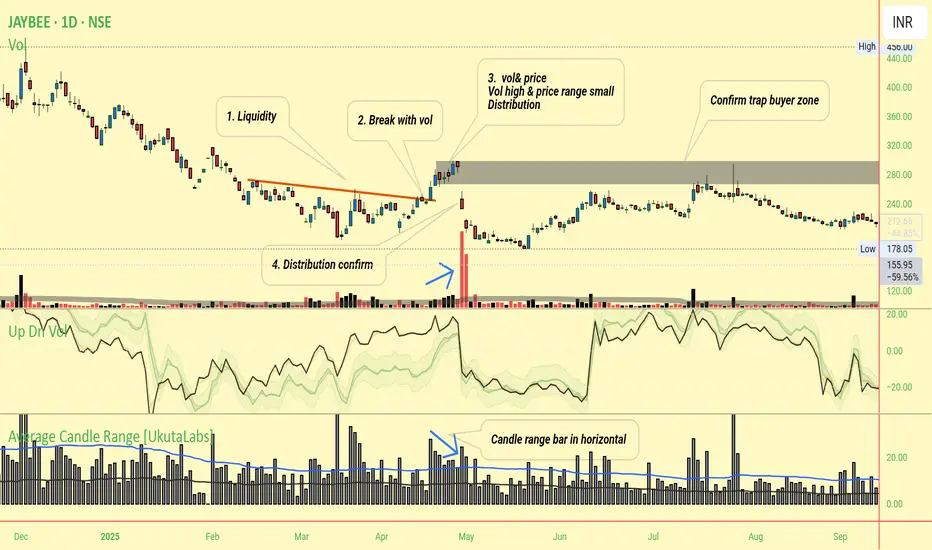
Breakout liquidity accumulation distribution Breakout use as liquidity, offload position using liquidity.
Stock create strong base, given break out with more then avg volume,
After price rise , but With small candle range ( that means buyer+ sellers heavy involved here)
Price range decrease while volume rise show distribution ( offloading someone)
After 4th point big negetive candle if we enter at Breakout must be exited all positions
Because now 3rd point vol rise & small candle now working strong resistance mostly people trap.
Small candle & rise volume distribution confirm only when big candle move down with high volume or low but have big body
( Because big body show dominate sign )
Just make this fast so don't add more details cover in depth
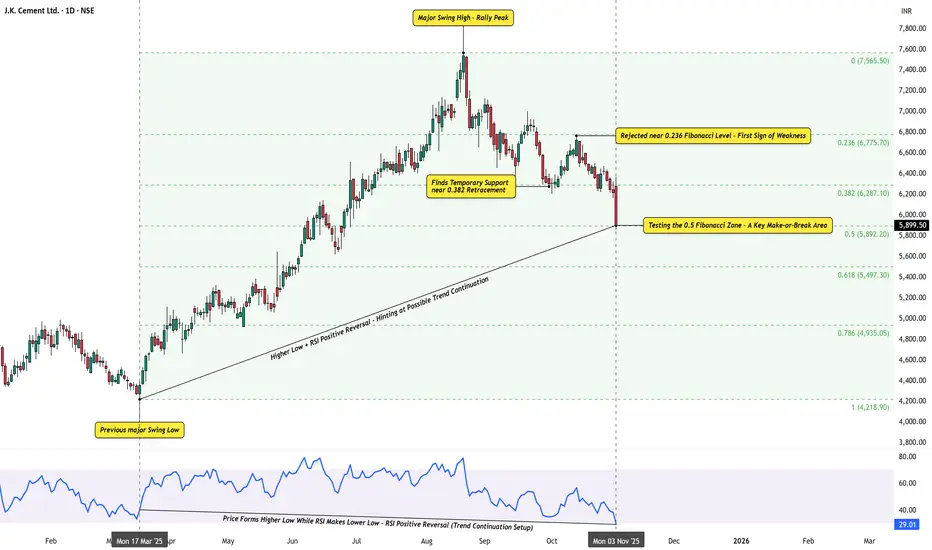
Fibonacci in Action – A Lesson from J.K. CementFibonacci retracement is one of the simplest yet most consistent tools for studying how markets correct within trends.
To understand it better, here’s a clean example from J.K. Cement .
After a strong uptrend from the March 2025 swing low to ₹7,565 , the stock began to retrace. Notice how price behavior respected the Fibonacci structure:
It bounced from the 0.382 level , illustrating a temporary reaction point.
Later, it faced resistance near 0.236 , where rallies often stall during corrective phases.
The 0.5 retracement zone now serves as a classic testing ground that often helps define trend continuation or deeper correction.
Even the RSI pattern offers insight — price forms a higher low while RSI makes a lower low, a textbook positive reversal setup that often aligns with trend studies.
The purpose of this example isn’t prediction, but to show how Fibonacci ratios and RSI behavior interact — highlighting rhythm, structure, and market psychology in motion.
Disclaimer: This analysis is for educational purposes only and does not constitute investment advice. Please do your own research (DYOR) before making any trading decisions.
Part 3 Institutional Trading Options as Hedging Tools
One of the main reasons institutions and traders use options is for hedging. For instance:
A portfolio manager can buy put options to protect against a fall in market prices.
A trader can sell covered calls to earn additional income while holding long-term positions.
This risk management function makes options a vital component of modern financial markets.
Part 2 Ride The Big Moves a. Single-Leg Strategies
Buy Call: Used when expecting a sharp rise.
Buy Put: Used when expecting a sharp fall.
Sell Call or Put: Used when expecting low volatility or price stability.
b. Multi-Leg Strategies
Covered Call: Holding a stock and selling a call against it to earn premium income.
Protective Put: Buying a put to hedge against downside risk in a stock position.
Straddle: Buying both a call and a put at the same strike to profit from volatility.
Strangle: Similar to a straddle but with different strike prices.
Bull Call Spread: Buying a lower strike call and selling a higher strike call to reduce cost.
Bear Put Spread: Buying a higher strike put and selling a lower strike put to reduce premium outlay.
These strategies help manage risk-reward ratios, making options suitable for both speculative and hedging purposes.
Part 1 Ride The Big Moves Option Expiry and Settlement
Every option has an expiry date. In India:
Index options (like Nifty and Bank Nifty) are cash-settled.
Stock options are physically settled, meaning actual delivery of shares can occur if positions are held until expiry.
As the expiry date approaches, time decay (Theta) reduces the option’s value if the underlying doesn’t move in the trader’s favor.
Part 2 Intraday Tradiing Master ClassHow Option Pricing Works
Option prices (premiums) are influenced by several factors. The most important are:
Underlying Price: The current price of the stock/index.
Strike Price: The difference between the current price and strike determines moneyness.
Time to Expiry: The more time left, the higher the premium (time value).
Volatility: Higher volatility increases the premium since there’s a greater chance of price movement.
Interest Rates & Dividends: These also affect option pricing slightly.
A famous model called the Black-Scholes Model is commonly used to calculate theoretical option prices based on these factors.
Part 1 Intraday Tradiing Master ClassTypes of Options
There are two basic types of options:
a. Call Option
A Call Option gives the buyer the right to buy an underlying asset at the strike price before the expiry date.
The buyer of a call expects the price of the asset to rise.
The seller (writer) of a call expects the price to fall or remain stable.
b. Put Option
A Put Option gives the buyer the right to sell an underlying asset at the strike price before expiry.
The buyer of a put expects the asset’s price to fall.
The seller (writer) of a put expects the price to rise or remain stable.
Advanced Hedging Strategies1. Understanding Advanced Hedging
At its core, hedging is a risk management technique that involves taking an offsetting position in a related asset to counterbalance potential losses. Advanced hedging, however, goes beyond simple protection. It focuses on optimizing risk-reward ratios, using derivatives combinations, and dynamically adjusting exposures according to market conditions. It is frequently used by institutional investors, hedge funds, multinational corporations, and sophisticated traders.
The aim is not just to eliminate risk but to control volatility, enhance returns, and maintain strategic flexibility.
2. Tools Used in Advanced Hedging
Before exploring the strategies, it’s important to understand the instruments used:
Options (Calls and Puts): Provide the right but not the obligation to buy or sell assets at a predetermined price.
Futures Contracts: Obligate both parties to transact at a set price on a future date.
Forwards: Customized agreements similar to futures but traded over the counter (OTC).
Swaps: Exchange of cash flows or financial instruments, commonly used to hedge interest rate or currency risks.
Exotic Derivatives: Include barrier options, binary options, and variance swaps, offering tailored risk exposures.
Advanced hedging strategies often combine several of these instruments into structured or synthetic positions.
3. Delta Hedging (Dynamic Hedging)
Delta hedging is a sophisticated options-based strategy that aims to neutralize the directional risk of an options position. “Delta” measures how much an option’s price changes relative to the underlying asset’s price.
For example, a trader holding a call option with a delta of 0.6 will hedge by selling 0.6 units of the underlying asset. As the asset price changes, the delta also changes, requiring continuous rebalancing — this is known as dynamic hedging.
Advantages:
Provides precise, real-time risk control.
Effective in managing volatility in fast-moving markets.
Challenges:
Requires constant monitoring and transaction costs.
Can lead to losses in extremely volatile or illiquid markets.
This strategy is common in options market-making, algorithmic trading, and institutional portfolio management.
4. Cross-Hedging
Cross-hedging occurs when the hedging instrument and the underlying asset are not identical but are correlated. This is often used when a direct hedge is unavailable or too costly.
For example, a jet fuel buyer might hedge fuel costs using crude oil futures since both prices move similarly. Similarly, a company exposed to a small currency may hedge through a major correlated currency.
Key to success: Correlation analysis. The hedge’s effectiveness depends on how closely the two assets move together.
Advantages:
Useful in illiquid or niche markets.
Provides flexibility in hedging complex exposures.
Limitations:
Imperfect correlation can lead to basis risk — the risk that the hedge and the asset move differently.
5. Interest Rate and Currency Swaps
Swaps are powerful tools in advanced hedging, especially for corporations and financial institutions exposed to interest rate or foreign exchange fluctuations.
Interest Rate Swaps: Allow companies to exchange fixed-rate payments for floating-rate ones, or vice versa.
Example: A firm with variable-rate debt may enter a swap to pay a fixed rate and receive a floating rate, stabilizing its interest expenses.
Currency Swaps: Used by multinational corporations to hedge exposure to exchange rate volatility in cross-border operations.
Benefits:
Long-term protection against rate or currency changes.
Can be customized to suit exposure duration and cash flow patterns.
Drawbacks:
Requires counterparties and involves credit risk.
Complex to price and monitor.
6. Options Combinations and Exotic Strategies
Professional traders often design options spreads or combinations for advanced hedging.
Examples include:
Collar Strategy: Combining a long position in the underlying with a protective put and a covered call. It limits both downside and upside risk.
Butterfly Spread: Involves multiple strikes to profit from low volatility while limiting risk.
Protective Put: Buying a put option to hedge a long position — a simple but powerful form of insurance.
Exotic Options: Barrier, Asian, or lookback options offer tailored protection and payoff structures for complex exposures.
These strategies allow cost-effective, precisely targeted, and conditional hedging.
7. Volatility Hedging
In turbulent markets, volatility becomes a risk of its own. Traders use volatility derivatives, such as VIX futures or variance swaps, to hedge exposure to market volatility.
For instance, during expected market turbulence, an investor might buy VIX futures or long volatility options to offset potential losses from market declines.
Advantages:
Protects against unpredictable volatility spikes.
Enhances portfolio stability in crisis periods.
Limitation:
Complex valuation and often expensive due to volatility premiums.
8. Tail Risk Hedging
Tail risk refers to extreme market events — low-probability but high-impact scenarios (like 2008’s financial crisis). Tail risk hedging involves using out-of-the-money (OTM) options or structured derivatives that pay off in extreme moves.
Hedge funds and institutional investors often dedicate a portion of their portfolio to such protection.
Examples:
Buying deep OTM puts on major indices.
Using credit default swaps (CDS) to hedge corporate bond risk.
Though costly during normal times, these hedges act as portfolio insurance during financial shocks.
9. Statistical and Quantitative Hedging
With the rise of algorithmic and quantitative finance, statistical hedging models use mathematics and machine learning to predict correlations and hedge dynamically.
Popular methods include:
Pairs Trading: Hedging two correlated assets (long one, short another).
Factor Hedging: Neutralizing exposure to risk factors like size, momentum, or value.
Machine Learning Models: Adaptive algorithms that adjust hedges in real-time using data patterns.
These quantitative strategies optimize efficiency and minimize human bias, often used by hedge funds and algorithmic trading systems.
10. Dynamic Portfolio Rebalancing
Advanced hedging isn’t static. It involves dynamic rebalancing — adjusting hedge ratios as market conditions evolve. Delta changes, volatility shifts, or interest rate movements may require frequent recalibration.
Portfolio managers often use Value at Risk (VaR) and stress testing to measure and fine-tune hedge effectiveness.
11. Strategic Considerations and Risks
While advanced hedging enhances risk control, it involves challenges:
Cost: Complex derivatives carry premiums and transaction fees.
Liquidity Risk: Some instruments may be difficult to exit in volatile markets.
Model Risk: Overreliance on quantitative models can lead to misjudgments.
Counterparty Risk: OTC contracts expose traders to default risk.
Therefore, successful advanced hedging requires continuous monitoring, robust analytics, and disciplined execution.
12. Conclusion
Advanced hedging strategies form the backbone of modern risk management. By intelligently combining instruments such as futures, options, swaps, and derivatives, investors can shield their portfolios from adverse market movements while maintaining exposure to potential gains. Whether through delta hedging, cross-hedging, volatility trades, or quantitative models, the essence of advanced hedging lies in precision, adaptability, and foresight.
Market Microstructure and Institutional Trading Strategies1. Introduction
Financial markets appear to be simple arenas where buyers and sellers exchange assets like stocks, bonds, or derivatives. However, beneath the surface lies a complex and dynamic framework known as market microstructure, which governs how trades occur, how prices are formed, and how information flows. Understanding this structure is crucial for institutional traders—large entities such as hedge funds, mutual funds, and investment banks—who move massive volumes of capital and rely on sophisticated strategies to minimize costs, manage risks, and exploit inefficiencies.
Market microstructure analysis goes beyond economics—it involves studying trading mechanisms, order types, liquidity dynamics, and the behavior of participants within electronic trading systems. Institutions, equipped with technology, algorithms, and data, use this knowledge to execute trades strategically and discreetly.
2. Defining Market Microstructure
Market microstructure refers to the study of the processes and outcomes of exchanging assets under explicit trading rules. It focuses on how a market operates rather than why it operates. It examines:
Trading mechanisms: How buyers and sellers interact (e.g., order-driven vs. quote-driven markets).
Price formation: How transaction prices reflect supply, demand, and information.
Information asymmetry: How private and public information affect prices and trading behavior.
Liquidity: How easily assets can be bought or sold without significantly impacting prices.
Transaction costs: The total cost of trading, including spreads, commissions, and slippage.
In modern financial markets, most trades occur electronically, through exchanges such as the NSE, BSE, NYSE, or NASDAQ, and also through dark pools and alternative trading systems (ATS). Each venue has unique microstructural characteristics that influence trade execution quality.
3. Core Components of Market Microstructure
a) Order Types and Book Dynamics
Orders are instructions to buy or sell. They can be market orders (executed immediately at the best available price) or limit orders (executed at a specified price or better).
The aggregation of limit orders forms the order book, showing real-time supply (asks) and demand (bids). The best bid and ask form the bid-ask spread, a key measure of market liquidity.
Institutional traders carefully analyze order book depth to detect hidden liquidity and avoid market impact.
b) Price Discovery and Efficiency
Price discovery is the process through which the market determines the fair value of a security based on new information and trading activity. A highly efficient market quickly incorporates information into prices. However, inefficiencies often exist due to human behavior, latency, or fragmented liquidity—creating opportunities for algorithmic exploitation.
c) Liquidity and Market Impact
Liquidity describes how easily large orders can be executed without moving prices. High liquidity lowers trading costs, while low liquidity leads to higher market impact—the adverse price movement caused by large trades. Institutions often break large orders into smaller ones to reduce this impact, a technique called order slicing.
d) Information Asymmetry
Not all market participants have equal access to information. Informed traders (e.g., institutions with research insights or advanced models) have an edge over uninformed traders. Market microstructure models like the Glosten-Milgrom or Kyle’s model explain how market makers set prices based on the likelihood of trading with informed participants.
4. Institutional Trading Landscape
Institutional traders dominate global markets, accounting for over 70% of total volume in major exchanges. Their goals differ from retail investors—they focus on minimizing execution costs, preserving anonymity, and optimizing returns through strategic execution.
The main categories of institutional players include:
Mutual funds and pension funds: Long-term investors prioritizing cost efficiency.
Hedge funds: Short-term and opportunistic traders using leverage and derivatives.
Proprietary trading desks: Institutions trading for their own profits.
High-frequency traders (HFTs): Using algorithms to exploit microsecond-level inefficiencies.
5. Institutional Trading Strategies
Institutional strategies are designed around execution quality, liquidity access, and market microstructure insights. Some key strategies include:
a) Algorithmic Trading
Algorithmic trading automates order execution using pre-programmed rules based on time, volume, or price. Algorithms minimize human error and allow precision in execution. Major algorithmic strategies include:
VWAP (Volume Weighted Average Price): Executes trades to match the day’s average traded price by volume.
TWAP (Time Weighted Average Price): Executes evenly over a set time period to reduce market impact.
POV (Percentage of Volume): Trades as a fixed percentage of total market volume.
Implementation Shortfall: Balances execution speed and price impact to minimize total trading costs.
These methods ensure discretion and reduce detection by other traders or algorithms.
b) Statistical Arbitrage
Statistical arbitrage exploits short-term mispricings between correlated securities. By using mathematical models and historical data, institutions identify temporary price divergences—for example, between two companies in the same sector—and trade to profit when prices revert to equilibrium.
c) Market Making and Liquidity Provision
Institutional market makers continuously quote buy and sell prices, profiting from the bid-ask spread while providing liquidity. In exchange, they bear inventory and adverse selection risks if trading against informed participants. Many HFT firms specialize in market making, balancing massive order flows across venues.
d) Dark Pool Trading
To avoid signaling their intentions, institutions use dark pools—private trading venues where large orders are executed anonymously. Prices are typically derived from public exchanges, but the details of participants and order sizes remain hidden. This reduces market impact and helps institutions accumulate or unwind positions quietly.
e) Smart Order Routing (SOR)
SOR technology scans multiple exchanges and trading venues simultaneously to find the best prices and liquidity. For example, if the same stock trades on NSE, BSE, and alternative systems, the router splits the order to achieve optimal execution based on latency, volume, and fees.
6. Role of Technology and High-Frequency Trading
The fusion of technology, speed, and data analytics has redefined institutional trading. High-frequency trading (HFT) algorithms now operate in microseconds, reacting to price changes faster than human perception. They exploit minuscule price discrepancies across markets or react to order book imbalances.
While HFTs improve liquidity and narrow spreads, they also raise concerns about market stability, flash crashes, and predatory behavior—where algorithms anticipate and exploit slower traders.
To stay competitive, institutions invest heavily in:
Co-location services (placing servers near exchange data centers).
Low-latency networks and fiber-optic cables.
Artificial intelligence and machine learning for predictive analytics.
7. Transaction Cost Analysis (TCA)
Every institutional trade generates explicit (fees, commissions) and implicit (spread, market impact, timing) costs. TCA is a systematic approach to measure and minimize these costs.
By comparing execution prices to benchmarks (like VWAP or arrival price), traders assess their execution performance and refine future strategies.
8. Regulation and Market Transparency
Market microstructure is heavily influenced by regulation, ensuring fairness and stability.
In India, SEBI enforces transparency, monitors algorithmic trading, and prevents manipulation. Globally, frameworks like MiFID II (Europe) and Reg NMS (U.S.) promote best execution and transparency across fragmented markets.
However, regulators must constantly adapt to technological advancements such as AI-driven trading and decentralized finance (DeFi).
9. Challenges and Evolving Trends
Institutional trading faces emerging challenges, including:
Data Overload: Massive real-time data streams require advanced analytics.
Latency Arbitrage: Millisecond advantages can create unfair competition.
Regulatory Complexity: Compliance across multiple jurisdictions increases costs.
AI and Quantum Trading: The next frontier involves predictive modeling and ultra-fast computation.
Trends like blockchain-based settlement, tokenized securities, and ESG-integrated trading models are reshaping the future of market microstructure.
10. Conclusion
Market microstructure provides the foundation for understanding how financial markets function at their most granular level. For institutional traders, mastering it is not optional—it’s essential.
By analyzing order flow, liquidity patterns, and execution mechanics, institutions craft strategies that optimize performance while minimizing costs and risks.
In an era where technology defines speed and information defines power, successful institutional trading lies at the intersection of data, discipline, and deep microstructural insight. The future belongs to those who can blend quantitative intelligence with strategic precision—turning market complexity into competitive advantage.
Trading Secrets in the Indian Market1. Understanding the Indian Market Dynamics
The first secret to successful trading in India is understanding the unique nature of its markets. The National Stock Exchange (NSE) and the Bombay Stock Exchange (BSE) dominate equity trading, while commodity and currency markets are handled by exchanges like the Multi Commodity Exchange (MCX) and NSE Currency Derivatives.
India’s markets are driven by a mix of domestic and foreign institutional investors (FIIs), retail investors, and algorithmic traders. Each group behaves differently, creating distinct patterns of price movement. For example, FIIs are often influenced by global macroeconomic trends, while retail investors react to domestic news and momentum. Recognizing which group is driving the market at any given moment helps traders align with the prevailing force rather than fight it.
2. Timing is Everything
In Indian trading, timing plays a crucial role. Unlike Western markets, Indian markets operate from 9:15 AM to 3:30 PM, with distinct phases:
Opening volatility (9:15–9:45 AM): News adjustments and overnight developments cause sharp movements.
Mid-session stability (11 AM–2 PM): Institutional participation increases, offering trend clarity.
Closing action (2:45–3:30 PM): Day traders square off positions, and short-term volatility often spikes.
Smart traders avoid jumping in at the opening frenzy unless they’re skilled scalpers. Instead, they wait for confirmation of trends in mid-session before entering trades. Many successful traders also track pre-open market data and FII-DII activity reports to anticipate the day’s direction.
3. The Secret of Volume Analysis
Volume is the footprint of smart money. In India, large institutions often accumulate or distribute shares quietly before big moves. Monitoring unusual volume spikes in less popular stocks can reveal where institutional money is flowing. Tools like the Volume Weighted Average Price (VWAP) and On-Balance Volume (OBV) help traders identify genuine accumulation versus false breakouts.
For example, if a mid-cap stock consistently trades with increasing volume and stable prices, it often signals stealth buying. Conversely, sudden volume surges after a long rally might indicate distribution — a cue for traders to be cautious.
4. News and Event Trading
The Indian market is highly news-sensitive. Announcements such as RBI policy decisions, GDP releases, corporate earnings, or even political events can cause dramatic swings. Experienced traders prepare in advance by maintaining an economic calendar and building strategies around volatility events.
For instance:
Before budget sessions, traders often position themselves in infrastructure and PSU stocks.
Before RBI rate announcements, banking and NBFC stocks are watched closely.
During election periods, volatility surges across indices, creating short-term trading opportunities.
A key secret is not to chase prices after the news breaks but to anticipate how the news will impact sentiment and position early with proper stop-losses.
5. The Role of Technical Analysis
While fundamental analysis explains why a stock should move, technical analysis shows when it will move. In India, many traders rely on technical tools like moving averages, RSI (Relative Strength Index), MACD (Moving Average Convergence Divergence), and Bollinger Bands.
However, the secret lies not in using too many indicators but in mastering a few. Seasoned traders combine price action with volume, trendlines, and support-resistance zones to create high-probability setups. The Indian market often respects round numbers and psychological levels — for example, Nifty 20,000 or Bank Nifty 45,000 — as traders set key positions there.
6. Institutional and FII Tracking
Foreign Institutional Investors (FIIs) play a massive role in market trends. When FIIs buy heavily, the market tends to rally; when they sell, corrections follow. Daily FII-DII data published by the NSE can reveal institutional sentiment.
The secret? Don’t react to one-day flows. Look for multi-day patterns. If FIIs have been net buyers for several sessions, it usually signals a bullish undertone. Retail traders can ride these institutional waves instead of betting against them.
7. Risk Management — The Hidden Power
No trading secret is more powerful than risk control. Even the best analysis fails without discipline. The Indian market, with its high intraday volatility, can wipe out profits quickly if traders neglect stop-losses.
Professional traders follow the 2% rule — never risk more than 2% of total capital on a single trade. They also use trailing stops to lock in profits as the market moves in their favor. Furthermore, diversification across sectors — IT, banking, energy, and FMCG — helps manage risk exposure during sector rotations.
8. Behavioral and Psychological Edge
Trading success in India is as much about psychology as analysis. The market thrives on fear and greed — both of which trap retail traders. The secret is to cultivate emotional discipline:
Don’t chase momentum after large moves.
Don’t panic sell during temporary dips.
Accept losses gracefully and learn from them.
Smart traders treat trading like a business — with records, reviews, and strategy adjustments. Maintaining a trading journal helps identify emotional biases and recurring mistakes.
9. Using Derivatives and Options Smartly
The derivatives segment — especially options trading — has exploded in India. Yet most retail traders lose money because they speculate without understanding volatility and time decay.
The secret is to use derivatives for hedging and strategic advantage. For example:
Buying calls on strong stocks before earnings.
Selling options in range-bound markets to earn premium decay.
Using spreads to limit risk while maintaining directional exposure.
Experienced traders track open interest (OI) data on NSE to gauge market sentiment. Rising OI with price increases signals bullish positions; falling OI indicates unwinding.
10. Learning from Market Leaders and Technology
The final secret is continuous learning and adaptation. India’s trading ecosystem evolves rapidly — with algo trading, smart order routing, and artificial intelligence now influencing prices. Staying updated with market trends, following top investors, and learning from their strategies gives traders a competitive edge.
Platforms like Zerodha Varsity, TradingView, and NSE Smart Trader offer resources to refine trading skills. Moreover, using algorithmic backtesting tools can help validate strategies before risking real capital.
Conclusion: Mastering the Indian Trading Arena
The Indian market offers immense opportunity — from booming IPOs to active derivatives and commodity trading. However, success isn’t about having inside information; it’s about mastering market behavior, timing, discipline, and strategy.
To summarize the secrets:
Study market dynamics and participant behavior.
Perfect your timing based on market phases.
Use volume to detect smart money.
Trade news with preparation, not emotion.
Keep technical analysis simple but effective.
Follow FII-DII data for institutional direction.
Protect your capital through strict risk management.
Develop emotional discipline and patience.
Use derivatives wisely for hedging and leverage.
Keep learning and adapt to technological advances.
Trading in the Indian market isn’t just about buying low and selling high — it’s about understanding why, when, and how prices move. Those who combine knowledge, discipline, and adaptability turn the market’s volatility into opportunity.
In the end, the greatest trading secret is simple: Consistency beats intensity. Small, disciplined wins every day compound into long-term success in India’s dynamic financial markets.
Derivatives and Hedging RisksIntroduction
In modern financial markets, derivatives play a crucial role in managing uncertainty and volatility. A derivative is a financial instrument whose value is derived from an underlying asset such as stocks, commodities, interest rates, currencies, or indices. These instruments are widely used by investors, corporations, and financial institutions to hedge risks, speculate on price movements, and enhance portfolio performance.
Hedging, on the other hand, refers to the practice of reducing or offsetting potential losses from adverse price movements in an asset. Derivatives are the most efficient tools for hedging because they allow traders to take positions that move inversely to their underlying exposures. Together, derivatives and hedging form the backbone of risk management strategies in global financial systems.
Understanding Derivatives
Derivatives are contracts between two or more parties whose value is based on agreed-upon financial variables. These instruments do not necessarily involve the actual buying or selling of the underlying asset. Instead, they function as financial agreements to exchange cash flows or values based on the performance of the underlying asset.
Main Types of Derivatives
Futures Contracts
Futures are standardized agreements traded on exchanges to buy or sell an asset at a predetermined price and date in the future. Futures are used extensively for hedging commodities, currencies, and indices.
Example: A farmer might sell wheat futures to lock in prices before harvest to protect against falling wheat prices.
Forwards Contracts
Forwards are similar to futures but are traded over-the-counter (OTC) and customized to suit the needs of the buyer and seller. Since they are not standardized, they carry higher counterparty risk.
Example: An importer may enter a forward contract to purchase U.S. dollars at a fixed rate three months ahead to guard against currency depreciation.
Options Contracts
Options give the holder the right, but not the obligation, to buy (call option) or sell (put option) an asset at a predetermined price before or on a specific date. Options are flexible instruments for both hedging and speculation.
Example: An investor may buy a put option on a stock to protect against a potential price decline.
Swaps
Swaps involve the exchange of cash flows between parties, often related to interest rates or currencies. The most common types are interest rate swaps and currency swaps.
Example: A company paying variable interest might enter an interest rate swap to exchange its variable payments for fixed ones, reducing exposure to interest rate fluctuations.
Purpose and Importance of Derivatives
Derivatives serve several essential functions in financial markets:
Risk Management (Hedging) – The most important function of derivatives is to mitigate risk. Investors use derivatives to protect against price changes in commodities, currencies, or securities.
Price Discovery – Futures and options markets provide valuable information about future price expectations, helping businesses plan production and investment.
Market Efficiency – Derivatives improve liquidity, allowing for more efficient capital allocation and portfolio diversification.
Leverage and Speculation – They allow investors to take large positions with smaller capital outlays, though this can increase potential losses.
Understanding Hedging
Hedging is a defensive strategy used to offset potential losses in one position by taking another position in a related derivative instrument. The goal is not to generate profit but to minimize uncertainty and protect against adverse movements.
How Hedging Works
The process of hedging typically involves identifying a risk exposure and then selecting an appropriate derivative instrument to counterbalance that risk.
For example:
An airline company concerned about rising fuel costs might use crude oil futures to lock in fuel prices.
A multinational firm expecting payment in euros might use currency forwards to secure the current exchange rate.
By doing so, these entities ensure that fluctuations in market prices do not drastically affect their financial outcomes.
Common Hedging Instruments
Futures and Forwards for Price Risk
Companies use these contracts to fix the buying or selling price of an asset. This reduces uncertainty in cash flows and budgeting.
Options for Downside Protection
Options allow investors to protect against losses while still participating in potential gains. This is often referred to as an “insurance strategy.”
Swaps for Interest Rate and Currency Risk
Swaps are commonly used by corporations to stabilize cash flows and reduce borrowing costs when dealing with fluctuating interest rates or foreign currencies.
Hedging Strategies in Practice
Commodity Hedging
Producers and consumers of commodities such as oil, gold, or wheat use futures and options to stabilize prices and manage inventory risk.
Currency Hedging
Exporters and importers use forward or futures contracts to protect against adverse exchange rate movements. This ensures predictable revenue and cost structures.
Interest Rate Hedging
Financial institutions use interest rate swaps and futures to manage exposure to changing interest rates. For instance, banks with variable-rate assets and liabilities often hedge to maintain stable margins.
Equity Hedging
Investors use options and index futures to protect portfolios from market downturns. A common approach is buying put options on indices to limit losses during a market correction.
Advantages of Using Derivatives for Hedging
Risk Reduction – The primary advantage is minimizing exposure to market volatility.
Cost Efficiency – Derivatives require smaller initial investments than directly buying or selling the underlying asset.
Flexibility – With multiple contract types and structures, hedgers can customize their risk management approach.
Liquidity and Accessibility – Exchange-traded derivatives are liquid and transparent, offering ease of entry and exit.
Risks and Limitations of Derivatives and Hedging
While derivatives are powerful tools, they also carry certain risks that must be carefully managed.
Market Risk – Prices may move unpredictably, resulting in losses even in hedged positions.
Credit (Counterparty) Risk – In OTC contracts like forwards and swaps, there is a risk that one party may default.
Liquidity Risk – Some derivatives may lack buyers or sellers, making it hard to exit positions.
Operational Risk – Errors in execution, settlement, or valuation can lead to losses.
Basis Risk – The hedge and the underlying exposure may not move perfectly in correlation, resulting in imperfect hedges.
Speculative Misuse – Derivatives can be misused for speculative purposes, amplifying losses due to high leverage.
Regulatory Framework and Risk Management
Post the 2008 financial crisis, global regulators emphasized transparency, reporting, and clearing mechanisms for derivatives. Institutions are now required to:
Use central clearinghouses for standardized contracts.
Maintain adequate collateral (margin) to cover exposures.
Conduct regular stress testing and valuation reviews.
These measures aim to reduce systemic risk and ensure that derivatives serve their intended purpose—effective risk mitigation.
Conclusion
Derivatives and hedging together represent the foundation of modern financial risk management. Derivatives provide powerful mechanisms to transfer and manage risk efficiently, while hedging strategies enable investors and corporations to protect themselves from adverse market movements. When used responsibly, derivatives help stabilize earnings, control costs, and improve financial predictability.
However, their complexity demands a deep understanding and disciplined application. Poorly designed or speculative use can lead to severe financial losses, as history has shown. The key to success lies in prudent strategy, robust regulation, and transparent practices. In essence, derivatives and hedging transform uncertainty into opportunity—offering stability in an unpredictable financial world.
How to Catch Momentum Traders1. Understanding Momentum Trading
Momentum trading is based on a simple but powerful concept: “The trend is your friend.” Momentum traders look for assets that show strong upward or downward trends and enter trades expecting those moves to continue. They don’t rely much on fundamental analysis or long-term value; instead, they focus on price action, volume, and technical signals.
Momentum in markets occurs when a large number of traders and investors pile into a position, causing rapid price acceleration. This can be driven by positive earnings reports, macroeconomic news, market sentiment, or algorithmic activity. As long as the momentum persists, traders can capture substantial profits — but when it reverses, losses can be just as swift.
2. The Psychology Behind Momentum Traders
To catch momentum traders, one must first understand their psychology. Momentum traders are drawn to:
Speed: They prefer fast-moving markets.
Volatility: Higher volatility offers bigger profit potential.
Liquidity: They trade in assets where they can enter and exit easily.
Trends: They look for confirmation of existing price direction, not reversals.
They often use breakout strategies — buying when the price breaks above resistance or shorting when it falls below support. Their collective actions amplify market moves, creating self-reinforcing cycles. Recognizing this crowd behavior helps other traders anticipate momentum-driven surges or collapses.
3. Identifying Momentum Trades in Action
Catching momentum traders begins with identifying when they enter or exit markets. Certain indicators and patterns reveal their presence:
High Trading Volume: A sudden surge in volume signals institutional or retail momentum traders jumping in. Volume confirms the strength of a price move.
Breakouts: When price breaks above previous resistance levels with strong volume, it’s often the starting point of a momentum rally.
Price Acceleration: Rapid price increases or decreases without major pullbacks are typical of momentum trading.
Volatility Expansion: Momentum traders love volatility; rising average true range (ATR) often hints that they are active.
By watching these indicators, you can anticipate when momentum traders are likely entering or exiting, giving you an advantage.
4. Tools and Indicators to Catch Momentum Traders
Momentum traders rely heavily on technical indicators, and these same tools can help others catch their movements. Key ones include:
Relative Strength Index (RSI): Measures speed and change of price movements. Momentum traders often enter when RSI crosses above 50 or 70, signaling strong bullish momentum.
Moving Average Convergence Divergence (MACD): Identifies momentum shifts. A bullish crossover often indicates that momentum traders are entering.
Volume Oscillator: Highlights surges in volume that accompany price trends.
Rate of Change (ROC) and Momentum Indicators: Directly show how fast price is changing, helping identify momentum bursts.
Moving Averages (20-day or 50-day): Price consistently staying above a moving average signals continued momentum.
By monitoring these indicators in real-time, one can identify when momentum traders are likely to act — or when they might be exhausted.
5. Following the Money: Watching Institutional Flow
While many momentum traders are retail participants, large institutional players also engage in momentum strategies using algorithmic systems. To catch them, monitor order flow and market depth:
Order Book Data: Large buy or sell orders can signal where institutional momentum traders are accumulating or distributing positions.
Volume-Weighted Average Price (VWAP): Momentum traders often enter when price crosses above VWAP, showing market strength.
Dark Pool Activity: A sudden rise in dark pool trades can hint at institutional buildup before visible market momentum.
Understanding these flows can help you anticipate short-term trends before the broader market catches on.
6. Trading Strategies to Catch Momentum Traders
Once you’ve identified momentum activity, there are several ways to trade effectively around it:
A. Trade with the Momentum
This approach means joining the trend early and riding the wave. To do this:
Wait for confirmation via volume and breakout.
Use tight stop-losses to manage risk.
Scale out gradually as momentum matures.
For example, if a stock breaks above resistance with double average volume, entering shortly after confirmation can capture a strong upward move.
B. Fade the Momentum
Advanced traders sometimes trade against momentum when it looks overextended. Signs of exhaustion include:
RSI above 80 (overbought) or below 20 (oversold).
Divergence between price and momentum indicators (e.g., price rises but RSI drops).
Sharp reversal candles like shooting stars or bearish engulfing patterns.
Timing is critical; entering too early can lead to losses, as momentum can persist longer than expected.
C. Momentum Reversal Traps
Sometimes momentum traders push prices to extremes, creating opportunities for reversal setups. By waiting for false breakouts or sudden volume drop-offs, contrarian traders can profit when momentum collapses.
7. The Role of News and Sentiment
Momentum traders react swiftly to news — earnings, economic releases, political events, or even social media hype. Monitoring news feeds, Twitter sentiment, and Reddit or X (formerly Twitter) discussions can reveal where retail momentum might strike next.
Tools like Google Trends, social sentiment trackers, and alternative data feeds help anticipate “hot” assets before they explode in price. Momentum-driven rallies often start with strong emotional triggers — greed, fear, or excitement — amplified by online chatter.
8. Risk Management When Dealing with Momentum Traders
Catching momentum traders can be profitable, but it’s risky. Momentum trades reverse sharply, and being on the wrong side can cause steep losses. To manage risk:
Set stop-losses tightly to limit exposure.
Avoid chasing late moves — entering after most of the momentum has played out.
Use trailing stops to lock in profits while allowing room for trends to continue.
Diversify across assets to avoid concentrated momentum shocks.
Momentum markets can be emotional and unpredictable — discipline is essential.
9. Recognizing Momentum Exhaustion
Momentum cannot last forever. The key to catching traders is knowing when they’re about to exit. Warning signs include:
Diminishing volume after a strong run.
Price stagnation despite positive news.
Divergences in RSI or MACD indicating weakening trend strength.
Parabolic price rise followed by sharp pullbacks.
When these appear, momentum traders are likely reducing positions or reversing direction — a perfect signal for strategic counter-trades.
10. Combining Technical and Behavioral Insights
The most successful way to catch momentum traders is by merging technical analysis with behavioral understanding. Markets move not just because of charts but because of emotions — greed, fear, and herd behavior. Recognizing patterns of crowd psychology alongside price signals provides deeper insights.
For instance:
Fear-driven selling during bad news can create oversold momentum trades.
FOMO-driven rallies often signal near-term tops.
Algorithmic bursts create predictable short-term spikes.
By studying how traders react collectively, you can identify entry and exit points that align with — or exploit — momentum participants’ behavior.
Conclusion
Catching momentum traders isn’t about outsmarting them — it’s about understanding and timing them. Momentum trading shapes short-term market movements, and those who can identify when and where it happens gain a significant advantage.
The keys are:
Recognize technical signals like breakouts, volume surges, and volatility expansion.
Track order flow and institutional participation.
Manage risk carefully with stop-losses and profit-taking strategies.
Understand trader psychology — emotion fuels momentum.
In essence, markets are waves of energy created by collective behavior. Momentum traders ride those waves — and with the right tools, timing, and mindset, you can catch them before they crest or crash.
Carbon Credit and ESG Trading: A New Era of Sustainable Finance1. Understanding Carbon Credits
A carbon credit represents a permit that allows a company or organization to emit a certain amount of carbon dioxide (CO₂) or other greenhouse gases (GHGs). Typically, one carbon credit equals one metric ton of CO₂ equivalent (CO₂e). The concept emerged from the Kyoto Protocol (1997) and was further refined under the Paris Agreement (2015), both of which aimed to create global mechanisms to reduce emissions.
There are two primary carbon markets:
Compliance Markets: These are regulated by governments or international bodies. Entities are assigned emission caps, and if they exceed them, they must buy carbon credits from others who have reduced emissions below their limits.
Example: The European Union Emissions Trading System (EU ETS) is the world’s largest compliance carbon market.
Voluntary Markets: Here, companies or individuals purchase carbon credits voluntarily to offset their emissions, even if they are not mandated to do so.
Example: A corporation may offset its air travel emissions by investing in reforestation or renewable energy projects.
2. How Carbon Credit Trading Works
The carbon trading system operates under a “cap-and-trade” model:
Cap Setting: A governing body sets a limit (cap) on the total emissions allowed within a specific sector or region.
Allocation: Companies receive or purchase emission allowances.
Trading: Firms that emit less than their allowance can sell their surplus credits to others who exceed their limits.
Verification: Independent auditors verify emission reductions to ensure integrity and transparency.
This market-based approach incentivizes companies to invest in cleaner technologies, as reducing emissions can generate tradable credits and financial rewards.
3. Economic and Environmental Impact
Carbon trading creates an economic value for emission reductions, encouraging innovation in renewable energy, energy efficiency, and carbon capture. It aligns business incentives with environmental outcomes. By putting a price on carbon, it makes pollution a financial liability rather than an external cost.
Globally, the carbon market is expanding rapidly. The EU ETS, China’s National ETS, and California’s Cap-and-Trade Program together cover billions of tons of CO₂ annually. The voluntary carbon market also reached record highs, driven by corporate net-zero commitments and growing environmental awareness among consumers.
4. Challenges in Carbon Trading
Despite its promise, carbon trading faces challenges:
Lack of Standardization: Different countries and organizations follow varied methodologies for measuring and verifying carbon credits.
Greenwashing: Some companies use carbon offsets to appear sustainable without making real emission reductions.
Price Volatility: Carbon credit prices fluctuate due to regulatory changes and market sentiment.
Double Counting: Ensuring that emission reductions are not claimed by multiple parties remains a key concern.
To enhance credibility, organizations like Verra (VCS), Gold Standard, and Climate Action Reserve have established verification frameworks to certify carbon projects and improve transparency.
5. Introduction to ESG Trading
ESG trading refers to the practice of integrating environmental, social, and governance factors into investment decisions and portfolio management. ESG metrics assess how responsibly a company operates and how sustainable its business practices are in the long term.
Environmental factors include carbon emissions, renewable energy use, waste management, and resource conservation.
Social factors cover labor practices, human rights, diversity, and community impact.
Governance factors focus on corporate ethics, board structure, transparency, and compliance.
Investors increasingly view ESG performance as a proxy for risk management and long-term resilience, rather than mere philanthropy.
6. ESG Investing and Market Growth
ESG investing has grown exponentially over the past decade. Global ESG assets surpassed $40 trillion by 2025, reflecting a major shift in capital allocation. Institutional investors, sovereign wealth funds, and retail traders alike are demanding greater accountability and disclosure from companies.
Financial products linked to ESG include:
Green Bonds: Debt instruments financing environmentally friendly projects.
Sustainability-linked Loans: Interest rates tied to ESG performance targets.
ESG ETFs and Mutual Funds: Funds that invest in companies with strong ESG ratings.
Stock exchanges worldwide—such as the London Stock Exchange, Singapore Exchange, and Bombay Stock Exchange (BSE)—now require listed companies to disclose ESG data, ensuring transparency and comparability.
7. Carbon Credit and ESG Trading: The Connection
Carbon credit trading and ESG investing intersect in several ways:
Environmental Metrics: Carbon reduction is a key “E” metric in ESG scoring. Companies active in carbon markets often score higher on environmental performance.
Financial Innovation: ESG funds are increasingly integrating carbon offset credits into their portfolios or partnering with projects that generate verified credits.
Corporate Strategy: Firms that trade or retire carbon credits to offset emissions can strengthen their ESG profiles, attracting sustainable investors.
In essence, carbon trading contributes to quantifiable ESG outcomes, helping corporations demonstrate tangible progress toward net-zero goals.
8. Technological Advancements in Carbon and ESG Markets
Emerging technologies are transforming both carbon and ESG trading:
Blockchain: Ensures transparency and traceability in carbon credit issuance and trading, preventing fraud or double-counting.
AI and Data Analytics: Improve ESG scoring by analyzing vast datasets from sustainability reports, satellite imagery, and social media.
Tokenization: Digital carbon credits (like KlimaDAO and Toucan Protocol) are creating decentralized carbon markets, enabling small investors to participate.
Such innovations enhance accessibility, liquidity, and trust—key pillars for scaling sustainable finance.
9. Global Policy and Regulation
Governments and regulators are increasingly aligning policies to support carbon and ESG markets:
The Paris Agreement (2015) commits nations to limit global warming to below 2°C.
The Task Force on Climate-related Financial Disclosures (TCFD) promotes standardized climate reporting.
The EU Taxonomy defines what qualifies as a sustainable activity, guiding ESG investors.
India’s Perform, Achieve, and Trade (PAT) scheme and Carbon Credit Trading Scheme (CCTS) are local examples encouraging carbon efficiency.
As climate risks become financial risks, central banks and regulators are integrating sustainability criteria into their frameworks.
10. The Future of Carbon and ESG Trading
The future points toward convergence—where carbon markets and ESG frameworks reinforce each other to drive a sustainable economy. Companies with strong ESG credentials will have better access to carbon finance, and carbon-neutral portfolios will become mainstream.
Looking ahead, the focus will shift from offsetting emissions to reducing them at the source. Investors will increasingly demand measurable impact and verified sustainability data, making transparency a competitive advantage. Carbon credit prices are expected to rise as governments tighten emission caps, creating both opportunities and risks for traders and corporations.
Conclusion
Carbon credit and ESG trading represent the twin engines of sustainable capitalism. While carbon credits place a tangible price on environmental impact, ESG trading embeds sustainability into the financial DNA of markets. Together, they redefine how companies measure success—not merely in profit, but in purpose.
As the global economy moves toward decarbonization, those who integrate carbon efficiency and ESG principles early will not only protect the planet but also unlock new financial value in the green economy of the future.
Multi Commodity Exchange of India (MCX)1. Understanding MCX and Its Role
Founded in 2003, the Multi Commodity Exchange (MCX) is India’s leading commodity derivatives exchange, regulated by the Securities and Exchange Board of India (SEBI). It provides a transparent platform for price discovery and risk management in commodities. Traders, investors, producers, and importers use it to hedge against price volatility and gain exposure to commodities without physically owning them.
MCX primarily deals in futures contracts—agreements to buy or sell a commodity at a predetermined price and date. Recently, options trading on MCX has also gained momentum, giving traders flexibility to manage risks more effectively.
2. Why Trade on MCX?
Trading on MCX has several advantages that attract both individual and institutional investors:
Diversification: Commodity trading helps diversify portfolios beyond stocks and bonds.
Inflation Hedge: Commodities like gold and crude oil often move in tandem with inflation, protecting against purchasing power loss.
Transparency: Prices on MCX reflect real-time market conditions influenced by domestic and global factors.
Leverage Opportunity: Traders can control large positions with a relatively small margin.
Hedging Tool: Farmers, importers, and industrial users can hedge against price fluctuations.
3. Key Commodities Traded on MCX
MCX offers contracts across various sectors:
Bullion: Gold, Silver
Energy: Crude Oil, Natural Gas
Base Metals: Copper, Zinc, Lead, Nickel, Aluminium
Agri-commodities: Cotton, CPO (Crude Palm Oil), Mentha Oil, Cardamom
Each commodity has its own contract size, expiry date, and tick size (minimum price movement). Traders should familiarize themselves with these specifications before entering trades.
4. How MCX Trading Works
Trading on MCX resembles stock market trading but focuses on commodity futures. Here’s a simplified flow:
Select a Commodity: Choose based on research, volatility, and interest.
Analyze the Market: Study price charts, trends, and fundamentals.
Place an Order: Use a registered broker to execute buy/sell positions.
Monitor Margins: Maintain margin requirements to avoid liquidation.
Square Off or Roll Over: Close positions before expiry or shift to a future contract.
Contracts are cash-settled, meaning there’s no need for physical delivery unless specifically opted for.
5. Opening an MCX Trading Account
To start trading on MCX, follow these steps:
Select a SEBI-Registered Broker: Popular brokers include Zerodha, Angel One, Upstox, and ICICI Direct.
Open a Trading and Demat Account: Submit KYC documents—PAN, Aadhaar, bank proof, and photo.
Deposit Margin Money: Brokers may require an initial margin to start trading.
Get Access to Trading Platform: Use broker-provided software or apps for real-time trading.
6. Strategies for Successful MCX Trading
MCX trading is driven by both technical and fundamental factors. Here are essential strategies for consistent performance:
a) Technical Analysis
Use charts, price patterns, and indicators such as Moving Averages, RSI (Relative Strength Index), MACD, Bollinger Bands, and Fibonacci retracements to predict market trends and identify entry/exit points.
b) Fundamental Analysis
Monitor macroeconomic factors like global demand-supply dynamics, weather patterns, geopolitical tensions, inventory data, and currency fluctuations. For example, crude oil prices depend on OPEC decisions and global energy demand.
c) Trend Following Strategy
Commodities often show strong directional trends. Identifying and following these trends using moving averages or breakout patterns can be highly effective.
d) Range Trading
In less volatile periods, commodities tend to move within defined price ranges. Traders can buy at support levels and sell at resistance.
e) Hedging Strategy
Producers and consumers of commodities hedge to protect against price swings. For example, a jeweler may hedge gold prices by taking opposite positions in futures.
7. Risk Management in MCX Trading
Managing risk is the cornerstone of successful trading. Commodity markets can be volatile, and leverage amplifies both gains and losses. Key risk management principles include:
Use Stop-Loss Orders: Always set stop-loss levels to limit downside risk.
Position Sizing: Never risk more than 2–3% of your trading capital in one position.
Avoid Over-Leverage: High leverage can quickly wipe out your capital during volatile swings.
Diversify Across Commodities: Don’t put all your funds in a single commodity.
Regular Monitoring: Keep track of open positions and adjust based on market conditions.
8. Economic Factors Influencing MCX Prices
Commodity prices on MCX are affected by a mix of domestic and international forces:
Global Supply and Demand: For example, oil prices rise when global supply tightens.
Currency Fluctuations: Commodities priced in USD move inversely to the Indian rupee.
Government Policies: Export/import regulations, taxes, and duties can alter prices.
Inflation and Interest Rates: Higher inflation often drives commodity prices up.
Geopolitical Events: Wars, sanctions, or trade disruptions influence commodity flows.
9. Common Mistakes to Avoid in MCX Trading
Many beginners lose money in MCX trading due to emotional decisions and lack of planning. Avoid these mistakes:
Trading Without Research: Entering trades based on rumors or tips is risky.
Ignoring Stop-Loss: Not setting stop-loss levels leads to major losses.
Overtrading: Excessive trading often reduces profits due to high transaction costs.
Lack of Discipline: Successful trading requires patience and consistent strategy execution.
Neglecting Global News: Commodity markets are globally linked—always follow global updates.
10. Tips for Long-Term Success
To master MCX trading and build consistent profits:
Stay Educated: Continuously learn about commodity trends, technical tools, and new regulations.
Backtest Strategies: Analyze past performance before applying strategies in live markets.
Keep a Trading Journal: Record all trades—entry/exit, reason, and outcome—to identify strengths and weaknesses.
Focus on Select Commodities: Start with 2–3 commodities and gain expertise before expanding.
Control Emotions: Fear and greed are traders’ worst enemies; follow logic, not emotion.
Conclusion
Trading on the Multi Commodity Exchange (MCX) offers immense opportunities for wealth creation, diversification, and risk management—but it also demands discipline, analytical skill, and patience. A successful MCX trader treats the market as a profession, not a gamble. By combining technical insights, fundamental awareness, and strict risk control, traders can build a sustainable edge in India’s vibrant commodity markets.
Ultimately, the key to MCX success lies not just in predicting prices but in managing risks, understanding market behavior, and executing a consistent strategy. Whether you’re hedging business exposure or trading for profit, MCX offers a world of opportunities—if approached wisely and strategically.
How to Trade Smart with Crypto1. Understand the Crypto Market Fundamentals
Before you can trade smart, you must understand what you’re trading. Cryptocurrencies are decentralized digital assets built on blockchain technology. Bitcoin (BTC), Ethereum (ETH), Solana (SOL), and thousands of others represent different projects, purposes, and technologies.
Key points to understand:
Bitcoin (BTC) is the first and most influential cryptocurrency, often seen as a digital store of value.
Altcoins like Ethereum, Binance Coin, and Cardano serve specific network functions (smart contracts, DeFi, etc.).
Stablecoins (like USDT, USDC) are pegged to fiat currencies and used for liquidity and hedging.
Tokens vs. Coins: Coins operate on their own blockchain (e.g., Bitcoin), while tokens are built on others (e.g., Uniswap token on Ethereum).
Understanding market structure—spot trading, futures, leverage, and decentralized exchanges (DEXs)—helps you make informed decisions rather than emotional ones.
2. Choose a Reliable Exchange and Secure Your Assets
Trading starts with choosing the right exchange. Reputable centralized exchanges like Binance, Coinbase, Kraken, or Bybit offer security, liquidity, and various tools. For advanced users, decentralized exchanges like Uniswap or PancakeSwap provide more control and privacy.
Smart traders prioritize security:
Use hardware wallets (Ledger, Trezor) for long-term storage.
Enable two-factor authentication (2FA) and strong passwords.
Avoid keeping large sums on exchanges; “not your keys, not your coins” is a golden rule.
A smart trader treats cybersecurity as seriously as trading strategy—because one mistake can mean total loss.
3. Learn Market Analysis: Fundamental vs. Technical
Two main forms of analysis drive smart trading: fundamental analysis (FA) and technical analysis (TA).
Fundamental Analysis
FA examines the intrinsic value of a crypto asset. Key factors include:
Project purpose – What problem does it solve?
Team and development – Are the developers credible?
Tokenomics – Supply, demand, and utility.
Adoption and partnerships – Who’s using or supporting it?
For example, Ethereum’s strength comes from its use in decentralized applications and DeFi, while meme coins often lack fundamentals and depend on hype.
Technical Analysis
TA studies price charts and patterns to forecast market behavior. Smart traders use indicators like:
Moving Averages (MA) – Identify trend direction.
Relative Strength Index (RSI) – Detect overbought or oversold conditions.
MACD – Reveal momentum shifts.
Support and Resistance – Predict entry and exit zones.
Combining FA and TA provides a balanced, data-driven approach instead of trading on speculation or emotion.
4. Develop a Clear Trading Strategy
A smart crypto trader never trades blindly. Instead, they follow predefined strategies based on risk appetite and time commitment.
Common strategies include:
a. Day Trading
Frequent trades within a day, taking advantage of volatility. It requires constant monitoring and fast decisions.
b. Swing Trading
Holding positions for days or weeks to capture medium-term price movements. It’s less stressful but demands chart analysis.
c. Scalping
High-frequency trading to profit from small price changes. This needs precision, low fees, and strong emotional control.
d. Position Trading
Long-term strategy based on major trends or fundamental belief in an asset’s future. Often used by Bitcoin or Ethereum holders.
e. Dollar-Cost Averaging (DCA)
Investing a fixed amount periodically regardless of price. It reduces emotional bias and smooths out volatility over time.
Choose a method that fits your lifestyle, time availability, and psychological comfort.
5. Manage Risk Like a Professional
Trading smart is not about maximizing profits—it’s about minimizing losses.
Risk management separates successful traders from gamblers.
Key principles include:
Never risk more than 1–2% of your capital per trade.
Set stop-loss orders to automatically limit downside.
Take-profit targets to secure gains.
Diversify: Don’t put all your money into one coin or project.
Use leverage cautiously: Leverage amplifies both gains and losses.
A disciplined trader thinks in probabilities, not certainties. Even the best setups can fail; risk management ensures you live to trade another day.
6. Keep Emotions in Check
The crypto market is extremely volatile—prices can move 20% in an hour. Greed and fear often drive traders to make impulsive decisions. Smart traders master their emotions by following a system, not feelings.
Avoid:
FOMO (Fear of Missing Out) – Chasing hype can lead to buying tops.
Panic Selling – Dumping assets during dips often locks in losses.
Overtrading – Too many trades increase fees and mistakes.
Build emotional discipline by keeping a trading journal—record why you entered and exited a trade. Reviewing patterns helps you identify emotional triggers.
7. Stay Updated and Adapt
Crypto evolves daily—new technologies, regulations, and narratives emerge constantly. Staying informed gives traders an edge.
Follow:
News platforms like CoinDesk, CoinTelegraph, and Decrypt.
Data tools like CoinMarketCap and Glassnode.
On-chain analytics for wallet movements and whale activity.
Social signals from Twitter, Reddit, and Discord (with caution).
Adaptability is essential. For instance, shifts like Ethereum’s “Merge,” Bitcoin halving cycles, or new layer-2 solutions can drastically impact market sentiment.
8. Understand Market Cycles and Sentiment
Crypto operates in cycles driven by liquidity, investor psychology, and Bitcoin halving events. Typically:
Bull Markets – Optimism and price surges.
Bear Markets – Pessimism, consolidation, and accumulation phases.
Smart traders use tools like the Fear & Greed Index or on-chain metrics (e.g., exchange inflows) to read sentiment and position accordingly. They accumulate during fear and take profits during euphoria—the opposite of the crowd.
9. Embrace Automation and Tools
Smart traders leverage technology:
Trading bots execute automated strategies using algorithms.
Portfolio trackers like CoinStats or Zapper monitor performance.
Alert tools like TradingView notify price movements.
DeFi protocols enable yield generation through staking or liquidity provision.
However, automation requires careful setup. Bots can fail in volatile markets, so human oversight remains critical.
10. Think Long-Term and Build Wealth Sustainably
The smartest crypto traders see the market not just as a casino, but as a wealth-building ecosystem. They combine trading with long-term investing, staking, and diversification across assets like NFTs, DeFi tokens, and Bitcoin.
Principles for long-term success:
Compound your gains instead of withdrawing impulsively.
Learn continuously through books, courses, and communities.
Protect capital—survival is the first step to profitability.
Have patience—crypto rewards those who endure cycles.
Remember: The most successful traders are not those who made one lucky trade but those who consistently manage risk and adapt over time.
Conclusion
Trading smart in crypto is a blend of knowledge, strategy, and discipline. It’s about understanding market behavior, applying data-driven decisions, managing emotions, and protecting capital. While the market offers immense opportunities, it equally demands respect for its volatility and unpredictability.
Smart crypto trading isn’t about predicting every move—it’s about building a system that survives and thrives across all conditions. Whether you’re a beginner or a seasoned trader, the path to success lies in continuous learning, emotional mastery, and a focus on long-term growth rather than short-term greed.
In the ever-changing world of digital assets, remember this timeless rule:
Trade with logic, not emotion. Plan every move, and let patience and discipline guide your profits.
Part 1 Support and Resistance Introduction to Options
Option trading is one of the most powerful and flexible instruments in the financial markets. It allows traders and investors to speculate, hedge, or enhance returns with limited risk. Simply put, an option is a contract that gives the buyer the right, but not the obligation, to buy or sell an underlying asset (like a stock, index, or commodity) at a predetermined price (strike price) before or on a specific date (expiry date).
Unlike shares, which represent ownership in a company, an option is a derivative instrument — its value is derived from the price of an underlying asset. Options are widely traded in stock markets, especially on exchanges like the NSE (National Stock Exchange) in India and NYSE/NASDAQ in the U.S.