Market Bubbles & Crashes in IndiaHistorical Context of Market Bubbles in India
India's financial markets have evolved over the last century, but the modern stock market history largely starts post-independence. The Bombay Stock Exchange (BSE), established in 1875, has been the central hub for trading activity, now supplemented by the National Stock Exchange (NSE), founded in 1992. Throughout this history, India has experienced multiple market bubbles and crashes, some unique to its economic environment and others reflective of global trends.
Major Market Bubbles in India
1. Harshad Mehta Bubble (1992)
One of the most infamous market bubbles in Indian history was the 1992 Harshad Mehta scam, which caused a meteoric rise in stock prices, particularly in the banking and IT sectors. Mehta exploited loopholes in the banking system to manipulate stock prices, creating artificial demand. The BSE Sensex rose from about 1,000 points in early 1990 to nearly 5,000 points by April 1992—a staggering 400% increase in two years.
Causes of the Bubble:
Financial system loopholes, especially in ready-forward deals.
Excessive speculative trading by retail and institutional investors.
Media hype and public optimism, driving momentum investing.
Crash Trigger:
When the scam was exposed, investor confidence collapsed. Stocks plummeted, wiping out enormous wealth. The Sensex fell by almost 60% over a few months. The aftermath led to reforms in banking, securities regulations, and transparency norms.
2. Dot-Com Bubble (1999–2000)
India’s technology sector experienced a bubble during the dot-com boom of the late 1990s. Fueled by global technology optimism, internet-related and IT companies saw their valuations skyrocket despite limited profits. The Sensex rose from around 3,000 points in 1998 to over 6,000 points in early 2000.
Causes:
Global IT optimism and foreign investment inflows.
High investor appetite for tech IPOs despite uncertain business models.
Liberalization policies encouraging foreign institutional investment.
Crash:
When the global tech bubble burst in 2000, the Indian market corrected sharply. Many overvalued IT firms collapsed, and investors faced substantial losses. This crash highlighted the risk of speculative inflows in emerging markets and emphasized the need for robust corporate governance.
3. 2007–2008 Global Financial Crisis and Indian Market
Although not originating in India, the 2007–2008 global financial crisis triggered a significant Indian market bubble burst. Prior to the crash, India witnessed a strong bull run, with the Sensex touching 20,000 points in early 2008, fueled by foreign capital inflows and credit expansion.
Causes of Bubble:
Excessive foreign institutional investment and liquidity.
Credit expansion and easy access to finance for corporate growth.
Over-optimism about India’s economic growth potential.
Crash Trigger:
Global liquidity drying up, the collapse of Lehman Brothers, and slowing domestic growth led to panic selling. The Sensex fell from over 20,000 points to around 8,500 points in October 2008, a massive correction exceeding 50%. The crisis reinforced the interconnectedness of Indian markets with global finance and the dangers of over-reliance on foreign capital.
4. COVID-19 Pandemic Bubble and Correction (2020–2021)
The COVID-19 pandemic created an unprecedented economic shock, yet markets rebounded rapidly due to liquidity injections by central banks, fiscal stimulus, and retail investor participation. The Sensex and Nifty 50 reached all-time highs by late 2021, despite the ongoing health crisis and economic uncertainty.
Causes of Bubble:
Record liquidity and low-interest rates encouraging stock market investments.
Surge in retail investors entering through mobile trading platforms.
Momentum investing in sectors like pharma, IT, and consumer goods.
Correction:
Global inflation concerns, rising bond yields, and sector rotation in 2022–2023 led to sharp corrections, reminding investors that price appreciation without fundamental backing is unsustainable.
Behavioral and Economic Drivers of Bubbles
Several factors contribute to bubbles and crashes in India:
Speculation and Herd Behavior: Investors often follow trends without analyzing fundamentals, driven by fear of missing out (FOMO).
Excess Liquidity: Low-interest rates and easy credit can inflate asset prices.
Media Influence: Sensational reporting can fuel market optimism or panic.
Regulatory Gaps: Loopholes or slow regulatory response can exacerbate unsustainable price movements.
Global Influences: India’s markets are increasingly sensitive to international trends, such as interest rates, crude prices, and foreign investment flows.
Impact of Market Bubbles and Crashes
Economic Impact: Crashes can reduce household wealth, lower consumption, and slow economic growth.
Investor Confidence: Frequent bubbles followed by crashes can erode trust in financial markets, discouraging long-term investment.
Regulatory Reforms: Many Indian market reforms—like SEBI regulations, tighter banking oversight, and improved disclosure norms—were reactions to past bubbles and scams.
Behavioral Lessons: Investors learn the importance of diversification, risk management, and the dangers of speculative investing.
Measures to Prevent and Mitigate Bubbles
India has strengthened its financial ecosystem over time:
Regulatory Oversight: SEBI actively monitors stock manipulation, insider trading, and market abuse.
Market Education: Initiatives to educate retail investors on risks and fundamentals.
Transparency: Mandatory disclosure norms and corporate governance standards.
Circuit Breakers: Stock exchanges have mechanisms to halt trading during extreme volatility to prevent panic selling.
Despite these measures, complete prevention is impossible. Market psychology and macroeconomic factors always carry some risk of bubbles forming.
Conclusion
Market bubbles and crashes in India reflect a combination of investor psychology, regulatory environment, economic policies, and global influences. From the Harshad Mehta scam to the post-COVID rally, India has repeatedly experienced cycles of irrational exuberance followed by harsh corrections. While these events can cause economic disruption and personal financial losses, they also drive reform, strengthen market resilience, and provide critical lessons for investors. Understanding the patterns, causes, and effects of bubbles and crashes helps market participants make informed decisions, manage risk, and foster sustainable growth in India’s capital markets.
Community ideas
Event-Based Trading: A Comprehensive OverviewTypes of Events in Event-Based Trading
Event-based trading revolves around various types of events that can materially impact the value of securities. These events are generally categorized into corporate, economic, political, and market-wide events:
Corporate Events
These include events directly related to individual companies. Key examples include:
Earnings Announcements: Quarterly or annual earnings reports often trigger sharp price movements, especially if results deviate significantly from market expectations.
Mergers and Acquisitions (M&A): News of a merger, acquisition, or takeover bid can drastically alter a company’s valuation. Traders may buy shares of the target company in anticipation of a takeover premium or short the acquirer if they anticipate integration challenges.
Stock Splits or Buybacks: Companies announcing stock splits or share repurchase programs can influence demand and supply dynamics, creating trading opportunities.
Spin-offs: When a company spins off a subsidiary, traders often analyze relative valuations to exploit potential mispricings.
Economic Events
Economic data releases and policy decisions can move markets significantly:
Interest Rate Announcements: Central bank decisions can influence bond yields, currency valuations, and stock markets.
Inflation Data and Employment Reports: Unexpected deviations from forecasts often lead to volatility in equities, currencies, and commodities.
GDP Growth Reports: Market participants adjust their risk exposure based on economic growth trends.
Political Events
Political developments can have far-reaching effects:
Elections: Outcome predictions or surprises can shift investor sentiment across sectors or entire markets.
Regulatory Changes: Policy shifts in taxation, environmental regulations, or trade agreements can impact specific industries.
Geopolitical Tensions: Conflicts, sanctions, or trade wars create sudden market reactions, often in commodities like oil or gold, and in related equities.
Market Events
Market-specific events include phenomena like:
IPO Launches: Newly listed stocks often experience high volatility due to initial market sentiment and institutional interest.
Index Rebalancing: Periodic adjustments of stock indices by benchmark providers can create temporary demand-supply imbalances.
Corporate Governance Changes: Resignations of key executives or board restructuring can influence investor confidence.
Key Principles of Event-Based Trading
Event-based trading relies on a combination of research, anticipation, timing, and risk management. The key principles include:
Anticipation and Analysis
Traders must anticipate which events could lead to profitable opportunities. This requires understanding historical market reactions, industry dynamics, and economic sensitivities. For example, if a central bank is expected to raise interest rates, currency and banking stocks may react predictably.
Volatility Exploitation
Events often create short-term price spikes or drops due to sudden shifts in supply-demand dynamics. Event-based traders seek to enter positions before or immediately after such moves to profit from rapid price changes.
Information Advantage
Traders rely on timely and accurate information. Access to real-time news feeds, earnings reports, economic indicators, and regulatory filings is critical. Some professional event traders use alternative data sources, such as satellite imagery for commodity analysis or shipping data for logistics insights.
Short-Term Focus
While some event-based strategies can be medium-term, most trading revolves around short-term price reactions. Traders often hold positions for hours, days, or weeks, depending on the nature and expected impact of the event.
Risk Management
Event-based trading carries inherent risks due to unpredictable outcomes. Sudden reversals, rumors, or delayed reactions can lead to losses. Traders use stop-loss orders, position sizing, and hedging strategies to protect capital.
Common Event-Based Trading Strategies
Event-driven traders often specialize in particular strategies based on event type and market response:
Merger Arbitrage
Traders exploit the price difference between the current trading price of a target company and the announced acquisition price. For instance, if a company is being acquired for $50 per share, but the stock trades at $47, traders might buy the stock anticipating a convergence to the acquisition price.
Earnings Plays
Traders anticipate stock price movements around earnings releases by analyzing historical earnings surprises and market expectations. They may use options strategies like straddles or strangles to profit from anticipated volatility.
Dividend Capture
Some traders focus on stock price movements around dividend announcements or ex-dividend dates, seeking short-term gains from anticipated adjustments in stock prices.
Regulatory Arbitrage
Traders identify potential winners or losers from regulatory changes. For instance, if a government announces incentives for renewable energy, event-based traders might buy stocks in solar or wind energy companies.
Macro Event Trading
Economic data releases, interest rate decisions, and geopolitical developments create opportunities in forex, bonds, commodities, and equity markets. Traders position themselves to profit from expected market reactions.
Tools and Techniques in Event-Based Trading
Successful event-based trading relies on a combination of analytical, technological, and informational tools:
News and Data Feeds
Real-time information from Bloomberg, Reuters, and other financial data providers allows traders to react swiftly to events.
Event Calendars
Calendars tracking earnings releases, IPOs, mergers, central bank meetings, and economic announcements help traders plan positions in advance.
Options and Derivatives
Options, futures, and other derivatives are often used to hedge risk or enhance returns, especially when anticipating large price swings.
Quantitative Models
Advanced event-based traders use algorithms to model market reactions based on historical data, volatility patterns, and correlations.
Sentiment Analysis
Natural language processing and social media monitoring help gauge market sentiment around corporate and macroeconomic events.
Advantages of Event-Based Trading
Profit Potential: Exploiting short-term mispricings around events can generate substantial returns.
Diverse Opportunities: Multiple event types across sectors and asset classes provide a wide array of trading possibilities.
Leverage Use: Derivatives allow traders to amplify returns on event-driven trades.
Reduced Market Direction Risk: Some strategies, like merger arbitrage, are less dependent on overall market trends.
Challenges and Risks
Despite its potential, event-based trading comes with unique challenges:
Unpredictable Outcomes: Not all events have the expected market impact; surprises can lead to significant losses.
Timing Sensitivity: Missing the optimal entry or exit window can erode potential profits.
High Volatility: Sharp price swings can trigger margin calls and emotional decision-making.
Information Competition: Institutional traders with superior access and algorithms may capture most profitable opportunities.
Regulatory Risks: Insider trading regulations must be strictly followed; trading on non-public material information is illegal.
Conclusion
Event-based trading is a sophisticated strategy that capitalizes on market inefficiencies caused by specific events. Its effectiveness relies on a blend of meticulous research, rapid execution, and robust risk management. By focusing on corporate announcements, economic indicators, political developments, and market-specific events, traders aim to exploit the short-term mispricings that naturally arise in response to new information. While it offers the potential for substantial profits, it also demands expertise, discipline, and technological resources to navigate its inherent risks successfully. In today’s fast-moving markets, event-based trading represents both a challenge and an opportunity for traders willing to act decisively on the information that shapes asset prices.
Weekly vs Monthly Options Trading1. Understanding Weekly and Monthly Options
Monthly Options
Also known as standard expiry options.
These options expire on the last Thursday of every month in markets like India (NSE).
They have been around since the inception of exchange-traded options.
Provide a longer duration of time value and stable premium structure.
Weekly Options
Introduced to provide short-term trading opportunities.
These options expire every Thursday (except monthly expiry week).
Much shorter lifespan—often just 5–7 days.
Popular in instruments like Nifty, Bank Nifty, FinNifty, and stocks (limited list).
2. Time Value & Theta Decay
One of the most important differences between weekly and monthly options is theta decay—the rate at which option premium loses value as expiry approaches.
Monthly Options
Have slower theta decay in the early weeks.
Premium erodes gradually.
Most decay accelerates in the last 7–10 days before expiry.
Suitable for swing and positional option selling.
Weekly Options
Have very fast theta decay.
Premium can melt drastically 2–3 days before expiry or even intraday.
Perfect for intraday and short swing theta-based strategies.
But risky for buyers since rapid decay eats premium quickly.
In short:
Sellers benefit more from weeklies due to rapid premium erosion.
Buyers must time entries well or risk losing premium quickly.
3. Liquidity & Bid–Ask Spreads
Monthly Options
Generally deep liquidity, especially in indices like Nifty.
Bid–ask spreads are narrower.
Easy to place big orders.
Weekly Options
Liquidity varies by strike.
ATM and near strikes have excellent liquidity in Nifty & Bank Nifty.
But far OTM strikes or stock weeklies may have wider spreads.
Bottom line:
Weekly options = high liquidity in popular indices.
Monthly options = stable liquidity across many strikes.
4. Volatility Impact (Vega)
Monthly Options
Higher vega.
More sensitive to changes in implied volatility (IV).
Good for volatility-based strategies like straddles, strangles, long vega positions, calendar spreads.
Weekly Options
Lower vega.
Less sensitive to IV unless close to events like results or macro announcements.
Therefore:
If you want to trade volatility → choose monthly options.
If you want to trade quick moves/time decay → choose weekly options.
5. Cost & Premium Differences
Monthly Options
Higher premiums because more time value exists.
Suitable for:
Hedging
Swing options buying
Calendar spreads
Position building
Weekly Options
Much cheaper premiums due to short life.
Allows:
Quick scalping
Event-specific trading
Intraday buying and selling
But sharp moves can wipe out premiums fast.
For buyers:
Monthly = safer, but slower.
Weekly = cheaper, but high risk.
6. Risk Differences
Risk in Weekly Options
Very high for buyers due to theta decay.
High for sellers during volatile sessions.
Strikes can become worthless within minutes near expiry.
Very sensitive to intraday big moves (gamma risk).
Risk in Monthly Options
More stable, controlled decay.
Better for hedged strategies.
Lower intraday gamma exposure.
Gamma exposure:
Weekly > Monthly
Means weekly options react faster to price moves: good for directional traders, dangerous for late sellers.
7. Which Is Better for Option Buyers?
Monthly Options
Better for buyers because:
More time for the trade to work.
Slower premium decay.
Good for swing/positional directional trades.
Weekly Options
Useful only when:
You expect a sharp, fast move (e.g., news, breakout, expiry day momentum).
Intraday or same-day scalping.
General rule:
Buyers prefer monthly options.
Experienced intraday traders may buy weeklies for quick momentum.
8. Which Is Better for Option Sellers?
Weekly Options
Best tool for sellers.
Rapid theta decay = high edge.
Ideal for:
Short straddles/strangles
Credit spreads
Iron condors
Intraday selling
Expiry day option selling
Monthly Options
Used for safe, hedged, non-aggressive selling.
Good for:
Covered calls
Calendar spreads
Iron condors
Protected strangles
General rule:
Sellers prefer weekly for profit.
Monthly for stability and lower risk.
9. Event Trading: Weekly vs Monthly
Weekly Options
Used for:
RBI policy
Fed minutes
Budget week
Elections
Major results (if available on the stock)
Global announcements
Because weeklies allow cheap premia and controlled exposure for short periods.
Monthly Options
Used for:
Longer-term swing trading around events.
Volatility build-up strategies.
Protecting long-term portfolios.
10. Strategies Suitable for Each
✔ Weekly Options: Best Strategies
Intraday scalping (ATM options)
Expiry day straddle/strangle selling
Credit spreads for quick decay
Ratio spreads
Iron flies (expiry week)
Short gamma strategies
✔ Monthly Options: Best Strategies
Long calls/puts (positional)
Calendar spreads (monthly vs weekly)
Diagonal spreads
Covered calls
Vertical debit spreads
Condors for stable markets
11. Who Should Trade What?
Weekly Options – Ideal for
Experienced intraday traders
Scalpers
Option sellers
Short-term event traders
High-risk traders
Monthly Options – Ideal for
Beginners
Positional traders
Swing traders
Hedgers
Risk-averse participants
12. Pros & Cons Summary
Weekly Options
Pros
Fast returns
Low premium
Ideal for intraday/expiry
High theta decay
Great for sellers
Cons
Very risky for buyers
Sudden losses during volatility
Requires precision timing
Higher gamma risk
Monthly Options
Pros
More stable
Less risky
Longer time value
Suitable for swing buyers
Good for hedging
Cons
Slower returns
Higher capital for sellers
Less excitement compared to weeklies
Final Conclusion
Weekly and monthly options serve different purposes. Weekly options provide speed, volatility, and rapid theta decay, making them ideal for advanced traders, especially sellers and intraday scalpers. Monthly options provide stability, safer premiums, and slower decay, making them suitable for swing traders, beginners, and long-term strategists.
A trader can use both depending on goals:
Weekly for tactical short-term trades.
Monthly for strategic long-term positioning.
Revenge Trading & Emotional ControlWhat Is Revenge Trading?
Revenge trading is the emotional attempt to immediately recover losses by placing impulsive, oversized, or irrational trades. It typically occurs after a trader:
Takes a big loss
Misses a trading opportunity
Feels unfairly “punished” by the market
Believes the market “owes” them a win
Experiences frustration or anger over previous trades
Instead of following their trading plan, the trader reacts emotionally, trying to “win it back” as quickly as possible. This behaviour often leads to:
Over-trading
Increasing position size
Entering without proper analysis
Chasing prices
Ignoring stop-loss rules
The result is usually more losses, creating a vicious emotional and financial cycle.
Why Revenge Trading Happens – The Psychology Behind It
Revenge trading stems from deep psychological triggers:
1. Ego and Self-Image
Traders often link success in trading with self-worth. A loss feels like a personal failure, so they try to “prove themselves right” through an immediate counter-trade.
2. Loss Aversion Bias
Humans hate losses more than they like gains. The fear of realizing a loss pushes traders into impulsive actions to “erase” it.
3. Dopamine Addiction
Winning trades release dopamine, creating a sense of reward. After a loss, traders crave that high again, leading to compulsive trading.
4. Fight-or-Flight Mode
After a painful loss, emotions trigger stress hormones like cortisol and adrenaline. This pushes traders into irrational, reactive behaviour.
5. Gambler’s Fallacy
Traders assume, “After a loss, the next trade must be a win,” causing them to take unnecessary risks.
The Consequences of Revenge Trading
Revenge trading can lead to disastrous outcomes:
1. Rapid Capital Erosion
Because revenge trades are impulsive and often oversized, they can quickly blow up an account.
2. Loss of Discipline
You abandon your trading rules, strategy, risk management, and stop-loss system.
3. Emotional Burnout
Anger, frustration, guilt, and regret increase stress and reduce clarity.
4. Long-Term Psychological Damage
Repeated losses from revenge trading can create fear, hesitation, self-doubt, or a complete loss of confidence in trading.
5. Spiral into Overtrading
One bad trade leads to another—forming a long chain of reckless decisions.
Signs You Are Revenge Trading
Recognizing the early signs helps you stop before damage is done:
You increase lot size after a loss without a reason.
You instantly re-enter the market after getting stopped out.
You feel angry or “challenged” by the market.
You stop thinking logically and only care about recovering losses.
You ignore your trading plan or take trades outside your strategy.
You keep staring at charts, forcing a setup that isn’t there.
If any of these happen, it’s a clear signal that emotions have taken over.
How to Stop Revenge Trading – Emotional Control Techniques
1. Create a Strict Trading Plan
A trading plan includes:
Entry rules
Exit rules
Risk-per-trade limit
Max losses per day or week
Position sizing rules
Allowed instruments and timeframes
A well-defined plan acts as a shield against emotional impulses.
2. Use a “Daily Loss Limit”
Professional traders use loss limits like:
Stop trading after 2 consecutive losing trades
Stop trading after losing 3%–5% of capital in a day
This prevents emotional escalation.
3. Step Away After a Loss
After a loss, impose a rule:
Take a 30-minute break
Walk, breathe, stretch
Drink water
Step away from charts
Distance helps reset the mind and prevents emotional reactions.
4. Practice Mindfulness & Breathing
Mindfulness helps reduce emotional volatility. Techniques include:
Deep breathing (inhale 4 sec, exhale 6 sec)
Meditation
Mental grounding
Self-talk (“It’s just a trade, not my identity”)
Controlling physiology helps control emotions.
5. Journal Your Trades and Emotions
Keep a journal where you record:
Entry/exit
Reason for trade
Emotions before and after
Lessons learned
Seeing emotional patterns written on paper is eye-opening.
6. Reduce Position Size After Losses
If you keep trading, decrease risk:
Trade 50% or even 25% of normal size
Avoid high-risk setups
Slow down decision making
Smaller size removes pressure and restores discipline.
7. Accept That Losses Are Part of Trading
No trader wins 100% of trades—not even Warren Buffett or top hedge funds.
Accepting losses as part of the business removes emotional sting.
8. Automate Parts of Your Trading
Use tools like:
Stop-loss automation
Alerts
Algo-based entries
Predefined bracket orders
Automation reduces impulsive manual decisions.
9. Focus on Process, Not Outcome
Shift your mindset:
Bad trade + profit = still bad (if you broke rules)
Good trade + loss = still good (if you followed rules)
Judge your execution, not your result.
Building Long-Term Emotional Strength as a Trader
Emotional control is like a muscle—trained over time. Here’s how to build it:
1. Build Confidence Through Backtesting
When you trust your strategy, you don’t panic or react emotionally.
2. Keep a “Win–Loss Reality Check”
Track stats like:
Win rate
Average win/loss
Drawdown
Maximum losing streak
This prepares your mind for normal market fluctuations.
3. Maintain a Balanced Lifestyle
A stressed or unhealthy mind is more prone to emotional decisions. Improve:
Sleep
Nutrition
Exercise
Social life
Mental rest
A mentally strong trader is a profitable trader.
4. Surround Yourself With the Right Environment
Avoid:
Constant exposure to social media hype
Telegram/WhatsApp tips
Traders showing big profits
This fuels FOMO and ego-driven decisions. Follow disciplined traders, not gamblers.
5. Treat Trading as a Business
Businesses have:
Plans
Budgets
Rules
Strict discipline
Trading should follow the same principles. Emotional trading = instant losses.
The Ultimate Goal: Becoming a Rational, Process-Driven Trader
Revenge trading is a symptom of emotional imbalance. To achieve market success, traders must become:
Disciplined
Patient
Objective
Process-oriented
Emotionally neutral
Risk-aware
Mastering emotions is harder than mastering charts—but it is the true edge in trading.
Final Summary
Revenge trading is a destructive emotional response to losses. It leads to irrational decisions, excessive risks, and rapid capital loss. By understanding the psychology behind it and implementing emotional control techniques—such as following a strict trading plan, setting daily loss limits, journaling, practicing mindfulness, and focusing on long-term discipline—traders can prevent revenge trading and build a stable, profitable career.
Part 2 Ride The Big Moves What Are Options?
An option is a financial contract that gives the buyer the right, but not the obligation, to buy or sell an underlying asset at a pre-decided price within a specific time.
There are two types of options:
Call Option – Gives the right to buy the asset at a fixed price.
Put Option – Gives the right to sell the asset at a fixed price.
The fixed price is known as the strike price, and the deadline to exercise the option is called the expiry date.
Part 1 Ride The Big Moves Strategy Selection Using Market Conditions
Choosing the correct strategy depends on:
a. Trend Direction
Uptrend: Long calls, bull spreads.
Downtrend: Long puts, bear spreads.
Sideways: Iron condor, calendar spreads.
b. Volatility Expectation
High expected volatility: Straddle, strangle.
Low expected volatility: Credit spreads, condors.
c. Time to Expiry
Short expiry favors sellers due to fast time decay.
Long expiry favors buyers due to slower decay.
d. Liquidity
High open interest and narrow bid–ask spreads reduce slippage.
Part 2 Intraday Trading Master Class Risk-Management Tips
Even the best strategy fails without discipline. Here’s the real game:
Avoid unlimited risk strategies early in your journey.
Never sell naked options without proper hedging.
Always size positions correctly—use only what you can afford to lose.
Monitor volatility (VIX, IV) before entering.
Know your exit even before you enter a trade.
Part 1 Intraday Trading Master Class How Option Trading Works
Let’s break it down simply:
1. Choose the Direction
Are you bullish or bearish?
Bullish → Buy Call or Sell Put
Bearish → Buy Put or Sell Call
2. Choose the Strike Price
Pick ITM, ATM, or OTM based on your style and risk.
3. Select Expiry
Weekly expiries are popular for index trading
Monthly expiries suit swings and positional trades
4. Enter & Exit the Trade
You don’t have to wait until expiry.
Most traders exit early based on target and stop-loss.
Trading is a SCAM?Is Trading Really Just Glamourized Gambling?
You’ve heard the line. You’ve probably even believed it at some point.
“Trading is just gambling with a fancy name.”
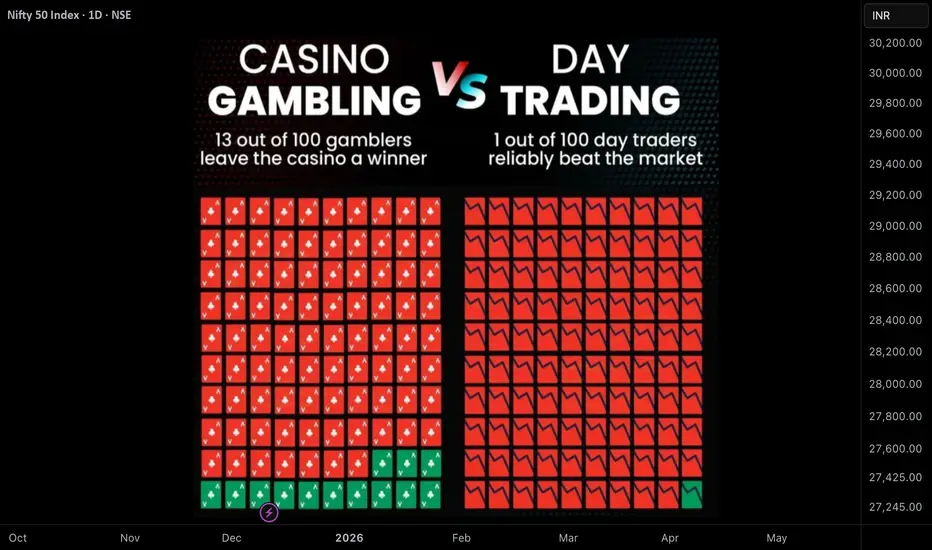
Add to that the widely quoted SEBI number—99% of traders lose money—and it feels like the argument ends right there. Case closed.
Except…it’s not.
People repeat this statistic as if it’s proof that trading is a doomed activity. But very few pause to ask the actual question:
Why do 99% lose?
Not because the game is broken.
Not because success is impossible.
But because most people don’t treat trading like what it truly is.
⸻
Trading is Not Gambling.
Trading is a sport.
And it’s a business.
Let’s break that down.
⸻
1. Trading is a Sport
Athletes don’t step onto the field and expect to win without training.
They practice. They review their performance. They train skills, build endurance, repeat drills thousands of times.
Successful traders do the same.
They learn, observe, analyze.
They train their mind as an athlete trains their body.
But the majority? They come in with zero preparation and expect instant profit.
When reality hits hard, they blame the market instead of acknowledging lack of discipline.
⸻
2. Trading is a Business
Every trade is like a business decision—based on research, risk, planning, and execution.
No business survives without budgeting, strategy, or performance tracking.
Yet most traders operate with no framework, no journal, no clarity.
They buy randomly, exit emotionally, and hope luck carries them.
But business doesn’t run on hope.
Neither does the market.
⸻
The Real Problem Is Not Trading—It’s Approach
Imagine a restaurant owner who never tracks expenses.
Imagine a sprinter who never practices.
Failure would be expected, right?
That’s exactly why most traders lose.
Not because trading is gambling.
But because they gamble instead of trading like professionals.
⸻
The 1% Think Differently
They treat trading like a craft.
They respect losses.
They follow rules.
They focus on long-term consistency—not overnight miracles.
That’s why they win.
⸻
Final takeaway
The next time someone says “trading is gambling,” remember this:
Trading only becomes gambling when you enter unprepared.
Treat it like a sport.
Build it like a business.
Master the game with intention and discipline.
And suddenly, the odds don’t stay at 99% anymore.
#stockmarkets #mindset
PCR Trading Strategies Option Buyers vs. Option Sellers
Option Buyers
Limited loss (only premium paid)
Unlimited profit potential
Higher risk of loss due to time decay
Good for small capital traders
Option Sellers (Writers)
Limited profit (premium received)
Potentially unlimited loss
Benefit from time decay
Requires high margin and experience
Example:
A seller who sells Nifty 22,500 CE for ₹100 receives ₹100 premium.
If Nifty stays below 22,500, the seller keeps the entire premium.
Option Trading Strategies How Option Premium Is Determined
The premium of an option depends on multiple factors. These include:
1. Underlying Price (Spot Price)
Directly impacts option value.
Call premiums rise when price goes up
Put premiums rise when price goes down
2. Time to Expiry (Time Value)
Options lose value as expiry approaches. This is called time decay or theta decay.
3. Volatility (IV – Implied Volatility)
Higher volatility increases premiums because uncertainty is higher.
4. Interest Rates & Demand-Supply
These have smaller effects but still influence prices.
Part 2 Master Candle Stick patterns Types of Options
1. Call Options (CE)
A call option gives the buyer the right to buy the underlying asset at the strike price before expiry.
You buy a call if you think the price of the asset will go up.
Example:
If Nifty is at 22,000 and you expect it to rise, you might buy a 22,200 CE.
If Nifty rises to 22,400, the premium of your call option increases, giving you profit.
Part 1 Candle Stick Patterns What Is an Option?
An option is a contract between a buyer and a seller.
The buyer pays a premium to purchase the right.
The seller receives the premium and takes on the obligation.
Every option contract has:
Strike Price – the predetermined price for buying or selling the asset
Expiry Date – the date on which the option contract ends
Premium – the cost of the option
Lot Size – fixed quantity of the underlying asset
Understanding these fundamentals is crucial before diving into live trading.
Candle Patterns How to Use Candle Patterns in Trading
Candlestick patterns alone are not enough. Combine them with:
Support & Resistance
Volume Profile
Market Structure
Trendline & Channels
Moving Averages
RSI / MACD
A candle pattern at a strong support zone is more reliable than a pattern in the middle of nowhere.
Premium Chart Patterns Why Chart Patterns Work
Chart patterns work because they reflect real market behavior.
Key reasons:
✔ Human psychology repeats
People fear losses and chase gains. This creates repeatable price movements.
✔ Institutions accumulate or distribute slowly
Big players cannot buy or sell at once—they create patterns during accumulation/distribution.
✔ Liquidity zones
Patterns often form near liquidity pools where many stop-loss orders exist.
✔ Self-fulfilling nature
When many traders recognize the same pattern, they take similar trades, increasing accuracy.
Options Buying vs Options Selling – Pros & Cons1. Options Buying – Overview
Options buyers purchase Call or Put options by paying a premium. They have limited risk (up to the premium paid) and unlimited or large potential reward.
A call buyer expects price to go up, and a put buyer expects price to go down.
Key Idea:
You are paying premium for the right to buy or sell an asset, not the obligation.
Pros of Options Buying
1. Limited Risk – Maximum Loss = Paid Premium
The biggest advantage is that risk is predefined.
Even if the market goes completely against you, the most you lose is the premium.
This makes option buying beginner-friendly from a risk-management perspective.
2. Unlimited or Large Profit Potential
Call buyers earn huge when the market rallies.
Put buyers make large profits when the market crashes.
Since options expand rapidly during trending moves, buyers can earn multiples (2x, 5x, even 10x) during strong breakouts or breakdowns.
3. Small Capital Requirement
A few hundred or a few thousand rupees can control a position of lakhs due to leverage.
This makes options buying attractive for small retail traders.
4. Ideal for News, Events & High Momentum
Buyers benefit the most during:
Budget sessions
Election results
RBI policy
Company results
Sudden large breakouts/breakdowns
Volatility increases premiums, which favors buyers in fast-moving markets.
Cons of Options Buying
1. Low Probability of Profit (Because of Time Decay)
Option premiums naturally decrease due to Theta decay.
You need the market to move:
Fast
Far
In your direction
Otherwise, premium collapses. Many buyers lose because the market only moves slightly, not enough to overcome time decay.
2. You Fight Against the Odds
Options are priced based on implied volatility, demand, and probability.
Sellers have statistical advantage because:
70% of options expire worthless
Time decay always works against buyers
Thus buyers have low chances of success unless they are skilled.
3. Volatility Crush
After major events, volatility drops sharply, reducing premium even if price moves in your direction.
Example:
After results or big news, IV crash eats away the premium.
4. Emotional Stress
Fast-moving premiums lead to:
Panic entries
Emotional exits
Overtrading
Fear of missing out
Options buying requires strong discipline and strict stop-losses.
2. Options Selling – Overview
Options sellers (also known as writers) sell calls or puts and receive a premium income.
They have:
High probability of profit
Steady income potential
But high or unlimited risk if unmanaged
Sellers rely on probability and time decay.
Key Idea:
Selling is similar to becoming an insurance company—high chance of small profits with low chance of large loss.
Pros of Options Selling
1. High Probability Trades
Most sellers target:
60–75% win probability per trade
Small but consistent profits
Time decay working in their favor
Even if the market moves slightly, sellers still win because premium loses value.
2. Time Decay Works in Your Favor
Theta (time decay) accelerates closer to expiry.
Sellers earn money simply because time is passing.
Especially effective:
Weekly expiry
Monthly expiry
Sideways markets
3. Stable, Consistent Income Strategy
Many professional traders, funds, and institutions follow options selling because it provides:
Regular income
Lower volatility in returns
Statistical edges
Covered calls, cash-secured puts, iron condors, credit spreads are all based on selling.
4. Volatility Crush is Beneficial
Events such as results, election outcomes, or data releases cause IV to drop afterward.
This makes premiums collapse, giving sellers quick profits.
5. Works Well in Sideways Markets
70% of the time, markets trade sideways.
Buyers struggle here, but sellers thrive because price stays within their profitable range.
Cons of Options Selling
1. High or Unlimited Loss Risk
Call sellers face unlimited risk if price moves upward violently.
Put sellers face huge risk if the market crashes.
This is why sellers must:
Trade with high capital
Use strict risk management
Often hedge positions
2. High Margin Requirement
Unlike buyers, sellers need large capital.
For index options like NIFTY or BANKNIFTY, margin can be:
₹1–2 lakh for naked selling
₹20k–50k for hedged spreads
Many retail traders cannot maintain these requirements.
3. Large Losses Come Suddenly
Sellers often make small profits for days but can lose months of gains in a single sudden market move.
For example:
War news
RBI policy surprise
Budget shock
Global crash
Overnight gap-ups or gap-downs
These events can cause heavy losses.
4. Requires Strong Discipline
Sellers must:
Hedge
Adjust positions
Cut loss quickly
Avoid greed
Avoid selling naked options
This makes selling more suitable for experienced traders.
3. Which is Better – Buying or Selling?
There is no fixed answer.
It depends on market conditions, trader skill, and psychology.
When to Prefer Options Buying
When expecting strong directional movement
During breakouts/breakdowns
During high momentum days
Before events with expected big moves
For small capital traders
Buyers should enter only in trending markets.
When to Prefer Options Selling
When markets are sideways
When volatility is high and expected to fall
For consistent income strategies
For experienced traders with good risk management
When trading weekly options
Sellers profit without needing large price movements.
4. Summary Table – Options Buying vs Selling
Feature Options Buying Options Selling
Risk Limited High/Unlimited
Reward Unlimited Limited
Capital Required Low High
Probability of Profit Low High
Fights Time Decay? Yes No
Benefits from IV? Increasing IV Decreasing IV
Best Market Trending Sideways
Skill Level Needed Medium High
Ideal For Small traders Professional traders
5. Final Thoughts
Both options buying and selling have their own place in a trader’s toolkit.
Buyers enjoy big rewards but face low probability trades due to time decay.
Sellers enjoy high probability setups but face the risk of large losses if the market moves violently.
Most successful traders eventually learn to combine both buying and selling through:
Spreads
Straddles
Strangles
Covered calls
Iron condors
Hedged strategies
Understanding the strengths and weaknesses of each approach helps traders manage risk and build consistent long-term profitability.
Swing Trading Strategies for Indian Stocks1. What Makes Swing Trading Effective in the Indian Market?
The Indian market has certain characteristics that make swing trading powerful:
Trending behaviour: Nifty, Bank Nifty, and sectors show clear medium-term trends.
FII-DII flows impact swings: Foreign inflows cause rallies; domestic booking brings dips.
Sector rotation: IT, Pharma, PSU, Metals, Banks rotate in cycles.
Volatility with direction: Ideal for capturing 3–10 day moves.
High liquidity stocks allow clean chart structures.
Because of these characteristics, stocks like Tata Motors, Reliance, HDFC Bank, L&T, ICICI Bank, BEL, Coal India, LTIM, HAL, and PSU banks offer excellent swing opportunities.
2. Core Swing Trading Concepts
2.1 Trend Structure
Before entering any swing trade, determine the trend:
Higher Highs & Higher Lows (HH-HL) = Uptrend
Lower Highs & Lower Lows (LH-LL) = Downtrend
Sideways consolidation = breakout/breakdown opportunity
Always trade in direction of trend for higher success.
2.2 Pullbacks and Reversals
Swing trades are often taken when:
Price pulls back to support in an uptrend
Price retests resistance in a downtrend
Price breaks out of consolidation
2.3 Support and Resistance Zones
Identify:
Weekly support/resistance
Daily swing highs/lows
Round levels like 100, 200, 500, 1000
50-day or 200-day moving averages
Strong zones = high-probability entries.
3. Best Swing Trading Strategies for Indian Stocks
Below are top-performing swing trading strategies tailor-made for the Indian market.
Strategy 1: Moving Average Pullback Strategy
This is the simplest and most reliable swing strategy.
How it works
Identify a stock in strong uptrend using 20 EMA & 50 EMA
Wait for a pullback to 20 EMA (aggressive) or 50 EMA (conservative)
Price must show bullish candle near EMA
Entry
Buy on bullish confirmation candle
Volume spike increases confidence
Stop Loss
Below recent swing low
Target
2–3x risk
Or next resistance
Best suited for
Trending stocks like PSU, banking, large caps.
Strategy 2: Breakout and Retest Strategy
Breakouts happen often in the Indian market because of strong retail + FII participation.
Steps
Identify a tight consolidation zone (triangle, flag, channel).
Wait for breakout with volume.
Do NOT buy breakout blindly; wait for retest.
Enter when retest shows bullish candle.
Why it works
Retest confirms:
Institutions support the breakout
False breakout is avoided
Best suited for
Midcaps (HAL, BEL, IRFC, JWL)
Momentum stocks
Strategy 3: RSI + Trendline Reversal Strategy
Combines momentum and price structure.
Setup
Draw a trendline connecting swing lows in uptrend.
Wait for price to touch trendline.
Check RSI between 38–45 (oversold in trend).
Entry
Enter when bullish candle appears at trendline.
Stop Loss
Just below trendline
Targets
Recent swing high or 1:2 risk–reward
Why it works
RSI 40 is the “bullish support zone” in strong uptrends.
Strategy 4: Inside Candle (NR4/NR7) Breakout Strategy
NR4/NR7 = Narrow Range candles, which signal volatility contraction.
Indian stocks behave strongly after volatility contraction.
Steps
Identify Inside Candle or NR4/NR7 pattern.
Mark high and low of inside candle.
Buy when price breaks above high.
Sell when price breaks below low.
Works best in
Stocks before results
Momentum phases
Strategy 5: Fibonacci Swing Trading Strategy
Used to find precise swing entries.
Steps
Identify strong impulsive upmove.
Draw Fib retracement.
Key buying zones:
38.2%
50%
61.8%
Confirmation
Bullish candle at zone
RSI above 40
Volume stabilizing
Targets
Previous swing high
127% or 161% extension
This method is widely used by India’s quantitative swing traders.
Strategy 6: Multi-Timeframe Swing Strategy
This increases accuracy by aligning multiple timeframes.
Steps
Check weekly trend (bigger trend)
Identify daily entry (swing pullback or breakout)
Confirm with 4-hour momentum
Example
Weekly shows uptrend
Daily pulls back to support
4H shows breakout candle
This gives extremely high-probability swing trades.
4. How to Select Stocks for Swing Trading in India
Selecting the right stocks matters more than strategy.
4.1 Criteria
High liquidity (above ₹300–500 crore daily turnover)
High relative strength vs Nifty
Stocks above 50-day and 200-day moving averages
Strong sector trend (sector rotation)
Volume patterns showing institutional activity
Best sectors for swing trades
PSU stocks
Banking
Defense
Auto
Metals
FMCG during slow markets
Avoid
Penny stocks
Illiquid stocks
Corporate governance issues
5. Indicators Useful for Swing Trading in India
Use indicators only for confirmation, not as signals.
1. Moving Averages
20 EMA (aggressive swing)
50 SMA (medium)
200 SMA (long trend)
2. RSI
Buy dips when RSI is 40–45 in uptrend
Sell rallies when RSI is 55–60 in downtrend
3. MACD
Confirms trend continuation.
4. Volume
One of the most important indicators:
Breakouts must have high volume
Retests should have low volume
6. Risk Management for Swing Trading
Risk management is the backbone of swing trading.
Position Sizing
Risk only 1–2% of capital per trade.
Stop Loss Placement
Must be based on swing low/high
Never place SL too tight
Profit Target
Maintain at least 1:2 Reward-to-Risk
Trail stop when price moves in your favor
Avoid Overnight Risk
Avoid holding during:
Major events
Budget announcements
RBI policy
Global event risk (US Fed)
7. Tools for Swing Trading
Charting
TradingView
ChartInk (Indian screeners)
Investing.com
Scanners
ChartInk swing scanner
TradingView breakout scanner
Volume surge screeners
Brokerage Platforms
Zerodha Kite
Upstox Pro
ICICI Direct Neo
Angel One Smart
8. Psychology for Swing Trading
Swing trading requires:
Patience to wait for setups
Discipline to exit when stop is hit
Ability to ignore intraday noise
Consistency in following rules
Most swing traders fail because they:
Enter too early
Exit too early
Add to losing trades
Trade too many stocks at once
Focus on quality, not quantity.
9. Example of a Complete Swing Trading Plan
Scan for stocks making higher highs.
Mark support zones on daily chart.
Wait for pullback with decreasing volume.
Enter on bullish candle with volume confirmation.
Place SL below swing low.
Target previous resistance.
Trail stop using 20 EMA.
This simple model can achieve high accuracy.
Final Summary
Swing trading in Indian stocks offers profitable opportunities because of strong trends, sector rotations, and active participation from institutions and retail traders. The most effective strategies include:
Moving average pullbacks
Breakout + retest
RSI + trendline reversals
Inside bar volatility breakouts
Fibonacci retracements
Multi-timeframe confirmation
With proper risk management, psychology, and disciplined execution, swing trading can become one of the most profitable and low-stress trading styles in the Indian equity market.
Breakout & Breakdown Trading (Success vs Failure Patterns)1. What is a Breakout?
A breakout happens when price moves above a key resistance after staying inside a consolidation zone. It indicates that buyers have overcome sellers, showing strength and potential for trend continuation.
Common breakout zones:
Horizontal resistance
Trendlines
Channel tops
Supply zones
Chart patterns like triangle, flag, wedge, cup & handle
A successful breakout must show:
Strong volume
Clear candle close above resistance
Follow-through in next candles
Retest with buying support
2. What is a Breakdown?
A breakdown occurs when price moves below a major support level after consolidation. It signals that sellers have overpowered buyers, indicating bearish continuation.
Breakdown zones include:
Horizontal support
Trendline breakdown
Channel bottom break
Demand zone break
Pattern failures (Head & shoulders, double top)
A valid breakdown must show:
High selling volume
Clear candle close below support
Lower lows on follow-through
Retest with rejection
3. Why Breakouts & Breakdowns Matter? – Market Psychology
A breakout/breakdown reflects imbalanced order flow:
Breakout psychology
Sellers at resistance get absorbed
New buyers enter
Short sellers hit stop-loss and add fuel to upside
Momentum traders join
Trend accelerates
Breakdown psychology
Buyers at support get exhausted
Short sellers enter
Long holders exit in panic
Fresh supply increases
Trend intensifies
These mechanics make breakout/breakdown candles sharp and powerful.
4. Success Patterns – What Makes a Breakout/Breakdown Work?
To increase accuracy, focus on confluence signals. When multiple signals align, probability increases.
A. Successful Breakout Signs
Volume Expansion
Volume must rise 30%+ compared to recent average.
High volume = real institutional participation.
Strong Marubozu / Bullish Candle
A candle that closes near its highs.
Shows aggressive buying.
Retest + Support Hold
Price revisits breakout level.
Buyers defend the zone → confirmation.
Low Wick Candles
Less rejection = clean breakout.
Trend Alignment
Breakout in direction of higher-timeframe trend works better.
Breakout After Tight Consolidation
The tighter the range, the bigger the explosion.
B. Successful Breakdown Signs
High Selling Volume
Indicates institutional unloading.
Bearish Marubozu Candle
Indicates dominance of sellers.
Retest + Rejection at Support-turned-Resistance
Very strong confirmation.
Lower Lows & Lower Highs Formation
Market structure shifts bearish.
Volatility Contraction → Expansion
After compression, breakdowns travel fast.
5. Failure Patterns – Why Breakouts & Breakdowns Fail?
Most retail losses occur in false breakouts and false breakdowns—commonly called Traps.
Smart Money often pushes price beyond a level briefly, triggering retail entries and stop-losses, then reverses the move.
A. False Breakout (Bull Trap)
Price goes above resistance only to fall back quickly.
Reasons:
Big players remove liquidity by trapping buyers
Low volume breakout
No candle close above resistance
Overbought conditions
Breakout during news whipsaws
Higher timeframe resistance not broken
Key signs:
Long upper wicks
Quick rejection
Bearish engulfing after breakout
Volume divergence (price up, volume down)
B. False Breakdown (Bear Trap)
Price dips below support but reverses fast.
Reasons:
Institutions collect liquidity
Weak selling participation
Not enough follow-through
Price at oversold zone
Higher timeframe support not broken
Key signals:
Long lower wicks
Bullish engulfing after fake breakdown
High volume on recovery candle
6. Entry Techniques (High Probability)
A. Breakout Entry Types
Aggressive Entry (On breakout candle)
High reward if breakout is strong
High risk of fakeout
Conservative Entry (On retest)
Wait for price to retest the breakout zone
Ideal for safer trading
Higher accuracy
Continuation Entry (After first pullback)
Enter when new higher low is formed
Best for trending markets
B. Breakdown Entry Types
Aggressive (On breakdown candle)
Retest Entry (Support becomes resistance)
Continuation (Lower high formation)
Retests offer the safest and most reliable entries in both breakout and breakdown setups.
7. Stop-Loss Placement
Proper SL protects capital in case of failed pattern.
Breakout SL
Below breakout level
Below retest low
Below previous swing low
Breakdown SL
Above breakdown zone
Above retest high
Above previous swing high
Avoid placing SL too close; markets often "hunt" tight stops.
8. Profit Target Strategies
To maximize gains:
Measure move technique
Target = Height of consolidation range
Fibonacci extensions
Common targets: 1.272, 1.618
Next supply/demand zones
Trailing stop using ATR
Lock profits in strong trends
Price-action based exits
Exit on reversal signal or opposite engulfing
9. High-Timeframe Confluence
Breakouts aligned with HTF structures have the highest win rate.
Example:
Weekly uptrend
Daily resistance breakout
1H retest entry
Multiple timeframe agreement = strong institutional bias.
10. Common Mistakes Traders Make
❌ Entering too early inside the range
❌ Trading without volume confirmation
❌ Trading breakouts against higher-timeframe trend
❌ Chasing after extended candles
❌ Placing SL too tight
❌ Trading breakouts during news events
❌ Over-leveraging for "guaranteed" moves
Correcting these issues can drastically improve win rate.
11. How Smart Money Creates Traps
Smart Money uses liquidity manipulation:
Pushes price slightly above resistance
Retail enters breakout longs
Smart Money sells into retail buying
Price reverses → SL hunting
After trapping traders, real move begins
Understanding this reduces fakeout trades dramatically.
12. Breakout vs Breakdown – Which is More Reliable?
Neither is inherently better, but:
Breakouts work better in bullish markets
Breakdowns work better in bearish conditions
Always trade in line with market sentiment and broader trend.
Conclusion
Breakout and breakdown trading is powerful—but only when you combine volume, price action, market structure, and retests. Successful setups show strength, follow-through, and clean technical confirmation. Failed setups often show wick rejections, low volume, and lack of structure.
Mastering the difference between success and failure patterns can significantly improve your accuracy and confidence as a trader.
Algo, Quant & Data-Driven Trading1. What is Algorithmic Trading?
Algorithmic trading (algo trading) is the execution of trades automatically using pre-defined rules or instructions coded into a computer system. These rules may involve price, time, volume, technical indicators, or market conditions.
Key Characteristics of Algo Trading
Rule-Based Execution
You define a rule — for example:
“Buy Nifty futures when RSI crosses below 30 and reverses above 35.”
Once coded, the algorithm runs these rules without emotional interference.
Speed & Efficiency
Computers can analyze market data and execute orders in milliseconds — far faster than any human.
Backtesting Before Deployment
Algos can be tested on past market data to evaluate:
Returns
Drawdowns
Win/loss ratios
Risk exposures
Reduced Human Error
Since execution is automated, biases like fear, greed, hesitation, revenge trading, and overtrading are minimized.
Common Algo Trading Strategies
Trend Following Algorithms (moving averages, breakout systems)
Mean Reversion Models (RSI, Bollinger Band reversals)
Arbitrage Algorithms (cash–futures arbitrage, index arbitrage)
Scalping Bots (ultra-short-term trades)
Execution Algos (VWAP, TWAP, POV for institutions)
Who Uses Algo Trading?
Hedge funds
Prop trading firms
Banks
HNIs and retail traders using API platforms (Zerodha, Dhan, Fyers, etc.)
Market makers
Algo trading is mainly about automating the process and ensuring executions happen as planned.
2. What is Quantitative Trading?
Quantitative trading (quant trading) goes deeper than algos. It uses mathematics, statistics, econometrics, probability models, and programming to design trading strategies. While algo trading focuses on execution, quant trading focuses on research, model building, and predictive analytics.
Features of Quant Trading
Data-Driven Strategy Design
Quants use large datasets — sometimes decades of tick-by-tick data — to identify patterns.
Mathematical Models
Models include:
Time-series analysis
Stochastic calculus
Machine learning
Factor modelling
Risk modelling
Monte-Carlo simulations
Systematic and Scientific Approach
Strategies are created, tested, validated statistically, and deployed based on mathematical confidence.
Large Data Sets
Quants analyze:
Price, volume, and order book data
Options Greeks
Fundamental indicators
Macroeconomic data
Alternative data (web traffic, satellite images, social media sentiment)
Common Quant Strategies
Statistical Arbitrage
Pairs trading, cointegration models, mean reversion baskets.
Factor-Based Investing
Value, growth, quality, momentum, volatility factors.
Volatility Trading
Options models, volatility surface analysis, VIX-based strategies.
Machine Learning Models
Classification and regression to predict direction, volatility, or regime changes.
Optimization Algorithms
Portfolio optimization using Markowitz, Black-Litterman, risk parity.
Quant Roles
Quant trading involves teams such as:
Quant researchers
Quant developers
Data scientists
Risk modelers
Execution quants
In short, quant trading is the brain, and algo trading is the hands that execute.
3. What is Data-Driven Trading?
While algo and quant trading use predefined models, data-driven trading takes the concept further by integrating:
Big data
Machine learning
Artificial intelligence (AI)
Alternative datasets
Predictive analytics
Here, the goal is to let data reveal patterns rather than humans designing them manually.
Key Inputs in Data-Driven Trading
Market Data — price, order book, volume, volatility
Fundamental Data — PE, EPS, ROE, balance sheet patterns
News & Sentiment Data — sentiment analysis using NLP
Alternative Data
Social media
Satellite images (crop yield, shipping)
Google searches
E-commerce traffic
Geo-location data
Machine Learning Methods Used
Regression models
Random Forests
Gradient Boosting
Neural networks
Deep learning (LSTM for time-series)
Reinforcement learning
Why Data-Driven Trading Works
Markets are becoming increasingly complex, influenced by:
Liquidity flows
Global macro events
Corporate actions
Social media reactions
Humans cannot process all this in real time — but machines can.
4. How Algo, Quant & Data-Driven Trading Fit Together
These three approaches are interconnected:
Quant Trading = Strategy Brain
Mathematical research, data analysis, and model creation.
Algo Trading = Strategy Execution Engine
Automates orders, reduces cost and slippage, ensures consistency.
Data-Driven Trading = Modern Enhancement Layer
Adds data intelligence and predictive power through AI and big data.
Together they form a cycle:
Data → Quant Research → Model → Backtest → Algo Code → Deployment → Live Trading → Feedback Loop
This feedback loop ensures improvement and adaptation to market conditions.
5. Tools Used in Algo, Quant & Data-Driven Trading
Programming Languages
Python (most popular)
R
C++ (for HFT)
Java
MATLAB
Libraries & Frameworks
NumPy, Pandas, Scikit-learn
TensorFlow, PyTorch
Statsmodels
Backtrader, Zipline
QuantLib
Trading APIs
Zerodha Kite API
Dhan API
Interactive Brokers
Alpaca
Binance API
Data Platforms
NSE/BSE feeds
Bloomberg
Reuters
Tick-by-tick data vendors
6. Advantages of Modern Trading Techniques
Emotion-free trading
Decisions are consistent at all times.
Backtest + forward test validation
Reduces guesswork and improves confidence.
Scalability
A strategy that works on one index can be replicated across markets.
High-speed execution
Essential for intraday, scalping, arbitrage.
Better risk management
Stop loss, position sizing, hedging, volatility filters can be coded in directly.
Discovery of new patterns
AI can find signals humans never notice.
7. Risks & Challenges
Overfitting
A model may perform excellently in backtest but fail in live markets.
Data Quality Issues
Incomplete or noisy data produces bad strategies.
Black-Box Models
AI predictions may not explain why a trade is taken.
Latency & Slippage
Poor infrastructure can ruin otherwise good models.
Regulatory Constraints
SEBI in India requires compliance for automated execution.
8. The Future: AI-First Trading
Markets will shift increasingly toward:
Reinforcement-learning-based strategies
Self-optimizing algorithms
Real-time sentiment AI
High-speed alternate data processing
Human traders will transition from manually trading to supervising machines.
Conclusion
Algo, Quant, and Data-Driven trading represent the evolution of modern markets. Algo trading automates execution. Quant trading builds mathematically robust strategies. Data-driven trading enhances prediction using AI and big data. Together, they enable trading that is fast, intelligent, adaptive, and emotion-free. Whether you trade equities, derivatives, currencies, or global markets, these methods help you understand market behaviour through science rather than speculation.
Fundamental Analysis Basics (P/E, P/B, ROE, ROCE)1. Price-to-Earnings Ratio (P/E Ratio)
What it Means
The P/E ratio tells you how much investors are willing to pay today for ₹1 of a company’s earnings. It connects a company’s market price with its profit generation ability.
Formula:
P/E = Current Market Price ÷ Earnings Per Share (EPS)
Why P/E Matters
A high P/E suggests that investors expect strong future growth.
A low P/E may indicate undervaluation, or that the company is facing growth challenges.
How to Interpret P/E
High P/E (>30): Market is optimistic, often seen in growth sectors like technology or consumer internet companies.
Moderate P/E (15–30): Indicates stable performance, common in quality midcaps and blue-chip stocks.
Low P/E (<15): Might indicate a value pick or a fundamentally weak company.
Limitations
P/E does not work well if profits are volatile or negative.
P/E differs widely across sectors—comparing a bank with a tech company is misleading.
Best Use Cases
Compare P/E with the stock’s historical average.
Compare P/E with the industry average.
Use Forward P/E (P/E using estimated future earnings) to understand growth visibility.
2. Price-to-Book Ratio (P/B Ratio)
What it Means
The P/B ratio compares the company’s market value with its book value (net assets). It tells how many times investors are paying relative to assets.
Formula:
P/B = Market Price per Share ÷ Book Value per Share
Book Value per Share = (Total Assets – Total Liabilities) ÷ Number of Shares
Why P/B Matters
Useful for asset-heavy sectors such as banks, NBFCs, manufacturing, and PSU companies.
Helps understand whether the stock trades above or below its actual net worth.
How to Interpret P/B
P/B < 1: Stock may be undervalued; the company trades below its net worth.
P/B between 1–3: Normal valuation for most companies.
P/B > 3: Indicates premium valuation; market expects strong future returns.
Limitations
Not useful for asset-light businesses like IT, FMCG, or digital companies where the real value lies in brand and intellectual property.
P/B alone does not measure profitability or efficiency.
Best Use Cases
Combine P/B with ROE to judge whether a company is generating strong returns on its net assets.
Valuable for evaluating banks and financial institutions.
3. Return on Equity (ROE)
What it Means
ROE shows how efficiently a company generates profits using shareholder equity. It reflects management’s ability to create value.
Formula:
ROE = Net Profit ÷ Shareholder’s Equity × 100
Why ROE Matters
High ROE indicates that the company uses shareholder money efficiently.
It reflects competitive advantage, pricing power, and strong demand.
How to Interpret ROE
ROE > 20%: Excellent – shows strong efficiency and high margins.
ROE 15–20%: Good – typical for stable companies.
ROE < 10%: Weak – indicates poor profitability or inefficient use of equity.
Limitations
ROE can be misleading if the company has very high debt; equity becomes smaller because debt funds the assets.
A temporary profit spike can artificially inflate ROE.
Best Use Cases
Compare ROE with the industry average.
Use ROE along with P/B to identify high-quality compounders.
Check 5–10 year ROE trends for consistency.
4. Return on Capital Employed (ROCE)
What it Means
ROCE measures profitability based on all capital employed, including equity and debt. It gives a more holistic view than ROE.
Formula:
ROCE = EBIT ÷ (Equity + Debt) × 100
Here, EBIT (Earnings Before Interest and Taxes) measures operating profit.
Why ROCE Matters
Shows how efficiently the company generates profits using both debt and equity.
Crucial for capital-heavy industries like manufacturing, steel, energy, or infrastructure.
How to Interpret ROCE
ROCE > 20%: Excellent capital allocation, highly efficient.
ROCE 15–20%: Good and sustainable.
ROCE < 12%: Weak returns relative to capital employed.
Limitations
ROCE may fluctuate due to capital expansion cycles.
Not very useful for debt-free companies where ROE already gives similar insight.
Best Use Cases
Compare ROCE with the company’s cost of capital (WACC).
High ROCE indicates strong pricing power and effective management.
How These Ratios Work Together
Using P/E, P/B, ROE, and ROCE in isolation is incomplete. Successful investors combine them for a full picture of valuation and performance.
1. P/E + ROE → Identifying Growth at Reasonable Price (GARP)
High ROE + reasonable P/E = High-quality stock at fair valuation.
Example: A company with ROE 20% and P/E 18 is usually attractive.
2. P/B + ROE → Banking and Financial Analysis
High ROE + moderate P/B = efficient bank with good asset quality.
A bank with ROE 17% and P/B 1.5 is stronger than a bank with ROE 10% and P/B 1.
3. ROCE + P/E → Capital-Intensive Business Screening
High ROCE suggests strong return on capital.
If P/E is low while ROCE is high, the stock may be undervalued.
4. ROE vs ROCE → Debt Analysis
ROE > ROCE: Company uses leverage (debt) to boost shareholder returns.
ROCE > ROE: Limited debt; equity is used more efficiently.
Practical Example (Simplified)
Suppose a company has the following metrics:
P/E = 20
P/B = 3
ROE = 22%
ROCE = 18%
Interpretation:
P/E 20 → Fair valuation.
P/B 3 → Market expects strong future performance.
ROE 22% → Very efficient with shareholder capital.
ROCE 18% → Strong use of total capital.
Conclusion:
This is a high-quality growth company trading at a fair-to-premium valuation.
How Investors Use These Ratios in Real World
1. For Long-Term Investors
Focus on businesses with consistently high ROE and ROCE.
Avoid companies with declining profitability, even if valuation looks low.
2. For Value Investors
Look for low P/E and low P/B stocks with improving ROE/ROCE.
These indicate potential turnarounds.
3. For Growth Investors
Accept high P/E if ROE and ROCE remain elevated for multiple years.
Growth sustainability is more important than cheap valuation.
4. For Traders
Use ratios to identify strong fundamentally-backed stocks for swing or positional trades.
Conclusion
P/E, P/B, ROE, and ROCE are essential tools of fundamental analysis. P/E and P/B help measure valuation, while ROE and ROCE measure profitability and efficiency. Together, they determine whether a stock is fundamentally sound, fairly priced, and capable of delivering long-term returns. When used consistently and compared with historical data, sector averages, and market conditions, these ratios give investors a powerful framework for making informed decisions.
How FIIs & DIIs Move Indian Indices1. Who Are FIIs and DIIs?
Foreign Institutional Investors (FIIs)
FIIs are global investment entities—like foreign mutual funds, pension funds, hedge funds, sovereign wealth funds, insurance companies—that invest in Indian stocks, bonds, and derivatives.
Their behavior is affected by:
Global interest rates
USD–INR exchange rate
U.S. Federal Reserve policy
Global risk sentiment
Crude oil prices
Geopolitical events
They typically invest in large, liquid stocks—especially Nifty 50 and Sensex constituents—because it is easier to deploy and withdraw large sums.
Domestic Institutional Investors (DIIs)
DIIs are Indian mutual funds, insurance companies, banks, pension funds, and local institutions.
Their behavior is influenced by:
Domestic savings flow (SIPs)
Indian interest rates
Local economic outlook
Government policies
Long-term investment demand
DIIs invest steadily and are less sensitive to global shocks compared to FIIs.
2. Why Do FIIs and DIIs Influence Indices So Strongly?
Large Volumes = Large Impact
FIIs and DIIs trade in thousands of crores. Even a Rs. 2,000–5,000 crore buy/sell day can move the Nifty by 80–150 points.
Index Stocks Are Their Primary Playground
Because they deal with huge amounts of capital, institutions prefer:
Highly liquid stocks
Large-cap companies
Market leaders
These are the companies included in major indices.
Therefore, institutional activity directly influences index movement.
They Drive Market Sentiment
When FIIs sell aggressively, the market becomes fearful.
When they buy heavily, the market turns bullish.
Sentiment drives retail behavior, amplifying moves.
3. How FIIs Move the Market
FIIs are often trendsetters. Their entries and exits create short-term and medium-term direction.
A. FII Buying Pushes Indices Higher
When FIIs buy:
Demand > Supply
Prices of index-heavy stocks rise
Nifty/Sensex rally
Example:
If FIIs buy heavily in HDFC Bank, Reliance, ICICI Bank, Infosys, TCS, these stocks—having high index weight—pull the indices up.
B. FII Selling Tanks the Market
When FIIs sell:
Supply > Demand
Prices fall sharply
Volatility increases
Indices correct
FIIs usually sell during:
Global uncertainty
Dollar strengthening
U.S. interest rate hikes
Emerging market risk-off sentiment
C. FIIs Often Buy in a Weak Rupee
If USD strengthens against INR, FIIs get more rupees per dollar → Indian assets become cheaper → FIIs buy.
D. FIIs Use Derivatives to Move Indices
They operate heavily in:
Index futures
Index options
Stock futures
A strong long buildup in index futures usually triggers a rally.
A strong short buildup leads to corrections.
4. How DIIs Move the Market
DIIs play a stabilizing role. They often counteract FIIs.
A. DIIs Buy When FIIs Sell
DIIs support the market during corrections.
This prevents sharp crashes and creates stability.
Example:
During FII outflows of several thousand crores, DIIs often step in and buy due to:
Strong domestic SIP inflows
Long-term investment strategy
This creates a floor for the market.
B. DIIs Support Specific Sectors
DIIs often allocate more into:
Banking
FMCG
Energy
Infrastructure
Therefore, DII buying can keep these sectors stable even when FIIs sell.
C. DIIs Move Much More Slowly
Compared to FIIs, DIIs are less aggressive. They invest based on:
Long-term performance
Asset allocation models
SIP flows
Hence, their impact is more stable and consistent.
5. Tug of War Between FIIs and DIIs
This “tug of war” largely determines the daily movement and medium-term trend of Indian indices.
Scenario 1: FIIs Buy, DIIs Buy → Strong Bull Market
This is the best phase for the market.
Indices make new highs
Volumes rise
Retail investors join the rally
Scenario 2: FIIs Sell, DIIs Buy → Sideways or Mild Correction
DIIs provide support.
Market doesn’t crash deeply.
Scenario 3: FIIs Buy, DIIs Sell → Sharp Rally, But Short-Lived
Since FIIs are stronger in the short term, markets rise quickly.
But selling pressure from DIIs may create resistance.
Scenario 4: FIIs Sell, DIIs Sell → Market Crash
This is the worst combination.
It leads to:
Sharp index falls
Panic selling
High VIX
Broader market damage
6. Impact on Major Indices
Nifty 50
Heavily impacted by:
Banking
IT
Oil & Gas
Autos
FIIs dominate banks and IT, so FII flow directly impacts Nifty.
Sensex
Sensex has fewer stocks but heavier weights.
Large FII flows into top 5 stocks move the entire index.
Bank Nifty
FIIs are highly active in:
HDFC Bank
ICICI Bank
Axis Bank
Kotak Bank
Therefore, Bank Nifty is the most sensitive index to FII flows.
Nifty Midcap & Smallcap
FIIs rarely invest here.
DIIs and retail investors dominate, so:
DIIs influence midcaps
Retail flows influence smallcaps
7. How Traders Can Use FII–DII Data
Daily FII–DII flow data is a powerful market sentiment indicator.
A. Positive FII Flows → Buy Dips
When FIIs buy consistently for many days:
Trend becomes bullish
Traders can buy on dips
Breakouts become stronger
B. Negative FII Flows → Sell on Rise
When FIIs sell aggressively:
Market stays weak
Rallies face resistance
Short trades in indices work well
C. Derivatives Data Gives Early Signals
Look at:
FII Index Futures Long/Short ratio
Index option positions
Put–Call Ratio
These often predict near-term index movements.
8. Why FIIs Are More Powerful Than DIIs (Short Term)
FIIs use derivatives heavily
FIIs buy and sell in large blocks
They influence global flows
Their decisions are fast and data-driven
Thus, FIIs create short-term trend, while DIIs create long-term support.
9. Why DIIs Are Important for Long-Term Market Stability
Stable SIP inflows into mutual funds
Indian savings shift from gold/real estate to markets
DIIs cushion the impact of global shocks
DIIs ensure the market doesn’t collapse during FII selling waves
This explains why Indian markets often recover quickly even after heavy FII selling.
Conclusion
FIIs and DIIs play a crucial and complementary role in shaping the Indian stock market.
FIIs drive short-term trends, bring massive liquidity, and influence daily market direction.
DIIs provide stability, long-term support, and counterbalance foreign volatility.
Understanding the behavior of these two institutional giants helps traders and investors:
Predict index movement
Read market sentiment
Manage risk
Time entries and exits
The tug of war between FIIs and DIIs is one of the most important drivers behind how Indian indices move every single day.
Price action series-The 2B Pattern Failed Breakout Reversal...Continuing the price action series with a pattern that appears at every major turning point in the market: the 2B Pattern, also known as the failed breakout reversal.
It forms when price breaks a previous high or low but fails to follow through and immediately returns back inside the prior range. This shift reveals exhaustion in the prevailing trend and exposes trapped traders on the wrong side.
Below are two real examples from Gold and dxy showing both the bullish and bearish version of the pattern.
Bullish 2B Pattern – Bottom Formation Left Chart
A 2B bottom occurs when price breaks below a previous swing low but cannot sustain the breakdown.
In the chart on the left:
Price takes out the prior low, triggering new short positions and stop-losses.
The breakdown immediately fails as price snaps back above that previous low.
This reclaim signals that the downward continuation attempt has failed.
The shift in pressure initiates a new upward move, confirming the reversal.
This is a classic 2B bottom structure: a failed breakdown followed by a strong reclaim.
Bearish 2B Pattern – Top Formation Right Chart
A 2B top occurs when price breaks above a previous swing high but fails to extend higher.
In the chart on the right:
Price pushes through the earlier swing high, inviting breakout buying.
Momentum fades almost instantly, and price falls back below the prior high.
This failure indicates buyers have lost control and the breakout has trapped late entries.
Price then shifts downward, validating the failed breakout.
This is the mirror image of the 2B bottom, but occurring at a swing high.
Why the 2B Pattern Works
A trend remains intact as long as it continues to produce new highs or lows.
A failed attempt to continue the trend shows:
exhaustion in momentum
absorption of breakout orders
trapped traders exiting
the beginning of a directional shift
The 2B identifies this shift before the full trend reversal is completed, making it an early but reliable reversal model.
Where This Pattern Performs Best
15m and 1H for intraday reversals after volatility spikes
4H for swing-trade reversals and cleaner structure
Daily for major tops and bottoms
Around key levels such as previous highs, lows, or liquidity zones
The pattern is especially common in Gold due to its volatile but structured movement.
Summary
2B Bottom failed breakdown
2B Top failed breakout
Works by showing loss of continuation and a shift in order flow
Ideal for identifying early reversals without predicting tops or bottoms
Sharing this purely for educational purposes as part of the Price Action Pattern Series.
More patterns will be published in the next parts of this series. Trade safe
Divergence Secrets Who Should Trade Options?
Options are suitable for:
Traders looking for leverage with limited risk
Investors wanting to hedge positions
Experienced traders generating income
Anyone willing to learn market structure and volatility
But they require discipline, knowledge, and proper risk management.